六十年代台湾古董旗袍:抽象肌理间的东方诗性
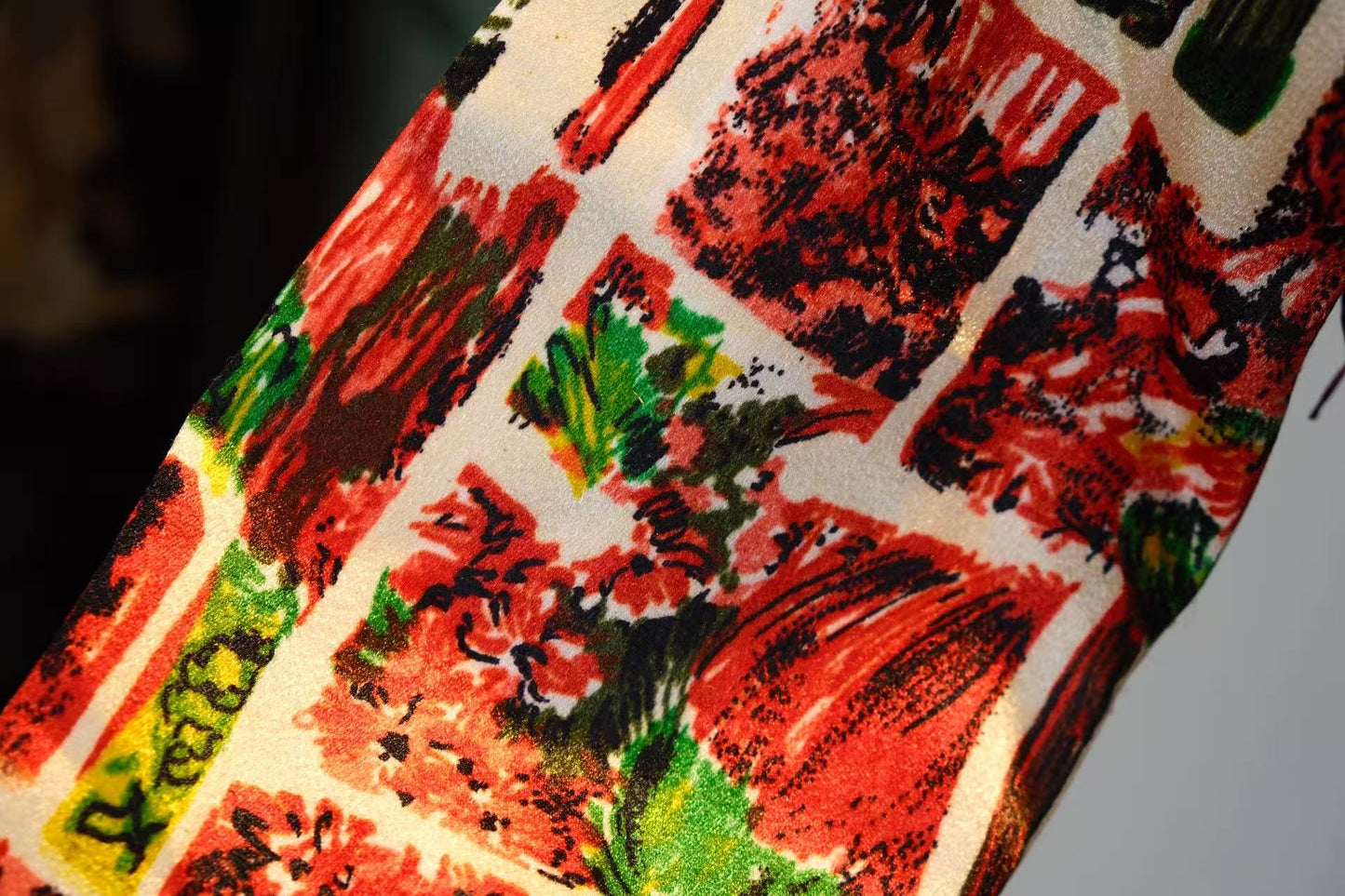
这件产自上世纪六十年代台湾的古董旗袍,以印花抽象几何肌理面料为载体,将东方美学的含蓄与现代艺术的张力凝于一袭素绡。其图案设计突破了传统花卉纹样的具象表达,以红、绿、赭石三色为主调,在米白色底布上构建出类似“砖石错落”的几何矩阵。每一方块内,墨色晕染如山水皴擦,绿色线条似草木抽芽,红色块面若晚霞浸染,既有抽象表现主义的笔触张力,又暗合中国传统“计白当黑”的留白智慧。
从艺术史视角观之,此旗袍的肌理表现与彼时台湾画坛“现代绘画运动”中折衷中西的美学追求遥相呼应——以西方现代主义的几何构成解构传统纹样,又以东方写意的笔触赋予其生命韵律。其印花工艺更显稀缺:在化纤面料尚未完全普及的年代,采用多版套色印花技术实现如此丰富的层次过渡,每一处色块的晕染、线条的断裂都需匠人精准控制,堪称台湾早期印染工艺的“活化石”。
作为台湾那个时代转型期的时尚见证,这件旗袍承载着中西文化碰撞的独特记忆。彼时台湾正处于东西方审美交汇的节点,设计师们既保留了旗袍“立领、斜襟、收腰”的经典形制,又大胆引入西方先锋艺术语言,使传统服饰成为时代精神的载体。其抽象几何图案不仅呼应了六十年代国际时尚界对“未来主义”的探索,更以岛屿特有的温婉与含蓄笔触,诠释了“于无形处见真章”的美学境界。
如今,这般融合艺术性、历史感与工艺价值的台湾古董旗袍已难寻觅。它不仅是衣饰,更是一份凝固的时光切片:当指尖抚过那些斑驳的色块,仿佛能触碰到六十年代台湾街头的怀旧光影,听见岁月在巷弄间流淌的回响。正如《考工记》所言:“天有时,地有气,材有美,工有巧”,此袍集时代之气、地域之韵、材质之美、工艺之巧于一身,堪称东方服饰艺术在宝岛写下的“纸上江山”。
1960s Taiwanese Antique Qipao: Oriental Poetics Amidst Abstract Textures
This antique Qipao, crafted in 1960s Taiwan, utilizes printed abstract geometric texture as its medium, condensing the restraint of Oriental aesthetics and the tension of modern art into a single robe of fine silk. Its pattern design breaks away from the representational nature of traditional florals, employing a palette of red, green, and ochre to construct a geometric matrix resembling "staggered brickwork" on an off-white base. Within each block, ink-washes evoke the "shading and texture" (Cunca) of landscape painting, green lines mimic sprouting vegetation, and red segments appear like sunset-soaked clouds. It possesses both the brushwork tension of Abstract Expressionism and the traditional Chinese wisdom of "treating white space as black" (Ji Bai Dang Hei).
I. Artistic Perspective: A Dialogue of Schools
From an art history perspective, the textural expression of this Qipao resonates with the pursuit of "eclecticism between East and West" found in Taiwan’s Modern Art Movement of the same period. It deconstructs traditional motifs with Western Modernist geometry while imbuing them with rhythmic vitality through Oriental freehand brushwork. Its printing process is particularly rare: in an era before the ubiquity of synthetic fibers, achieving such rich transitions required multi-plate color registration. Every blurred edge and fractured line demanded precise control, making it a "living fossil" of early Taiwanese textile craftsmanship.
II. Cultural Metaphor: The Fashion Witness of a Golden Age
As a witness to Taiwan's era of transformation, this Qipao carries the unique memory of the collision between Eastern and Western cultures. At that time, Taiwan served as a cultural intersection where East met West. Designers preserved the classic form—the standing collar, diagonal bodice, and cinched waist—while boldly introducing modern artistic language, transforming traditional attire into a vessel for the zeitgeist. These abstract patterns not only echo the international fashion world’s exploration of "Futurism" in the 1960s but also interpret an aesthetic realm where "truth is found in the intangible" through a uniquely gentle, island-inspired touch.
III. Historical Value: A Solidified Slice of Time
Today, antique Qipaos that fuse artistry, historical weight, and technical value are increasingly hard to find. It is more than an ornament; it is a solidified slice of time. Brushing your fingertips over the mottled color blocks feels like touching the nostalgic light and shadow of 1960s Taiwan streets and hearing the echoes of history flowing through the alleys. As Kao Gong Ji states: "The seasons of Heaven, the energy of Earth, the beauty of materials, and the skill of the artisan." This robe gathers the spirit of an era, the charm of a region, the beauty of material, and the ingenuity of craft—a "landscape on silk" of Oriental sartorial art.