1960s Hong Kong Antique Qipao: Ink-Wash Poetics and the Last Echo of Craftsmanship
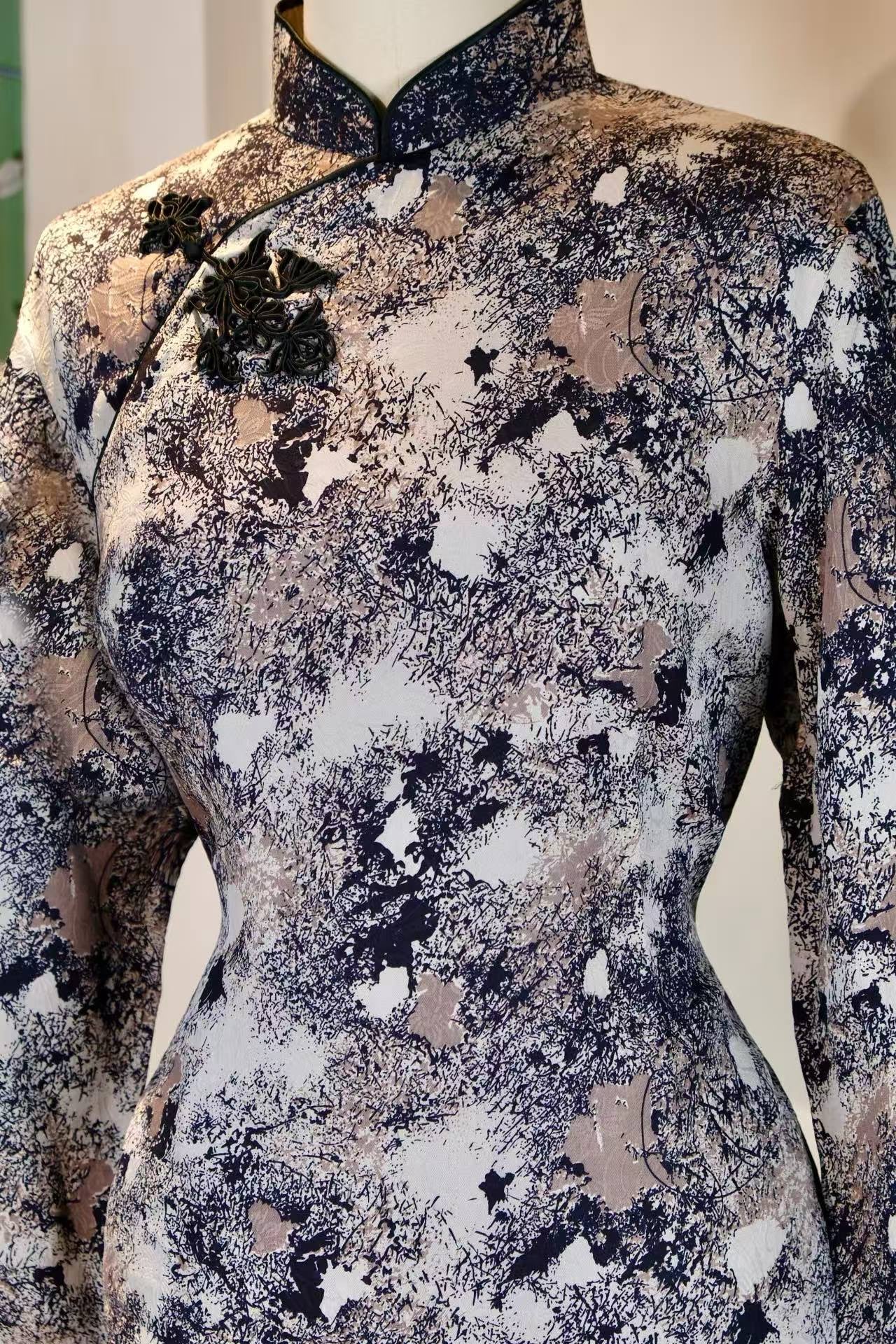
The Calligraphy of Silk: An Ink-Wash Epic Tracing back to the 1960s in Hong Kong, this antique qipao—crafted from jacquard silk with abstract ink-wash motifs—resembles a flowing landscape painting cut from the ink-plays (Moxi) of Lingnan literati. The fabric features a hidden jacquard base overlaid with abstract ink patterns: deep umber hues evoke the diffusion of a stone ink-drop, while pale ochre mimics the saturation of Xuan paper. Interspersed silver-white specks act as "flying white" (Feibai) brushstrokes, echoing the sentiment of the Song Dynasty master Mi Fu: "The art of ink-play is the remnant of the scholar's brush, housing the valleys and peaks of his soul."
The Synergy of Texture and Abstract Spirit The synergy between jacquard weaving and ink-wash diffusion creates a multidimensional relief: "From afar, it resembles misty peaks and rosy clouds; up close, it reveals the sculptural depth of woven threads." The abstraction of the pattern aligns with Su Shi’s literati spirit—"To judge a painting by its likeness to the original is the insight of a child"—eschewing literal flora and fauna for the evocative power of splashed-ink blocks and lines. Such a design was exceptionally rare in the 1960s; while most Hong Kong qipaos remained confined to traditional floral motifs, this piece stood as a vanguard practice, reflecting the modern transformation of traditional aesthetics in post-war Chinese society.
Conclusion: A Poetic Gaze at Tradition The charm of this garment lies not in the fabric itself, but in the millennium of cultural lineage it carries and the cultural self-awareness amidst the fissures of a changing era. Unfolding this qipao is like unrolling a scroll; within the depths of its ink-stains lies the last poetic gaze of 1960s Hong Kong literati toward a "Sartorial China."