深圳溯源
无法加载取货服务可用情况
衣服尺寸:
胸围/腰围/臀围:86/70/94 厘米
衣长:107 厘米
细节描述:
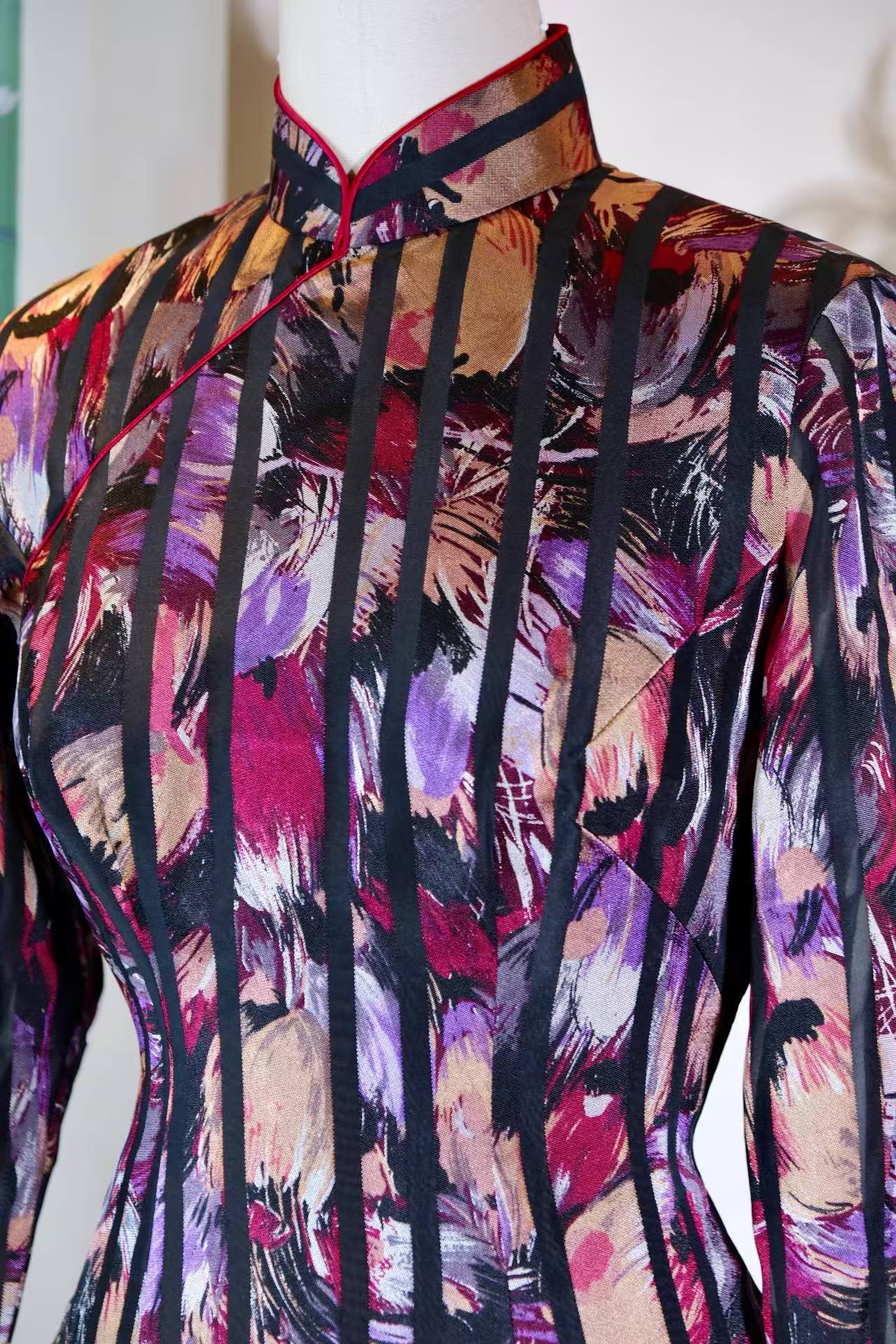
一、图案:水墨笔触与几何秩序的共生
旗袍面料以抽象花卉为母题,笔触如泼墨般恣意挥洒,玫红、紫藤、赭石与墨黑在米色底布上交织,形成“乱中有序”的视觉韵律。黑色竖条纹如琴键般贯穿全身,既分割了花卉的繁复,又以线性秩序赋予整体挺拔感,恰似宋代院体画中“折枝花卉”与“界画”技法的碰撞——前者写意,后者工谨,在方寸之间达成微妙平衡。
二、故事:六十年代香港的摩登剪影
这件旗袍诞生于1960年代的香港,彼时东西方文化在此激烈碰撞。设计师以西方抽象表现主义的笔触重构传统花卉纹样,又以“线香绲”勾勒领口、襟线与下摆,既保留了中式旗袍的含蓄骨架,又注入现代艺术的先锋气质。据《香港时装史》记载,此类“抽象花卉旗袍”多为当时上层女性出席社交场合的“战袍”,其稀缺性在于:面料需手工印染,每匹布的图案皆独一无二,且线香绲工艺对裁缝技艺要求极高,非十年以上经验的“红帮裁缝”难以驾驭。
三、艺术风格与稀缺性:传统工艺的现代性转译
从艺术史视角看,这件旗袍堪称“中西合璧”的典范。花卉的抽象笔触呼应了赵无极、朱德群等华裔艺术家的油画风格,而竖条纹的几何分割则暗合包豪斯设计理念。据不完全统计,现存完整的1960年代香港抽象花卉旗袍不足百件,且多藏于博物馆或私人藏家手中,其稀缺性不仅在于年代久远,更在于这种“传统工艺与现代艺术”的完美融合难以复制。
四、结语:衣以载道,穿越时光的东方美学
这件旗袍不仅是一件衣物,更是一部“穿在身上的艺术史”。它见证了六十年代香港的文化交融,承载了传统工艺的极致追求,其抽象花卉与线香绲的共生,恰如《考工记》所言:“天有时,地有气,材有美,工有巧,合此四者,然后可以为良。”今日重见,仍能从每一道笔触、每一寸绲边中,触摸到那个摩登时代的温度与风骨。
Measurements / Size Guide:
Bust / Waist / Hips: 86/70/94 cm
Total Length: 107 cm
Detailed Description:
The fabric utilizes abstract florals as its primary motif, with brushstrokes applied with the unrestrained freedom of splashed ink. Rose, wisteria, ochre, and soot black intertwine on a beige base, creating a visual rhythm described as "order within chaos."
Linear Structure: Vertical black stripes run through the garment like piano keys. They serve to partition the complexity of the florals while providing a linear order that grants the silhouette a sense of stature.
Artistic Dialogue: This interplay mirrors the collision of "broken-branch floral" (Zhezhi) and "boundary painting" (Jiehua) techniques found in Song Dynasty court paintings—where the former is expressive and freehand, and the latter is rigorous and disciplined.
Born in the 1960s, a decade of intense cultural collision in Hong Kong, this qipao represents a reconstruction of traditional patterns through the lens of Western Abstract Expressionism.
The Incense-Thin Pipe (Xianxiang Gun): The neckline, bodice edge (Jinxian), and hem are outlined with piping as delicate as a stick of incense. This retains the modest skeletal structure of the Chinese qipao while injecting the avant-garde spirit of modern art.
Social Context: According to A History of Hong Kong Fashion, such abstract floral qipaos were the "battle suits" of upper-class women for social engagements.
Scarcity of Craft: The fabric required manual printing, making the pattern on every bolt unique. Furthermore, the "incense-thin" piping demanded extreme precision; it was a technique mastered only by "Hongbang" (Shanghai-style) tailors with over a decade of experience.
From an art history perspective, this qipao is a paradigm of "East-meets-West."
Painterly Influence: The abstract brushwork echoes the oil painting styles of Chinese-French masters like Zao Wou-Ki and Chu Teh-Chun, while the geometric vertical stripes align with Bauhaus design principles.
Rarity: Statistical estimates suggest that fewer than a hundred intact 1960s Hong Kong abstract floral qipaos remain worldwide, mostly held in museum collections or by private connoisseurs. Its scarcity lies not just in its age, but in the irreproducible fusion of traditional craftsmanship and modern art.
This qipao is more than a garment; it is a "wearable history of art." It witnessed the cultural integration of 1960s Hong Kong and carries the ultimate pursuit of traditional craft. The symbiosis of abstract florals and delicate piping fulfills the ancient criteria of the Kao Gong Ji: "The season has its time, the earth has its qi, the material has its beauty, and the craft has its skill."
To see it today is to touch the temperature and spirit of a modern era through every brushstroke and every inch of its piping.