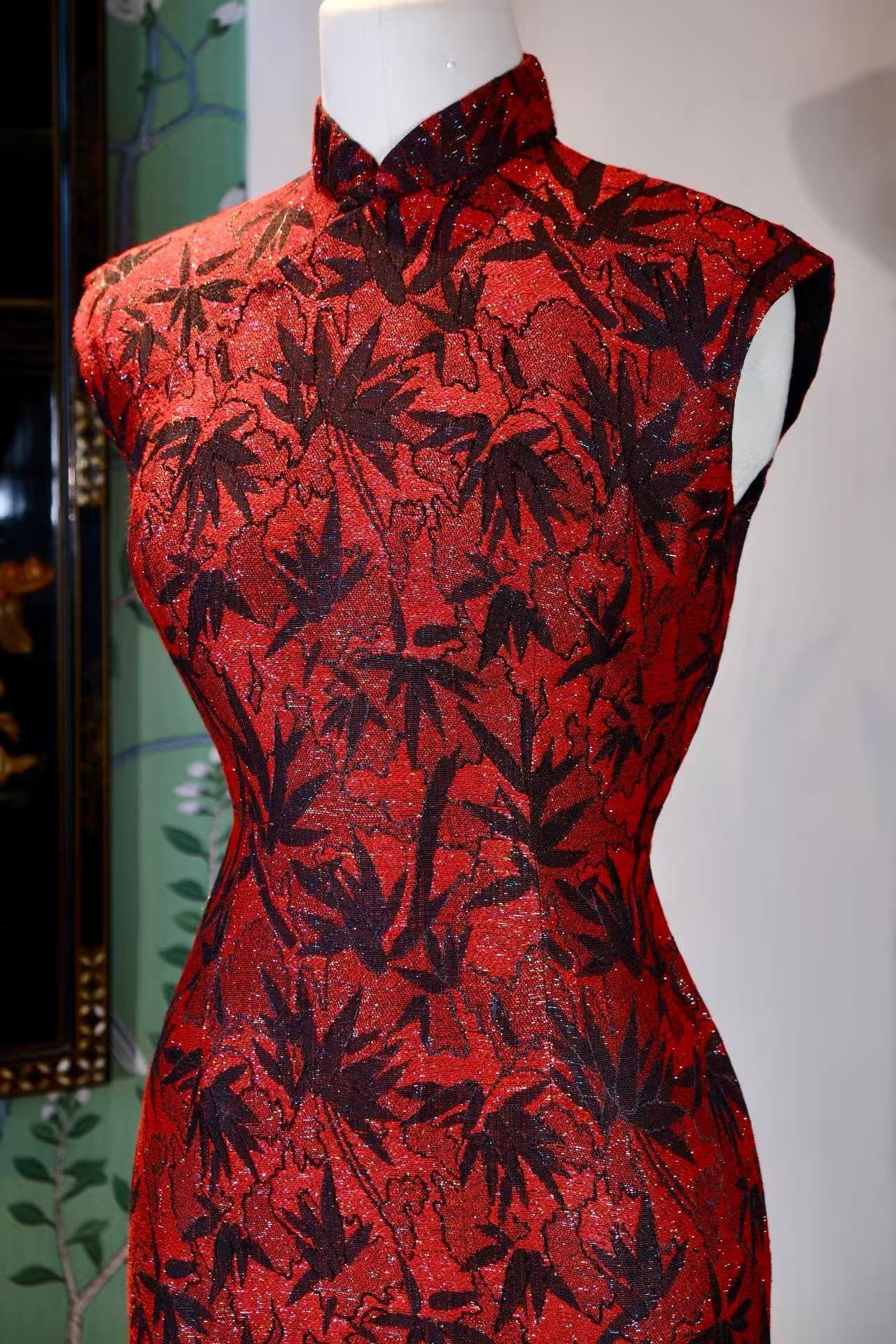
六十年代香港织金提花古董旗袍:锦上添花,风华绝代
这件产自上世纪六十年代香港的织金提花旗袍,以“翠竹”为纹样母题,将中国传统文人画的意境融入织物肌理。深红色底料如暮霭染就的宣纸,墨色竹影错落纷披——有的竹叶舒展如“八分书”的撇捺,带着《宣和画谱》所言“生郊野之间,而色不渝”的野逸;有的竹枝劲挺如“悬针”笔法,暗合《芥子园画谱》中“竹干忌十字,亦忌井字”的章法,于繁密中见疏朗,于婉转中藏骨力。
织金工艺更赋予竹影“金粉丽裳”的特质:金线在经纬间若隐若现,恰似苏轼《于潜僧绿筠轩》所咏“可使食无肉,不可居无竹”,将文人对竹的清雅寄托,转化为都市摩登的视觉符号。竹叶的边缘因金线折射出细碎光芒,仿佛晚风穿林时的粼粼金影,既保留了东方美学的“韵外之致”,又契合六十年代香港作为“东方之珠”的繁华气韵。
上世纪五六十年代的香港旗袍,承袭上海“海派”旗袍的精工基因,又融入殖民地时期的中西碰撞。这件旗袍的“织金提花”工艺,正是技术与审美的双重突破:不同于传统刺绣的“加法”装饰,它以丝线与金线交织,在织造阶段便让图案“长”在面料上,呈现出浮雕般的立体质感。这种工艺对织机精度与工匠经验要求极高,存世量稀少,堪称“织物界的珐琅彩”。
六十年代的香港,是旗袍工艺的“黄金末章”:随着成衣工业兴起,手工定制旗袍逐渐式微,而织金提花这类“费工耗材”的顶级工艺,更成为匠人绝响。这件旗袍的稀缺性,不仅在于织金面料的易损性——金线经半个世纪仍不氧化、不断裂,需原主人精心养护;更在于它见证了香港从“转口港”到“制造业中心”的历史转折,是“东方巴黎”摩登岁月的活化石。
当现代快时尚让服饰沦为“一次性消费品”,这件旗袍却以“织金作墨,经纬为纸”的匠心,将竹影的风骨、香江的繁华、时代的剪影,凝固成可穿行于时空的“移动画卷”。它不仅是衣,更是六十年代香港的“城市名片”,是东方美学在工业浪潮前的最后一抹鎏金余晖。
“云想衣裳花想容,春风拂槛露华浓。”这件织金竹影旗袍,恰似李白诗中“露华浓”的具象化——露珠的晶莹(织金的光泽)、竹的清韵(图案的意境)、盛唐的华美(六十年代的繁荣),在经纬间交织成一场跨越时空的风雅。它不仅是一件古董,更是一段凝固的城市记忆,一种永不褪色的东方美学。
1960s Hong Kong Gold-Jacquard Antique Qipao: Bamboo Shadows in Gilded Splendor
"Using gold as ink and warp-and-weft as paper, this garment freezes the character of bamboo and the prosperity of Hong Kong into a flowing scroll of time."
This gold-jacquard Qipao from 1960s Hong Kong adopts "Emerald Bamboo" as its central motif, seamlessly integrating the essence of traditional literati painting into the very grain of the fabric. The deep crimson base acts as Xuan paper stained by twilight, upon which inky bamboo shadows scatter—some leaves stretch like the strokes of "Clerical Script" (Ba Fen Shu), possessing the wild elegance of "colors that never fade in the wilderness"; others are as resolute as "Suspended Needle" calligraphy, following the compositional rules of the Manual of the Mustard Seed Garden.
The Gold Jacquard (Zhi Jin) technique bestows a "gilded brilliance" upon these shadows. Gold threads flicker amidst the silk, transforming the literati’s spiritual devotion to bamboo into a visual symbol of urban modernism. The edges of the bamboo leaves shimmer with fragmented light, like the golden ripples of a sunset breeze passing through a forest—preserving the "ethereal charm" of Oriental aesthetics while echoing Hong Kong's 1960s aura as the "Pearl of the Orient."
During this era, Hong Kong Qipaos inherited the meticulous genes of the Shanghai "Haipai" style while absorbing the East-West collision of the colonial period. This specific technique is a dual breakthrough: unlike the "additive" decoration of embroidery, it interweaves silk and gold threads so that the pattern "grows" out of the fabric during weaving, creating a relief-like texture. Such craftsmanship demands extreme precision and is as rare as "Enamelware in fabric."
The 1960s marked the "Golden Final Chapter" of bespoke Qipao craftsmanship in Hong Kong. As the ready-to-wear industry rose, top-tier techniques like gold jacquard became the "swan song" of master artisans. Its scarcity lies not only in its fragility—the gold threads have remained unoxidized and unbroken for half a century—but also in its role as a living fossil of the city’s transition into a manufacturing hub. It is the "Urban Calling Card" of 1960s Hong Kong, representing the final gilded glow of Oriental aesthetics before the industrial tide.
"Clouds remind me of her clothes, and flowers of her face; the spring breeze brushes the balustrade, and the dew is thick with fragrance." This gold-jacquard Qipao is the physical incarnation of the "thick dew" in Li Bai’s poem—the luster of the gold, the rhythm of the bamboo, and the opulence of an era interwoven into a timeless masterpiece.