深圳溯源
无法加载取货服务可用情况
衣服尺寸:
胸围/腰围/臀围:98/86/100 厘米
衣长:110 厘米
细节描述:
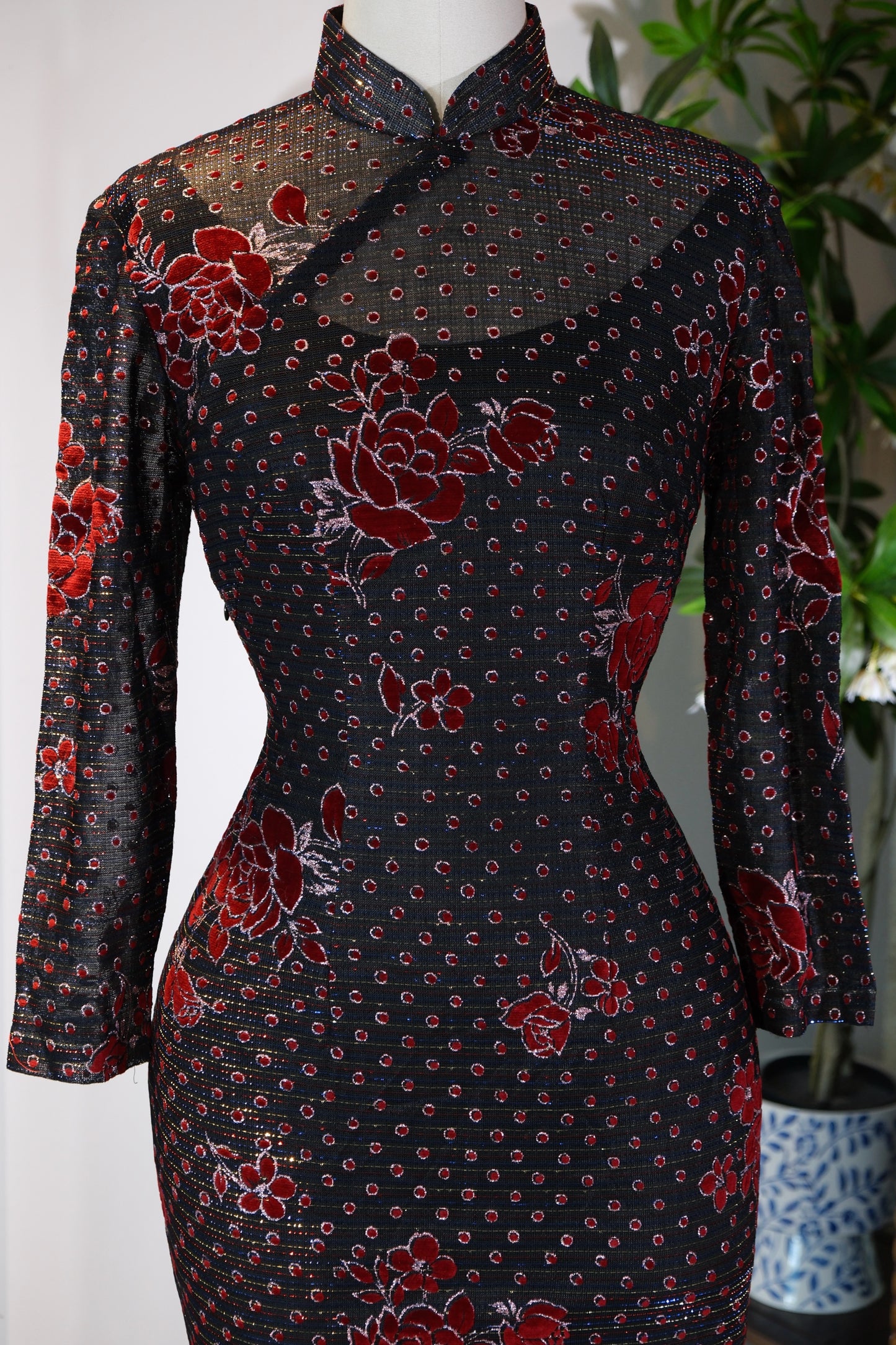
图案解构:金线与绒花的复调叙事
这件旗袍的图案体系由“经纬暗纹”与“表层植绒”双重结构构成,呈现出东方传统纹样与现代设计语言的精妙对话。
- 底纹:织金纱的星轨密码
黑色纱质底料中,以金线织就的暗纹为经纬骨架。这种六十年代香港被解构为几何化的连续纹样——金线以0.3毫米的细度穿梭于纱线间隙,形成若隐若现的菱形网格,远观如夜空中的星轨,近看则似《营造法式》中“方胜纹”的现代变体。金线在光线折射下会产生微妙的明暗变化,使黑色底料呈现出“墨分五色”的层次感,恰如文人画中的“积墨法”,在单一色调中营造出丰富的视觉纵深。
- 主纹:植绒牡丹的立体诗学
表层植绒图案以“缠枝牡丹”为主题,采用六十年代香港独有的“植绒”工艺:以朱红色绒料塑造牡丹花瓣,绒高增至2毫米,通过不同密度的植绒工艺,使花瓣边缘呈现“薄如蝉翼”的渐变效果;图案在平面上呈现出浮雕般的立体感,触摸时能感受到花瓣的柔软与枝叶的韧性,宛如将《牡丹亭》中“姹紫嫣红开遍”的意象凝固于织物之上。
- 辅助纹:几何碎花的现代性隐喻
在主纹间隙,散布着直径约0.5厘米的“几何碎花”——由四个红色圆点组成的菱形图案,以0.8厘米的间距均匀分布。这种看似随意的点缀,实则暗合六十年代“波普艺术”的视觉逻辑:红色圆点如同安迪·沃霍尔的“玛丽莲·梦露”版画中的色块,在古典纹样中注入现代艺术的叛逆基因。碎花与缠枝牡丹形成“疏可走马,密不透风”的对比,既平衡了主纹的繁复,又暗示了六十年代香港“传统与现代并存”的城市气质。
文化隐喻:黑金红的三重奏
黑色底料象征“玄”,是中国传统色彩中“众色之母”,代表宇宙的混沌与无限;金线暗纹象征“阳”,是光明与权力的符号,呼应六十年代香港经济的腾飞;朱红绒花象征“阴”,是生命与欲望的载体,暗合旗袍穿着者的女性身份。三者交织形成的“黑金红”配色,既符合《周易》中“阴阳相济”的哲学,又暗含六十年代香港“东方之珠”的城市定位——在传统与现代、东方与西方的张力中,绽放出独特的文化光芒。
Measurements / Size Guide:
Bust / Waist / Hips: 98/86/100 cm
Total Length: 110 cm
Detailed Description:
The pattern system of this cheongsam (qipao) is composed of a dual structure—"warp-and-weft hidden patterns" and "surface flocking"—presenting a subtle dialogue between traditional Eastern motifs and modern design language.
The Ground Pattern: The Star-Rail Code of Gold-Woven Gauze Within the black gauze base, hidden patterns woven with gold threads serve as the structural framework. In 1960s Hong Kong, this was deconstructed into geometric continuous patterns: gold threads as fine as 0.3 mm travel through the gaps in the yarn, forming a shimmering diamond grid. From afar, it resembles star trails in the night sky; up close, it appears as a modern variation of the "Fangsheng" (interlocking diamond) motif from the Treatise on Architectural Methods. The gold threads produce subtle shifts of light and shadow under refraction, giving the black base a layered sense of "five shades of ink," much like the "accumulated ink" technique in literati painting, creating rich visual depth within a monochromatic palette.
The Main Motif: The Three-Dimensional Poetics of Flocked Peonies The surface flocking features the "intertwining peony" theme, utilizing a flocking craft unique to 1960s Hong Kong. Vermilion red flocking material is used to sculpt the peony petals, with a pile height of 2 mm. Through varying densities, the petal edges achieve a gradient effect as "thin as a cicada's wing." The pattern presents a relief-like three-dimensionality on the flat surface; upon touching, one can feel the softness of the petals and the resilience of the stems, as if the imagery of "brilliant purples and bright reds blooming everywhere" from The Peony Pavilion has been frozen onto the fabric.
The Auxiliary Motif: Modernist Metaphors of Geometric Florets Scattered within the gaps of the main motif are "geometric florets" approximately 0.5 cm in diameter—diamond patterns composed of four red dots, evenly distributed at 0.8 cm intervals. This seemingly casual adornment actually aligns with the visual logic of 1960s "Pop Art." The red dots act like the color blocks in Andy Warhol's "Marilyn Monroe" prints, injecting a rebellious gene of modern art into the classical pattern. These florets create a contrast with the intertwining peonies of "sparse enough to let a horse run through, yet dense enough to block the wind," balancing the complexity of the main motif while hinting at the 1960s Hong Kong urban temperament where "tradition and modernity coexist."
The black base symbolizes Xuan (the mysterious), the "mother of all colors" in traditional Chinese color theory, representing the chaos and infinity of the universe. The gold hidden patterns symbolize Yang, the signifier of light and power, echoing the economic takeoff of 1960s Hong Kong. The vermilion flocked blossoms symbolize Yin, the carrier of life and desire, subtly aligning with the feminine identity of the wearer. The "Black-Gold-Red" palette formed by this trinity not only conforms to the philosophy of "harmony between Yin and Yang" in the I Ching but also implies Hong Kong's positioning as the "Pearl of the Orient" in the sixties—radiating a unique cultural brilliance amidst the tension between tradition and modernity, East and West.