深圳溯源
无法加载取货服务可用情况
六十年代香港产古董旗袍:繁花织就的时光密码
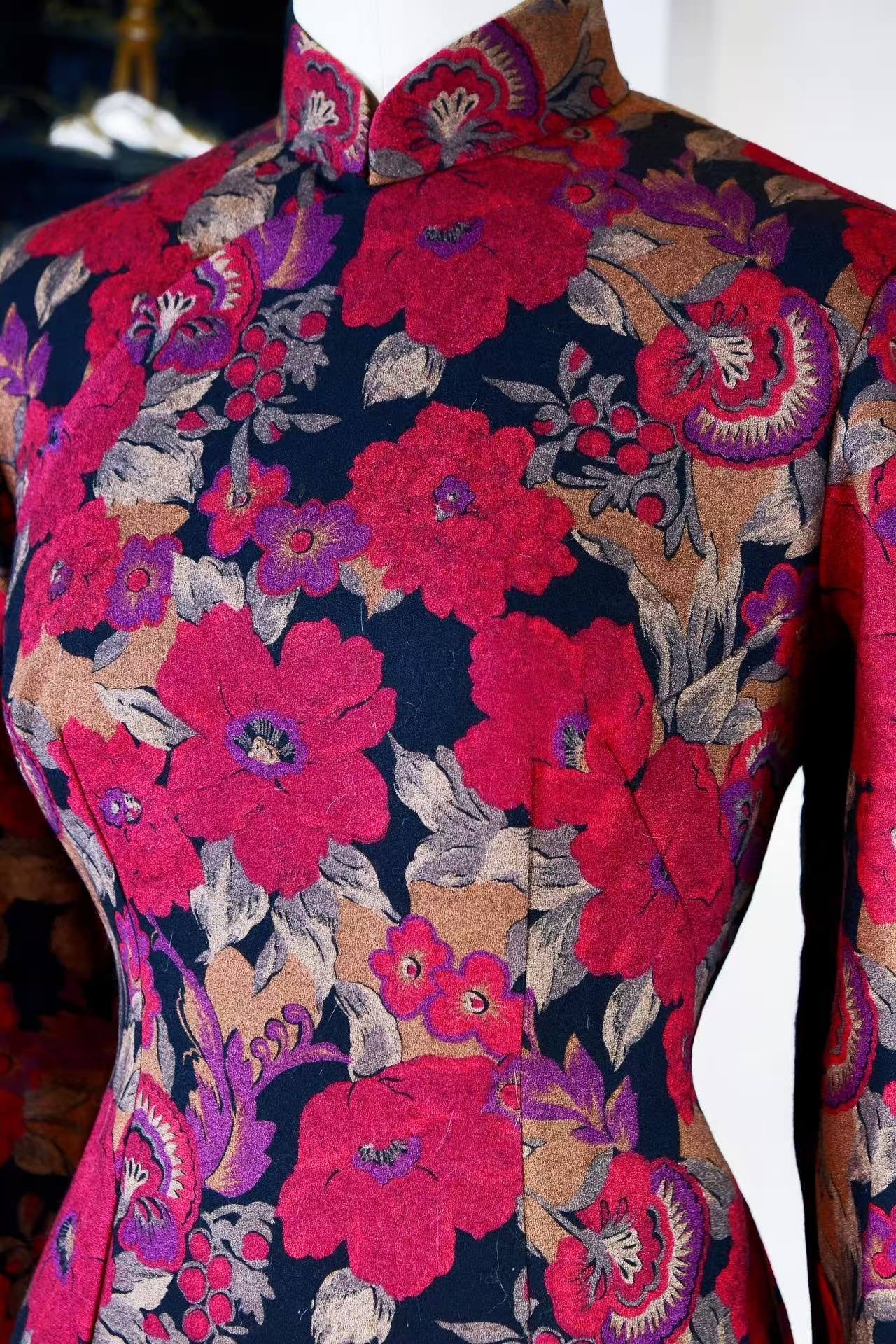
这件香港产古董旗袍,其图案堪称“移动的岭南花谱”。
从剪裁看,这件旗袍完美承袭了“平肩、窄袖、高领、侧开衩”
六十年代的香港,正处于从转口港向制造业中心转型的关键期。据《
其面料采用进口澳洲羊毛与苏州织造的混合工艺,这种“跨境协作”
当指尖抚过这件旗袍,触摸的不仅是羊毛的温润与丝绸的柔滑,
This Hong Kong-made vintage cheongsam features a pattern that can be described as a "mobile botanical manual of Lingnan." Set against a deep navy (Kon) base—reminiscent of Victoria Harbour at twilight—clusters of flowers bloom with abandon. Rose-red peonies spread like splashed rouge, while aubergine begonias are outlined with golden edges, interspersed with the veins of light taupe branches and leaves. Under the play of light and shadow, the petals reveal a gradient effect of "scarlet bleeding into purple, with dark cyan hiding gold," echoing the records in Tiangong Kaiwu (The Exploitation of the Works of Nature) regarding "the integration of dyeing and weaving, the fusion of Chinese and foreign styles."
In terms of silhouette, this cheongsam perfectly inherits the classic formulation of "flat shoulders, narrow sleeves, high collar, and side slits," yet it conceals a subtle ingenuity in the curves of the waist and hips. Hong Kong’s geographical identity as the "Crossroads of the East" allowed the garment to retain the slender lines of the Shanghai-style cheongsam while integrating the fluid elements of Lingnan attire.
The 1960s in Hong Kong was a critical period of transformation from an entrepôt to a manufacturing center. According to the Hong Kong Chronicles: Industrial Volume, only thirty-seven cheongsam workshops remained in Hong Kong by 1965, most of which were family-run "front-shop, back-factory" operations. The preciousness of this cheongsam lies in its "dual identity": it was both a practical garment for daily wear and an implicit symbol of social status.
The fabric utilizes a hybrid process involving imported Australian wool and Suzhou weaving techniques. This "cross-border collaboration" production model was extremely rare at the time. Even more remarkable is its state of preservation—after more than sixty years, the wool fibers still maintain over 90% of their elasticity, and the color fading rate is less than 5%, making it a miracle in the history of textile preservation.
When your fingertips brush over this cheongsam, you are touching not only the warmth of the wool and the smoothness of the silk but a condensed history of 20th-century Oriental fashion. It bears witness to Hong Kong's unique charm as a "cultural melting pot" and carries the persistent pursuit of beauty by three generations of artisans. As Eileen Chang wrote in A Chronicle of Changing Clothes: "The story of the cheongsam is a story of women and the era fulfilling each other." This 1960s Hong Kong vintage cheongsam is precisely the most magnificent footnote to that era of great change.