深圳溯源
无法加载取货服务可用情况
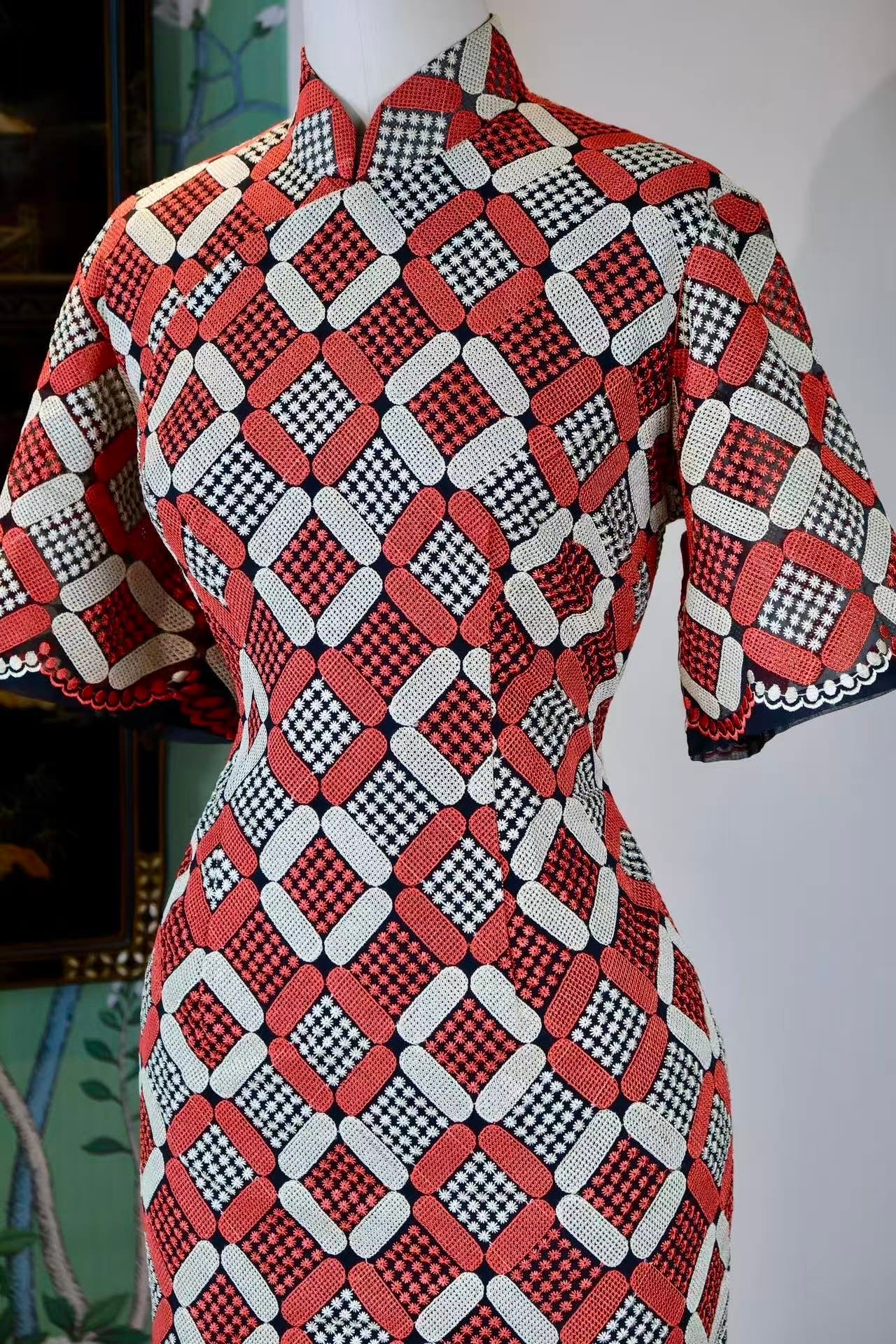
六十年代·几何绮梦:台湾产机器绣花蕾丝古董旗袍
一、器物观止:时光淬炼的织物诗学
当上世纪六十年代的工业美学邂逅东方传统形制,
二、纹样解码:几何宇宙中的东方哲思
旗袍上的图案,是一场视觉的理性狂欢。以红、白、黑三色为经纬,
三、工艺溯源:机械时代的诗意缝合
机器绣花技术在上世纪六十年代的台湾尚属先锋,
四、文化隐喻:全球化浪潮中的身份书写
六十年代的台湾,正处于东西方文化交融的十字路口。
五、结语:穿在身上的历史诗篇
当我们凝视这件古董旗袍,看到的不仅是布料与针线的组合,
When the industrial aesthetics of the 1960s encountered traditional Oriental forms, this Taiwanese antique Qipao became a solidified specimen of woven time. With machine-embroidered lace as its bone and geometric patterns as its soul, it continues to radiate an avant-garde yet elegant glow after half a century. Its scarcity lies not only in its limited survival but in its role as a witness to the transformation of Taiwan’s textile industry—a period when Taiwan transitioned from traditional handicrafts to mechanized production. This Qipao is the byproduct of the collision between technological innovation and cultural inheritance; every stitch and thread is engraved with the "fingerprints of an era."
The motifs on this Qipao are a visual carnival of rationality. Utilizing a palette of red, white, and black, it constructs a geometric network of interlaced rhombuses and rectangles, resembling the hexagram totems in the I Ching where "the firm and the yielding displace each other to produce change." The sharpness of the rhombus and the stability of the rectangle interlock to form a dynamic balance, echoing the creative wisdom from Kao Gong Ji: "The seasons of Heaven, the energy of Earth, the beauty of materials, and the skill of the artisan—combine these four, and a fine object is made." Each cell is filled with dense pointillist patterns: red like cinnabar, white like frost-covered snow, and black like profound iron. These three colors interact amidst the hollow texture of the lace, manifesting the philosophical concept of "being and non-being producing each other" from the Tao Te Ching.
Machine embroidery was a pioneering technology in 1960s Taiwan. The brilliance of this Qipao lies in the subtle reconciliation between mechanical precision and the softness of lace. The openwork structure of the lace is not mere perforation but a multi-layered superposition of embroidery threads, creating a relief-like three-dimensional effect. The scalloped wavy piping at the cuffs is a masterstroke; it breaks the rigidity of the geometric patterns, injecting a touch of feminine grace that mirrors the vivid charm of "Her artful smile so dimpled, her beautiful eyes so clear" from The Classic of Poetry. This aesthetic of "strength tempered with softness" is a modern interpretation of the "Beauty of Neutrality" (Zhong He Zhi Mei) in Oriental aesthetics.
Taiwan in the 1960s stood at the crossroads of East-West cultural fusion. The geometric patterns show traces of Western Modernist design, yet its form and material are deeply rooted in Oriental tradition. It serves as a cultural symbol, narrating the identity exploration of Taiwanese women amidst the wave of globalization—embracing modernity while steadfastly guarding their cultural roots. As the scholar Stephen Owen noted: "Tradition is not the preservation of ashes, but the passing on of fire." This Qipao is that inextinguishable flame within the passage of time.
When we gaze upon this antique Qipao, we see more than just a combination of fabric and thread; we see the aesthetic memory of an era and the survival wisdom of a culture. It uses geometric language and lace brushstrokes to write a poem about beauty, inheritance, and innovation upon the long scroll of time. Having traversed half a century of wind and rain, it speaks with elegance: true classics are never worn away by time; they only grow more brilliant through the polishing of years.