深圳溯源
无法加载取货服务可用情况
衣服尺寸:
胸围/腰围/臀围:86/74/94 厘米
衣长:100 厘米
细节描述:
一、衣上丹青:冰纹梅影里的东方诗性
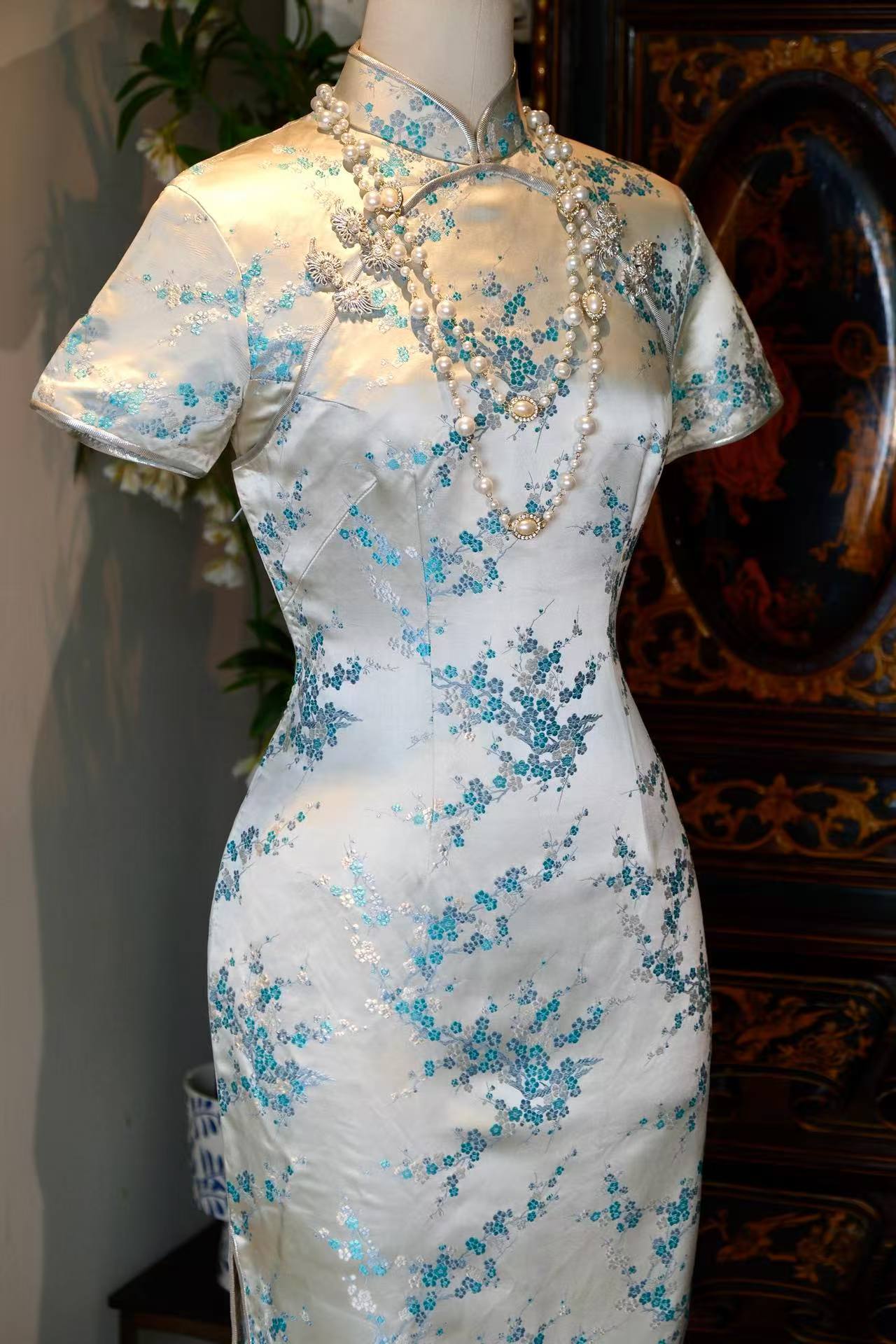
这件诞生于上世纪六十年代台湾的织锦缎旗袍,以月白色为底,如《长物志》所言“素瓷传静夜,芳气满闲轩”的澄澈。其纹样为“冰梅纹”变体——银线织就的冰裂纹如寒潭碎玉,其间错落点缀天青、湖蓝、月白三色梅花,花瓣以提花工艺呈现浮雕质感,枝桠转折处暗合《芥子园画谱》“梅梢如铁,花萼含春”的笔意。更妙在光影流转时,缎面泛起的珠光与梅花冷香相映,恍若宋人林逋“疏影横斜水清浅”的诗意具象化,将文人画的写意精神织入经纬。
二、衣脉相承:渡海风华里的时代注脚
1949年后,随国民政府迁台的江浙织造匠人,将苏州宋锦技艺与台湾本土丝线结合,催生出这批“渡海织锦”。此袍采用六十年代台湾特有的“三梭织法”——以两根银线夹一根彩色丝线交织,使纹样立体如浮雕,却又不失丝绸的垂坠感。彼时台湾丝绸业正值黄金期,此类织锦缎多供政要眷属与名媛定制,存世量不足百件。衣身侧缝的隐形拉链(六十年代台湾旗袍革新标志)与领口滚边工艺,既保留传统旗袍的含蓄,又暗藏现代裁剪的巧思,恰如白先勇《台北人》中“旧时王谢堂前燕,飞入寻常百姓家”的时代隐喻。
三、艺境天成:织锦里的文化密码
织锦缎作为中国丝绸工艺的巅峰,《天工开物》载其“一寸锦一寸金”。此袍纹样暗合“梅开五福”吉祥寓意:五瓣梅花对应“寿、富、康宁、攸好德、考终命”,冰裂纹则取“寒窗苦读终破壁”的士人精神。领口与袖口的银线滚边,宽不过0.5厘米,却需匠人以“挑经显纬”技法手工缝制,每一针都暗合《考工记》“天有时,地有气,材有美,工有巧”的造物哲学。
如今,台湾六十年代织锦缎旗袍因原料断供与匠人凋零,已成为博物馆级藏品。此袍保存完好,缎面未褪色、纹样无磨损,其稀缺性不仅在于工艺绝唱,更在于它是“两岸文化同根同源”的实物见证——正如陈从周先生所言:“中国园林之妙,在隔与不隔之间”,这件旗袍的美,亦在“传统与现代”“大陆与台湾”的微妙平衡中,织就了一段永不褪色的东方传奇。
Measurements / Size Guide:
Bust / Waist / Hips: 86/74/94 cm
Total Length: 100 cm
Detailed Description:
This brocade qipao, born in 1960s Taiwan, features a moon-white base—possessing the clarity described in Chang Wu Zhi: "Plain porcelain conveys the quiet night; fragrant air fills the leisure pavilion." Its motif is a variation of the "Ice Plum" (Bingmei) pattern.
The Design: Silver threads weave a cracked-ice texture resembling shattered jade in a frozen pond, interspersed with plum blossoms in shades of celadon, lake blue, and moon white.
The Craft: The petals are rendered with jacquard techniques to achieve a relief-like texture, while the angular branches echo the brushwork of the Mustard Seed Garden Manual of Painting: "Plum tips like iron, calyxes harboring spring." Under shifting light, the pearlescent satin reflects the "cool fragrance" of the blossoms, manifesting the poetic imagery of the Song dynasty poet Lin Bu: "Sparse shadows fall slant across the clear, shallow water."
Post-1949, weavers from Jiangsu and Zhejiang who migrated to Taiwan combined the techniques of Suzhou Song Brocade with local Taiwanese silk threads, giving birth to this "Cross-Strait Brocade."
Technique: This garment utilizes the "Three-Shuttle Weaving" method unique to 1960s Taiwan—interweaving two silver threads with one colored silk thread. This makes the patterns as three-dimensional as sculptures without sacrificing the silk's graceful drape.
Historical Context: During the golden age of Taiwan’s silk industry, such brocades were primarily custom-made for the families of political dignitaries and socialites; fewer than a hundred such pieces are estimated to survive. The inclusion of an invisible side zipper (a hallmark of 1960s Taiwan qipao innovation) and refined piping balances traditional reserve with modernist tailoring—a metaphorical "swallow from the halls of ancient nobles flying into the homes of ordinary people," as depicted in Bai Xianyong’s Taipei People.
As the peak of Chinese silk craft, brocade is described in Tiangong Kaiwu as "an inch of brocade is worth an inch of gold."
Symbolism: The pattern aligns with the "Five Blessings of the Plum Blossom," where five petals correspond to longevity, wealth, health, virtue, and a peaceful end. The cracked-ice pattern (Binglie) symbolizes the scholarly spirit of "breaking through the frozen window after years of hard study."
Precision: The silver-thread piping at the collar and cuffs is less than 0.5 cm wide, requiring the "lifting the warp to reveal the weft" manual technique. Every stitch fulfills the philosophy of Kao Gong Ji: "The season has its time, the earth has its qi, the material has its beauty, and the craft has its skill."
Today, 1960s Taiwanese brocade qipaos have become museum-grade collectibles due to the disappearance of raw materials and the passing of master craftsmen. This piece, perfectly preserved without fading or wear, is not just a masterpiece of craft but a physical witness to a shared cultural heritage—weaving a timeless Oriental legend in the delicate balance between tradition and modernity.