深圳溯源
无法加载取货服务可用情况
这件台湾产古董旗袍以“
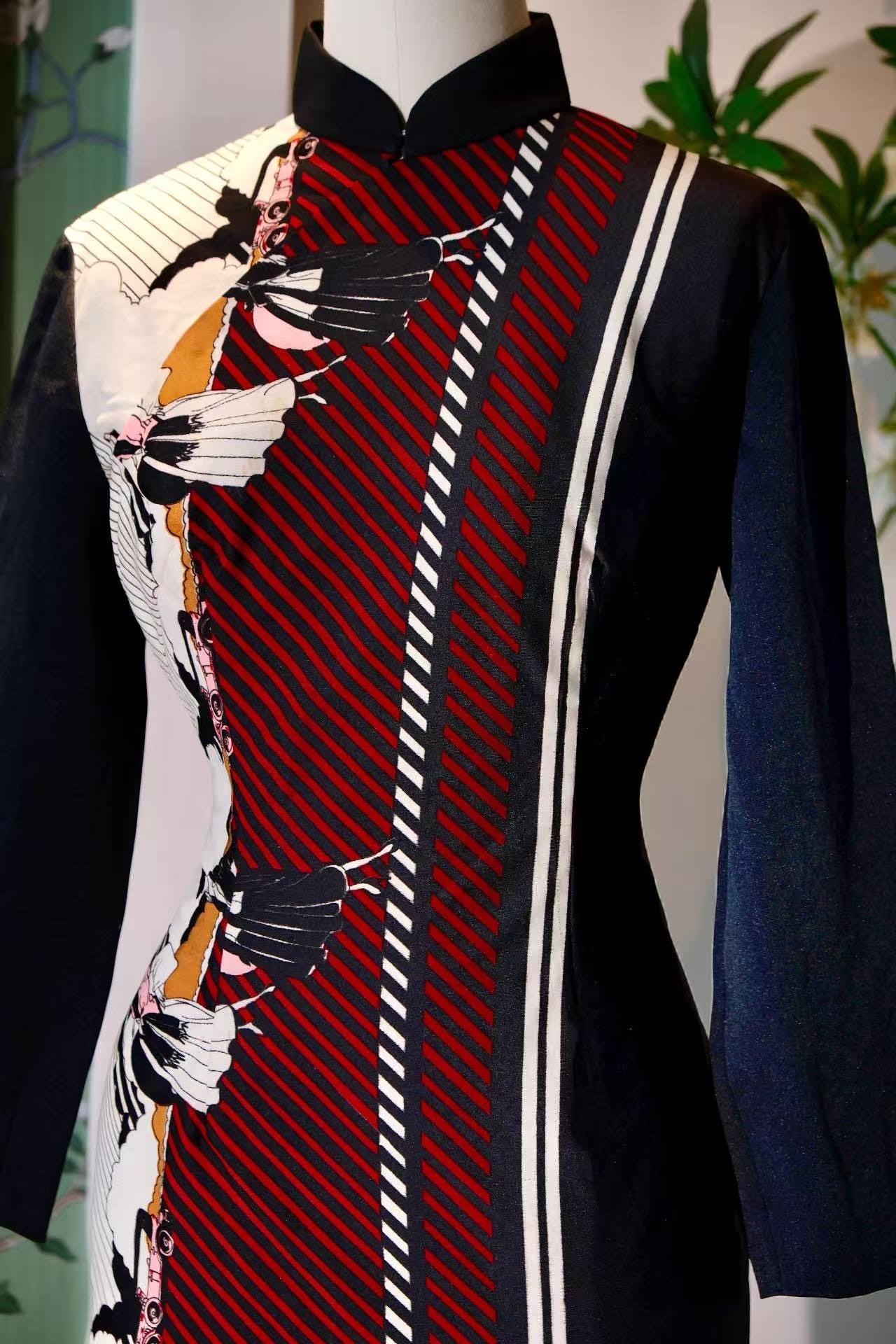
旗袍主体纹样以“红黑斜纹”为基底,构成强烈的几何节奏——
这件旗袍的稀缺性,首先源于其“几何艺术”风格的先锋性。
作为1960年代台湾出口型服饰的代表,
This vintage Taiwanese cheongsam uses "geometric art" as its brushwork, weaving a flowing epic of the era within the silk's warp and weft. Its pattern language transcends mere ornamentation, fusing the fashions of the 1950s New Look, mechanical aesthetics, and traditional imagery into a unique visual text, becoming a microcosm for decoding the cultural transition of post-war Chinese society.
The cheongsam's main motif is built on a "red and black diagonal stripe" base, creating a strong geometric rhythm—the red is as passionate as a metropolitan pulse, while the black carries the cool sobriety of the industrial age. The dynamic diagonal direction breaks away from the traditional vertical streamline of the cheongsam, subtly aligning with the "asymmetrical balance" sought by 1960s abstract art. As the art historian E.H. Gombrich stated: "The revolution of decoration is essentially the projection of the spirit of the age." Especially precious is the juxtaposition of the "Two-Skirted Lady" and the "Classic Car" imagery: the lady with the black-and-white skirt on the left, whose skirt folds are outlined in black and white lines, echoes the "Corolla Line" of Christian Dior's 1947 New Look.
The scarcity of this cheongsam primarily stems from the pioneering nature of its "geometric art" style. In the 1960s, the Taiwanese apparel industry was in transition between tradition and modernity. Designers boldly infused Western Constructivist methods into cheongsam design: the repetitive arrangement of red and black diagonal stripes forms a "visual rhythm," while the white vertical stripes cut across the space like feibai (flying white) in calligraphy. This design philosophy of "achieving much with little" echoes the geometric tailoring experiments of Balenciaga during the same period.
A deeper artistic value lies in its modern expression of "Oriental aesthetic concepts." The "Double Butterfly" (双蝶) image in the pattern not only inherits the traditional auspicious motif of "Butterflies Loving Flowers" from the Qing Dynasty Xuehuan Xiupu (雪宦绣谱) but is also abstracted to form the dynamic silhouette of the New Look skirt. This creative logic of "new combinations of old elements" validates Susanne K. Langer's assertion: "The essence of artistic form is the re-organization of experience."
As a representative piece of Taiwan's export-oriented clothing in the 1960s, the survival rate of these geometric art cheongsams is extremely low. At that time, the Taiwanese textile industry was transforming from "OEM production" to "original design." This piece retains traditional craftsmanship (such as the stand collar and the concept of "tailoring prioritizing intention" recorded in The Exploitation of the Works of Nature) while incorporating the printing technology of mechanized production, making it a valuable physical testament to the "modernization of traditional craft."
Behind it also hides a specific historical context: during the 1950s and 60s, Taiwanese women's clothing underwent a wave of "cheongsam Westernization," where the introduction of the New Look symbolized the active absorption of Western fashion. This cheongsam, which juxtaposes "Western silhouette" with "Chinese stand collar," precisely reflects the sentiment of scholar Tani E. Barlow: "The evolution of the cheongsam is a visual declaration of Chinese women seeking identity between tradition and modernity." When fingertips trace the red and black diagonal stripes on the silk, we touch not only the fabric's texture but also the cultural folds of an entire era. This vintage Taiwanese cheongsam, with geometric art as its shell and cross-cultural dialogue as its core, redefines mid-20th-century Oriental aesthetics amidst the elegant silhouette of the "Two-Skirted Lady" and the mechanical luster of the "Classic Car." Its scarcity lies not only in its exquisite craftsmanship and age but also in its irreplaceable quality as a "visual history book"—every pattern is the poetic rendering of history on clothing.