深圳溯源
无法加载取货服务可用情况
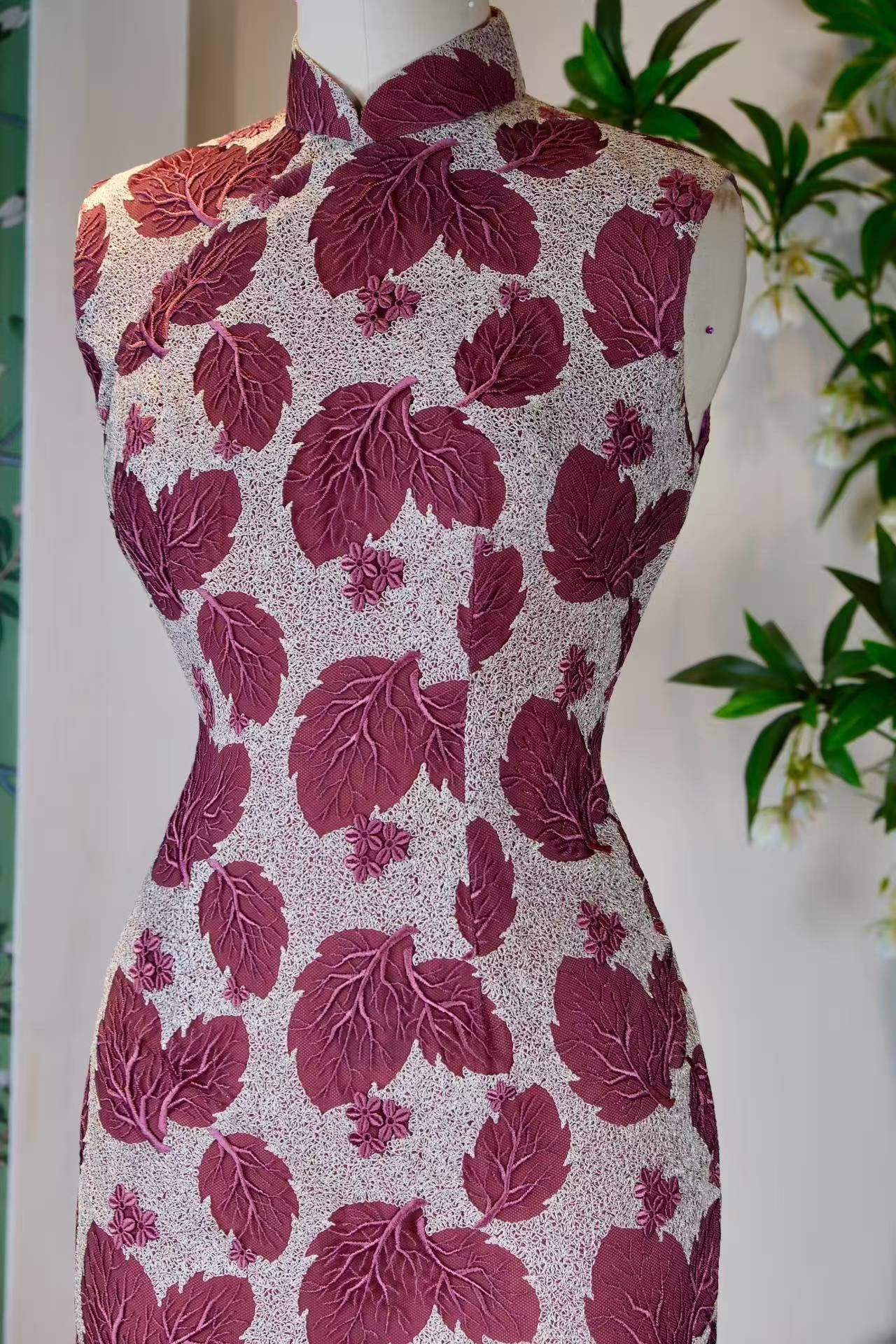
分享一件上世纪六十年代台湾铲镂空蕾丝刺绣网纱立体肌理感古董旗
这件上世纪六十年代的台湾古董旗袍,以通透网纱蕾丝为基底,
叶片纹样在中国服饰史中素有“草木荣华”的吉祥寓意,《诗经·
这件旗袍不仅是织物,更是一部凝缩的微观史:
This vintage Taiwanese cheongsam from the 1960s uses transparent mesh lace as its foundation, elevating leaf embroidery into a "natural growth upon fabric." The deep purple-red leaf motifs, like silhouettes of an autumn maple forest, are scattered across the light grey mesh base. Each leaf is outlined with delicate flat stitching, and the veining is rendered with layers of gradient silk threads, resembling the brush intent of "leaves distinguish light and shadow, veins vary between solid and void" from the Mustard Seed Garden Manual of Painting. This perfectly integrates the life-drawing spirit of Chinese painting into the language of embroidery.
Even more exquisite are the curling silk threads interspersed between the leaves. These "flowing water" (曲水纹) lines, sewn using gold couching (盘金绣) and dimensional embroidery (立体绣) techniques, simulate the natural texture of winding vines and condensed dew drops, causing the flat embroidery to suddenly gain a "vibrant and fragrant" three-dimensional quality. As stated in Shi Ming: Shi Shoushi (释名·释首饰), "Embroidery is a model (範), a luminous model (範範然光彩)," this robe uses the needle as a brush and thread as ink to weave a flowing "Scroll of Flora" within the lace grid.
The leaf motif has long carried the auspicious meaning of "flourishing vegetation" (草木荣华) in Chinese costume history. The Classic of Poetry: Lesser Odes uses the image of "plucking water caltrops, not filling the basket" to express a woman's longing, and the Songs of Chu elevates fragrant herbs to a symbol of noble integrity with the line: "I wear the angelica and fragrant herbs, and string the autumn orchids for my girdle." This cheongsam breaks away from the traditional "branch and stem" arrangement, utilizing a scattered composition that allows the leaves and curling lines to interweave freely. This retains the Oriental aesthetic core of "emulating nature" while aligning with the "organic form" design trend of the Western fashion world in the 1960s. The tension between the transparency of the lace and the density of the embroidery is evident. The curling silk threads act like the feibai (flying white) technique in calligraphy, creating a dynamic interplay of solid and void that fully demonstrates the compositional wisdom of "loose enough for a horse to run through, dense enough to block the wind." This courage to deconstruct and reorganize traditional motifs confirms the unique path of "localized modernity" in Taiwan's post-war apparel culture.
This cheongsam is more than just fabric; it is a condensed historical microcosm: the imported nature of the mesh lace testifies to Taiwan's dialogue with international fashion after the war; the indigenous quality of the leaf embroidery carries the poetry of millenniums of plant culture; and the innovativeness of the curling lines highlights the artisan's artistic consciousness during an era of change. When we gaze upon it in the light and shadow, we can almost hear the subtle sounds of embroidery needles in the Taiwanese workshops of the 1960s and see the graceful figure of the woman wearing the robe walking the streets of Taipei. This is the most moving charm of vintage clothing: it gives time a tangible feel, art a body temperature, and allows every stitch and thread to become an aesthetic secret code spanning half a century.