深圳溯源
无法加载取货服务可用情况
衣服尺寸:
胸围/腰围/臀围:108/92/110 厘米
衣长:120 厘米
细节描述:
衣上乾坤:暗夜里的星汉灿烂
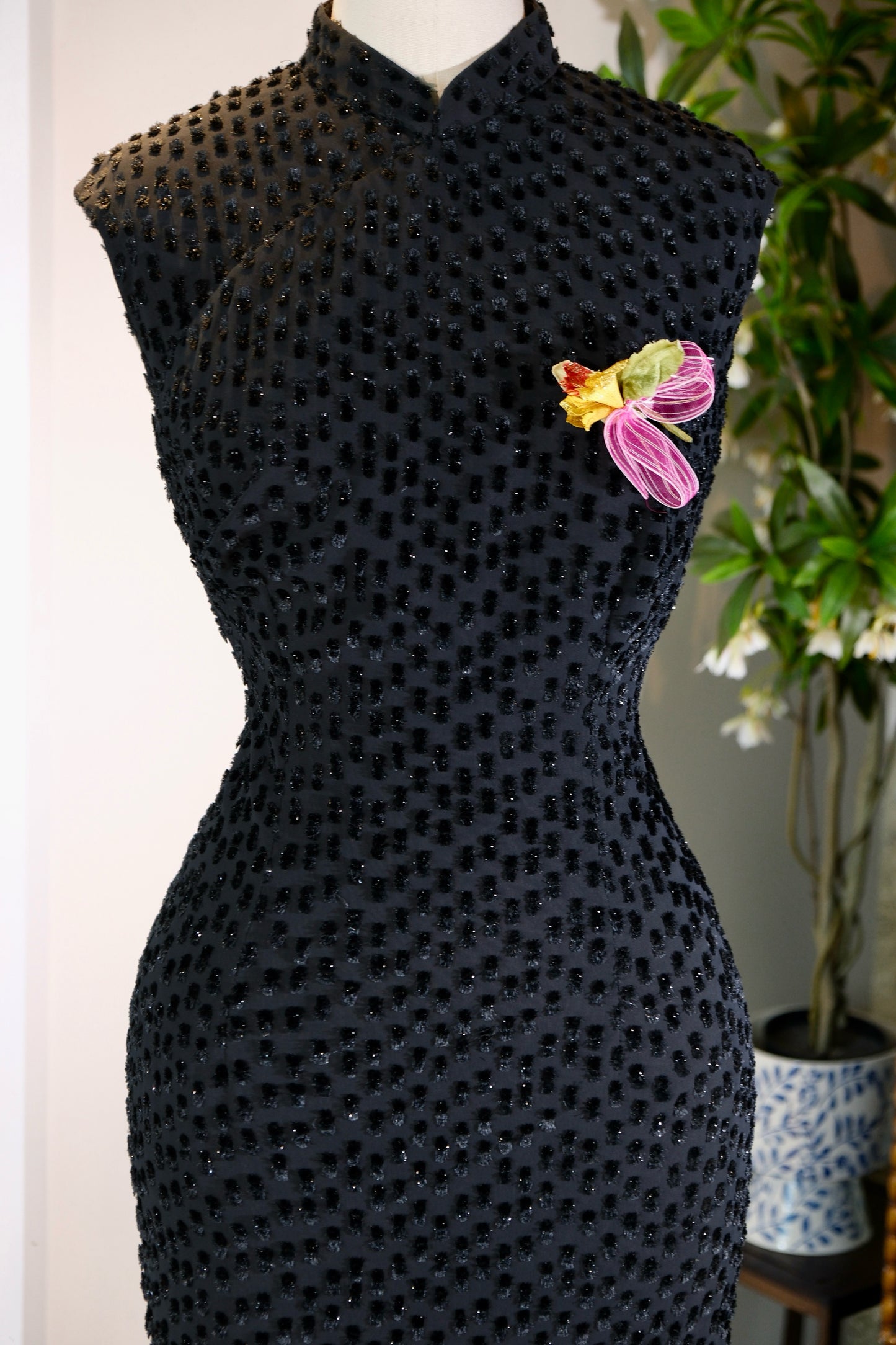
这件诞生于上世纪六十年代台湾的旗袍,以墨色为底,通体缀满植绒金葱圆点,似将午夜的星空裁作衣料。圆点并非简单的平面印花,而是以植绒工艺赋予其微凸的立体肌理,指尖拂过,能触到细密如夜露的颗粒感;金葱丝线则如星屑般隐于绒点之间,在光影流转时忽明忽暗,恰似《诗经》所言“月出皎兮,佼人僚兮”的朦胧诗意。无袖立领的设计利落挺拔,勾勒出东方女性颈项的优雅线条,而修身剪裁贴合腰臀曲线,下摆开衩处若隐若现的步履,又暗合“翩若惊鸿,婉若游龙”的古典韵致。
最点睛者,当属原配的丝缎胸针。粉紫与明黄的花瓣以缠丝工艺塑形,边缘缀以金线滚边,花蕊处嵌着细碎的织金,在墨色旗袍的映衬下,宛如暗夜中绽放的异域奇花。这枚胸针并非后世仿品,其丝线的褪色程度与旗袍的金葱氧化痕迹相契,证明二者自诞生起便如影随形,是六十年代台湾旗袍“配饰一体”工艺的活化石。
岁月留痕:海岛上的华服记忆
六十年代的台湾,正处东西方文化交融的特殊时期。彼时上海旗袍的余韵未散,又逢西方立体剪裁与新材料工艺的涌入,催生出独特的“台湾改良旗袍”。这件植绒金葱旗袍,正是这一时代的产物。植绒技术在当时属前沿工艺,需将短纤维垂直植于涂胶面料,再缀以金葱丝线,工序繁复且成本高昂,非寻常人家所能拥有。其诞生地极可能是台北迪化街一带的老牌绸缎庄,那里的师傅们以“海派”为骨,“岛风”为韵,将旗袍从日常服饰升华为身份与品味的象征。
我们不妨想象:某位出身优渥的台湾仕女,或许是在某个重要的晚宴或家族聚会中,身着此衣,配以珍珠耳坠与高跟鞋,在留声机的爵士乐中款款而行。旗袍的金葱在灯光下流转,胸针的花朵随步伐轻颤,每一寸衣料都诉说着那个年代特有的矜持与风情。而后,它被小心收进樟木箱,与泛黄的老照片、褪色的请柬一同沉睡,直到半个世纪后,才在某个旧物市场或老宅阁楼中重见天日。
孤品之珍:工艺与时间的双重馈赠
在古董旗袍的收藏领域,六十年代台湾产植绒金葱款堪称“凤毛麟角”。究其原因,一则在工艺:植绒金葱面料因纤维易脱落、金葱易氧化,保存难度极高,能完整留存至今者百不存一;二则在文化:彼时台湾旗袍虽盛,却多以素色或传统印花为主,如此大胆运用现代工艺与立体配饰者,多为定制孤品,未形成批量生产。
从艺术风格看,它打破了传统旗袍“含蓄内敛”的单一范式,将西方的华丽感与东方的线条美熔于一炉。墨色的沉稳、金葱的跳脱、胸针的明艳,构成一组充满张力的视觉交响,恰如六十年代台湾社会在传统与现代间的挣扎与绽放。正如服装史学家Valerie Steele所言:“服装是身体的建筑,更是时代的镜像。”这件旗袍,便是那个海岛年代最生动的镜像之一。
结语:衣以载道,美以传情
当你凝视这件旗袍,看到的不仅是一件衣物,更是一段被时光封存的记忆。它的每一道金葱、每一粒植绒、每一针胸针,都在诉说着六十年代台湾的风华与匠心。它适合被陈列在博物馆的玻璃柜中,也适合被真正懂它的藏家穿在身上,在某个特别的夜晚,让历史的星光再次流转于衣袂之间。
毕竟,真正的古董衣,从来不是用来“收藏”的,而是用来“延续”的——延续工艺的温度,延续时代的气息,延续东方女性骨子里的优雅与坚韧。
Measurements / Size Guide:
Bust / Waist / Hips: 108/92/110 cm
Total Length: 120 cm
Detailed Description:
Born in 1960s Taiwan, this cheongsam (qipao) uses an ink-black base adorned with all-over flocked gold-lamé polka dots, as if the midnight sky itself were tailored into fabric. These dots are not mere flat prints; the flocking technique endows them with a slightly raised, three-dimensional texture. Brushing your fingertips across it, you can feel a granular sensation as fine as night dew. The gold-lamé threads are hidden like stardust within the flocked dots, glimmering and fading as light shifts—a misty poeticism echoing the Book of Songs: "The moon comes forth in its brightness; how lovely is that beautiful lady!" The sleeveless standing collar is sharp and upright, tracing the elegant necklines of the Eastern woman, while the slim-fit cut contours the curves of the waist and hips. The fleeting glimpses of movement through the side slits capture the classical grace of "light as a startled swan, graceful as a roaming dragon."
The most striking feature is the original silk-satin brooch. The pink-purple and bright-yellow petals are shaped with silk-winding techniques, finished with gold-thread piping and delicate gold-weaving at the pistils. Set against the black cheongsam, it blooms like an exotic flower in the dark. This brooch is no modern replica; the fading of its silk threads and the oxidation of the gold lamé match the garment itself, proving they have been inseparable since birth—a living fossil of the "integrated accessory" craft in 1960s Taiwanese tailoring.
The 1960s in Taiwan was a unique period of cultural fusion between East and West. The lingering charm of the Shanghainese qipao had not yet faded, while Western 3D tailoring and new material technologies were flooding in, giving rise to the unique "Taiwanese Modified Cheongsam." This flocked gold-lamé piece is a direct product of that era. Flocking was a cutting-edge technology at the time, requiring short fibers to be planted vertically onto adhesive-coated fabric before being adorned with gold-lamé threads—a complex and costly process beyond the reach of ordinary households. Its birthplace was likely the established silk houses around Dihua Street in Taipei, where masters used "Shanghainese style" as the bone and "Island charm" as the soul, elevating the qipao from daily wear to a symbol of status and taste.
Imagine a well-to-do Taiwanese lady wearing this to an important banquet or family gathering, paired with pearl earrings and high heels, gliding gracefully to the jazz of a gramophone. The gold lamé shimmers under the lights, and the silk flower on the brooch trembles with every step. Every inch of fabric tells of the particular reserve and flair of that era. Later, it was carefully tucked into a camphor chest, sleeping alongside yellowed photographs and faded invitations for half a century before seeing the light of day once more in an antique market or an old attic.
In the realm of antique qipao collection, 1960s Taiwanese flocked gold-lamé models are "as rare as phoenix feathers." This is due, firstly, to the craft: the flocked fibers shed easily and the gold lamé oxidizes quickly, making preservation extremely difficult. Not one in a hundred has survived intact. Secondly, it is a matter of culture: while the qipao was popular in Taiwan then, most were plain or featured traditional prints. Such bold use of modern technology and 3D accessories was reserved for custom-made, unique pieces rather than mass production.
Artistically, it breaks the singular paradigm of "subtle restraint" in traditional qipaos, melting Western opulence and Eastern linear beauty into one. The steadiness of the black, the vibrancy of the gold lamé, and the brilliance of the brooch form a visual symphony full of tension—much like the struggle and blossoming of 1960s Taiwanese society between tradition and modernity. As fashion historian Valerie Steele once said: "Clothing is the architecture of the body, but even more so the mirror of an era." This cheongsam is one of the most vivid mirrors of that island era.
When you gaze at this cheongsam, you see more than a garment; you see a memory sealed in time. Every thread of gold lamé, every grain of flocking, and every stitch of the brooch speaks of the elegance and ingenuity of 1960s Taiwan. It deserves to be displayed in a museum's glass case, yet it also deserves to be worn by a collector who truly understands it—allowing the starlight of history to flow once more through its sleeves on a special night.
After all, true antique clothing is never meant to be "collected," but to be "continued"—continuing the warmth of craftsmanship, the breath of an era, and the innate elegance and resilience of the Eastern woman.