深圳溯源
无法加载取货服务可用情况
衣服尺寸:
胸围/腰围/臀围:88/76/96 厘米
衣长:130 厘米
细节描述:
当指尖触碰到这件上世纪六十年代台湾产的金丝绒旗袍时,那种细腻而厚重的触感,仿佛瞬间将人带回了那个新旧交替、风华绝代的年代。这不仅是一件衣物,更是一段被封存的历史,一种关于东方女性美的极致注脚。
一、墨色绒面上的繁花绮梦:图案与工艺的微观叙事
这件旗袍最摄人心魄之处,在于其面料与图案的完美共生。
金丝绒的深邃底色:
整件旗袍选用高贵的黑色金丝绒作为基底。金丝绒,这种自带贵族气息的面料,在六十年代是奢华的代名词。它吸纳了所有的光线,呈现出一种如深夜般深邃、静谧的“墨色”。这种黑,不是为了沉闷,而是为了衬托其上的璀璨。
亮片闪粉的手绘繁花:
若说金丝绒是夜,那么其上的图案便是漫天星辰。不同于传统的机织提花或苏绣,这件旗袍采用了极为罕见且耗时的“亮片闪粉手绘”工艺。
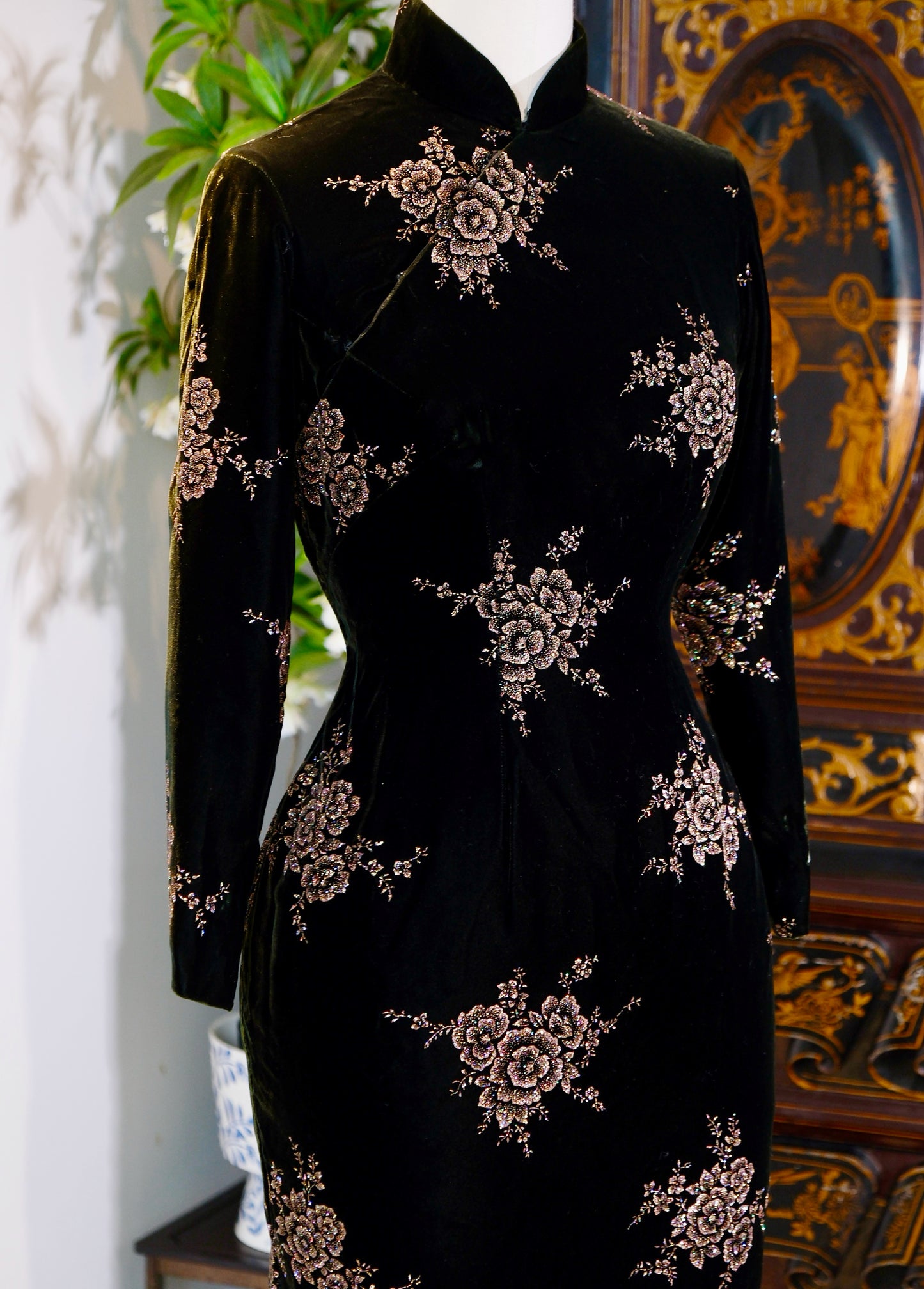
- 图案意象:衣身上散落着数朵盛开的牡丹或月季,花团锦簇,枝叶舒展。这些花卉并非写实主义的复刻,而是经过艺术提炼的装饰性纹样,带有那个时代特有的西式审美影响——既有东方的婉约,又有西方的立体感。
- 工艺技法:匠人运用胶水或特制粘合剂在丝绒上勾勒出花卉轮廓,再 painstakingly 地撒上细碎的亮片与闪粉。这种技法使得花朵在光线下呈现出一种浮雕般的立体感和闪烁的流动感。随着穿着者的步履移动,光影在黑色绒面上跳跃,宛如“疏影横斜水清浅,暗香浮动月黄昏”的视觉化呈现。
二、宝岛风华:六十年代台湾旗袍的黄金时代
这件旗袍的产地——台湾,为我们解读其背后的故事提供了重要的历史坐标。
大时代的迁徙与融合:
1949年前后,随着大量大陆移民迁台,包括上海在内的各地裁缝大师也将精湛的旗袍制作技艺带到了台湾。六十年代,正是台湾旗袍发展的鼎盛时期。这一时期的台湾旗袍,既保留了海派旗袍的精致剪裁,又融入了台湾本土的审美情趣与气候适应性改良。
名媛闺阁的珍藏:
在那个年代,拥有一件金丝绒手绘旗袍,是身份与地位的象征。它极有可能诞生于台北中山北路某家隐秘而高级的裁缝店,曾在一位名门闺秀或外交官夫人的衣橱中占据一席之地。它见证了那个时代台湾上流社会的觥筹交错,也聆听过无数关于家国、关于爱恨的深夜低语。
三、艺术风格与稀缺性:穿在身上的孤品
从服装史的角度来看,这件旗袍具有极高的研究价值与收藏价值。
中西合璧的艺术风格:
- 剪裁:它沿袭了六十年代经典的修身剪裁,强调女性的S型曲线,立领端庄,长袖优雅。这种剪裁摒弃了早期的繁复装饰,转而追求线条的流畅与面料的质感,体现了现代主义的萌芽。
- 装饰:手绘亮片工艺则带有Art Deco(装饰艺术)风格的遗韵,强调几何感与光泽感,却又用东方的花卉题材进行了本土化转译。
不可复制的稀缺性:
- 面料的易损性:金丝绒面料娇贵,难以保存,且亮片手绘工艺极易脱落。能历经半个多世纪依然保持绒面完整、亮片闪烁,实属凤毛麟角。
- 工艺的绝响:随着工业化成衣的普及,这种费时费力、完全依赖匠人手工绘制的手艺已近乎失传。每一件存世的古董手绘旗袍,都是孤品,世间再无第二件与之完全相同。
结语
这件金丝绒亮片手绘旗袍,如同一首写在黑色天鹅绒上的十四行诗。它不仅仅是一件衣服,它是六十年代台湾风华的缩影,是传统手工艺与现代审美碰撞的火花。
当您凝视它时,看到的不仅是那黑色绒面上熠熠生辉的花朵,更是那个回不去的黄金时代,以及那份独属于东方女性的、内敛而奢华的优雅。
Measurements / Size Guide:
Bust / Waist / Hips: 88/76/96 cm
Total Length: 130 cm
Detailed Description:
When the fingertips touch this velvet cheongsam (qipao) produced in Taiwan during the 1960s, that delicate yet substantial texture seems to instantly transport one back to an era of transition—a time of incomparable elegance. This is more than a garment; it is a sealed fragment of history, an exquisite footnote to the beauty of the Eastern woman.
The most captivating aspect of this cheongsam lies in the perfect symbiosis between its fabric and its patterns.
The Profound Base of Gilded Velvet: The entire garment utilizes noble black "gilded velvet" as its foundation. Velvet, a fabric inherently possessing an aristocratic aura, was the very definition of luxury in the 1960s. It absorbs all surrounding light, presenting a "midnight" shade—deep, quiet, and ink-like. This blackness is not meant to be somber; rather, it exists to accentuate the radiance upon it.
Hand-Painted Blossoms with Sequins and Glitter: If the velvet is the night, then the patterns are the stars across the sky. Unlike traditional machine-woven jacquard or Suzhou embroidery, this piece employs the exceedingly rare and time-consuming "hand-painted sequin and glitter" technique.
Visual Imagery: Clusters of blooming peonies or roses are scattered across the body, with lush petals and stretching leaves. These are not realistic replicas but artistically refined decorative motifs, bearing the influence of the Western aesthetic of that era—blending Eastern gentleness with Western three-dimensionality.
Technical Artistry: Artisans used glue or specialized adhesives to sketch the outlines of the flowers on the velvet, then painstakingly applied fine sequins and glitter. This technique gives the flowers a relief-like depth and a shimmering fluidity under light. As the wearer moves, light and shadow dance across the black velvet, creating a visualization of the classic poetic line: "Sparse shadows slant across clear, shallow water; a dim fragrance floats in the moonlight at dusk."
The origin of this piece—Taiwan—provides a vital historical coordinate for interpreting the story behind it.
Migration and Fusion of a Great Era: Around 1949, as a large wave of immigrants moved to Taiwan, master tailors from various regions—including Shanghai—brought their exquisite qipao-making skills to the island. The 1960s marked the peak of cheongsam development in Taiwan. During this period, the Taiwanese cheongsam retained the precise tailoring of the Shanghainese style while integrating local aesthetic tastes and modifications for the subtropical climate.
Treasures of the Socialite’s Wardrobe: In that era, owning a hand-painted velvet cheongsam was a symbol of status and prestige. It likely originated from a discreet, high-end tailor shop on North Chungshan Road in Taipei, occupying a place of honor in the closet of a prominent socialite or a diplomat’s wife. It witnessed the clinking glasses of Taiwan’s high society and listened to midnight whispers of family, nation, love, and loss.
From the perspective of fashion history, this cheongsam possesses immense research and collection value.
A Fusion of East and West:
Tailoring: It follows the classic slim-fit tailoring of the 1960s, emphasizing the feminine S-curve, with a dignified standing collar and elegant long sleeves. This silhouette discarded earlier complex decorations in favor of fluid lines and fabric texture, reflecting the early buds of modernism.
Decoration: The hand-painted sequin craft carries the lingering charm of Art Deco, emphasizing geometry and luster, yet it localizes these traits through traditional Eastern floral themes.
Irreplaceable Scarcity:
Fragility of Fabric: Velvet is delicate and difficult to preserve, and the hand-painted sequins are prone to falling off. It is exceptionally rare to find a piece that remains intact with shimmering sequins after more than half a century.
The Vanishing Craft: With the rise of industrialized ready-to-wear fashion, this labor-intensive craft—relying entirely on the artisan’s hand—has nearly vanished. Every surviving vintage hand-painted cheongsam is a unique piece; there is no second one in the world exactly like it.
This velvet hand-painted sequin cheongsam is like a sonnet written on black velvet. It is more than a dress; it is a microcosm of the 1960s Taiwanese splendor, a spark ignited by the collision of traditional craftsmanship and modern aesthetics.
When you gaze upon it, you see not only the brilliant flowers on the black velvet but also a golden age that cannot be returned to, and that reserved, luxurious elegance belonging uniquely to the Eastern woman.