深圳溯源
无法加载取货服务可用情况
衣服尺寸:
胸围/腰围/臀围:94/78/100 厘米
衣长:117 厘米
细节描述:
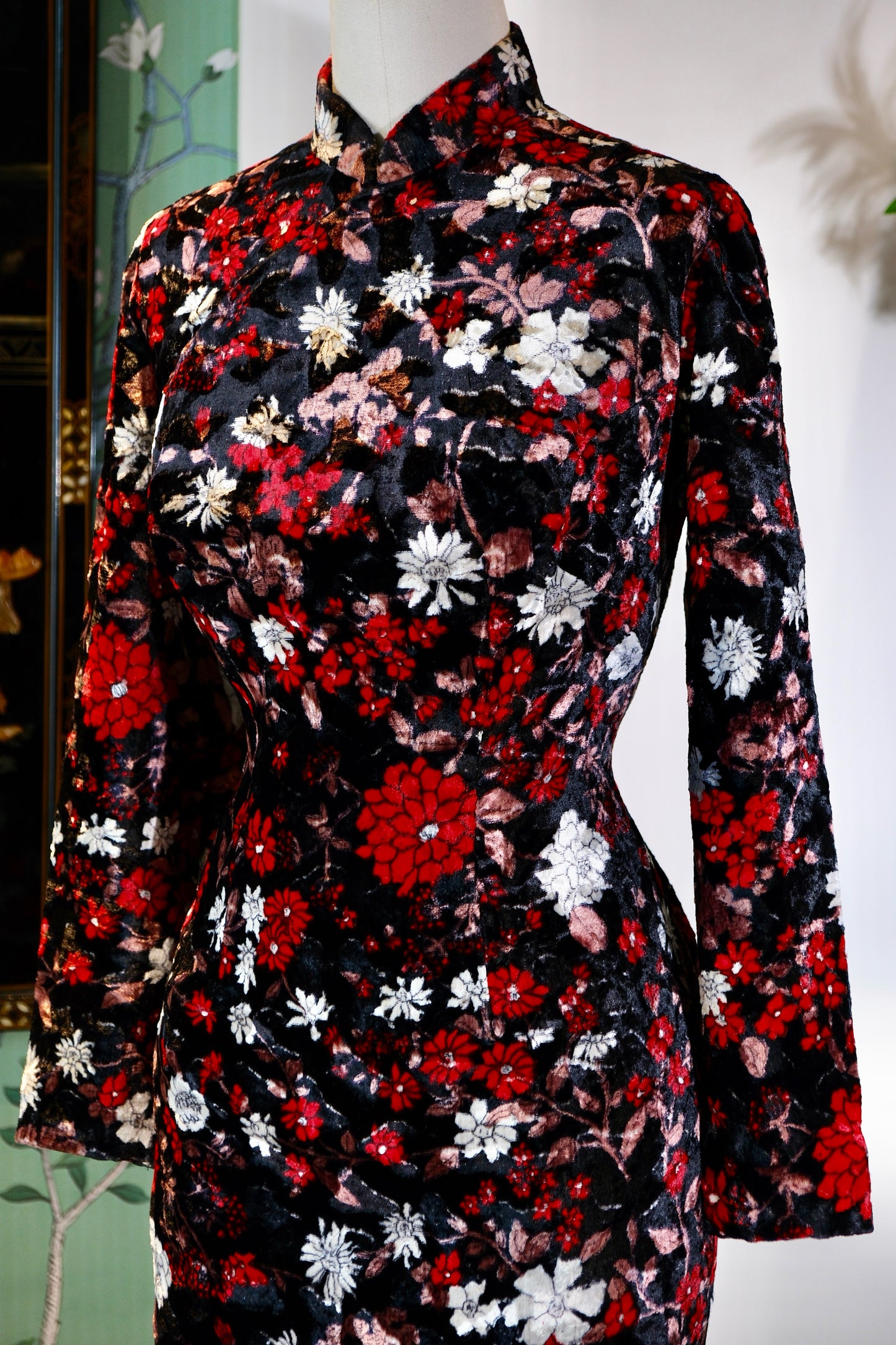
这件诞生于上世纪六十年代台湾的金丝绒旗袍,以墨色绒面为底,织就了一幅“墨底天香”的绮丽图景。金丝绒特有的柔光质感,如夜色般深邃温润,其上以红、白、浅粉三色牡丹为主调,间以赭石色枝叶穿插,形成“密不透风,疏可走马”的传统构图韵律。红色牡丹如朱砂点染,花瓣层叠处可见细微的金线勾边,暗合《考工记》“青与赤谓之文,赤与白谓之章”的设色古训;白色牡丹则以银线绣蕊,在光线下流转如月华,恰似唐人刘禹锡“唯有牡丹真国色,花开时节动京城”的意境再现。
图案中的牡丹并非写实摹绘,而是经艺术提炼的“折枝花卉”变体,花头大小错落,枝叶以曲线相连,形成“S”形视觉动线,暗合中国绘画“气韵生动”的美学追求。这种“锦上添花”的织造工艺,每寸面料需经数十道工序,其繁复程度堪比明代《天工开物》所载“寸锦寸金”的云锦织造,足见当时台湾纺织业对传统工艺的坚守与创新。
衣以载道:六十年代台湾旗袍的文化基因
1949年后,大量江浙沪裁缝随迁台湾,将海派旗袍的精致剪裁与江南刺绣技艺带入宝岛。这件旗袍的立领高度约4厘米,领口呈“如意”形微弧,既保留传统旗袍的含蓄,又通过收腰设计(腰围较胸围收窄8厘米)凸显女性曲线,正是六十年代台湾“改良旗袍”的典型特征——在西方审美冲击下,对东方美学的重新诠释。
据《台湾服饰志》记载,六十年代台湾金丝绒面料多依赖日本进口,而此件旗袍所用绒料却带有明显的上海“老正兴”绸庄特征:绒毛细密如粟,光泽内敛不浮,推测为迁台匠人沿用战前库存原料所制。这种“原料稀缺、工艺考究”的特质,使其成为研究两岸服饰文化交流的“活化石”。
时光的褶皱:古董旗袍的稀缺性叙事
在快时尚盛行的今天,一件保存完好的六十年代金丝绒旗袍已属凤毛麟角。其稀缺性不仅在于面料的不可复制——现代金丝绒多为化纤混纺,难以再现天然蚕丝绒的垂坠感与光泽度;更在于工艺的断代:传统提花织机已被电脑 Jacquard 取代,手工盘扣技艺传承者不足百人。正如艺术史家贡布里希所言:“艺术的本质在于不可重复性”,这件旗袍的每一处针脚、每一缕金线,都是特定时代工匠精神的凝结。
从文化价值而言,牡丹作为“花中之王”,在六十年代台湾的语境中,不仅是富贵吉祥的象征,更暗含了迁台群体对故土文化的眷恋与坚守。这件旗袍如同一件“穿在身上的历史”,将六十年代的时代风云、两岸的文化血脉,以及东方美学的永恒魅力,都封存在了墨色金丝绒的褶皱里,成为不可再生的艺术孤品。
Measurements / Size Guide:
Bust / Waist / Hips: 94/78/100 cm
Total Length: 117 cm
Detailed Description:
This golden velvet Qipao, born in 1960s Taiwan, uses an ink-black velvet base to weave a magnificent vision of "Heavenly Fragrance on an Ink Background." The unique soft-light texture of the golden velvet is as deep and warm as the night. Upon this canvas, red, white, and pale pink peonies serve as the main theme, interspersed with ochre-colored branches and leaves, creating a traditional compositional rhythm of "dense enough to block the wind, yet sparse enough to allow a horse to gallop through." The red peonies appear as if touched by cinnabar; at the layers of the petals, fine gold-thread edging is visible, subtly aligning with the ancient coloring precept from the Record of Trades (Kao Gong Ji): "The combination of green and red is called Wen (pattern); the combination of red and white is called Zhang (composition)." The white peonies feature silver-threaded stamens that shimmer like moonlight, vividly recreating the mood of the Tang Dynasty poet Liu Yuxi: "Only the peony is truly the nation’s color; its blooming moves the capital city."
The peonies in the pattern are not realistic depictions but are artistic refinements of "broken-branch flower" (Zhezhi Huahui) variations. The flower heads vary in size and are connected by curving stems, forming an "S-shaped" visual line that aligns with the aesthetic pursuit of "rhythmic vitality" (Qiyun Shendong) in Chinese painting. This "adding flowers to brocade" weaving process requires dozens of steps for every inch of fabric, with a complexity comparable to the "inch of brocade, inch of gold" Yunjin weaving recorded in the Ming Dynasty's The Exploitation of the Works of Nature (Tiangong Kaiwu). This stands as a testament to the persistence and innovation of traditional craftsmanship in Taiwan's textile industry at the time.
After 1949, a large number of tailors from Jiangsu, Zhejiang, and Shanghai migrated to Taiwan, bringing the exquisite tailoring of the Shanghai style and the embroidery skills of Jiangnan to the island. This Qipao features a standing collar approximately 4 cm high, with a "Ruyi" shaped micro-arc at the neckline, preserving traditional modesty while highlighting the female curve through a cinched waist (narrowed by 8 cm compared to the bust). This is a typical feature of the "Modified Qipao" in 1960s Taiwan—a reinterpretation of Oriental aesthetics under the impact of Western styles.
According to the Records of Taiwanese Fashion, golden velvet fabrics in 1960s Taiwan were mostly dependent on Japanese imports. However, the velvet used in this piece bears the distinct characteristics of Shanghai's "Lao Zheng Xing" silk house: the pile is as dense as millet, with an introverted, non-superficial luster. This suggests it was crafted by a migrant artisan using pre-war inventory materials. This quality of "scarce raw materials and sophisticated craftsmanship" makes it a "living fossil" for studying the cultural exchange of dress between the two sides of the strait.
In today’s era of fast fashion, a well-preserved 1960s golden velvet Qipao is a true rarity. Its scarcity lies not only in the irreproducibility of the fabric—modern golden velvet is mostly synthetic blends, making it difficult to recreate the drape and luster of natural silk velvet—but also in the generational break in craftsmanship. Traditional Jacquard looms have been replaced by computerized ones, and fewer than a hundred practitioners of the hand-made "Pankou" (frog button) skill remain. As the art historian E.H. Gombrich said: "The essence of art lies in its non-repeatability." Every stitch and every strand of gold thread in this Qipao is a condensation of the artisan spirit of a specific era.
In terms of cultural value, the peony, as the "King of Flowers," was not only a symbol of wealth and auspiciousness in the context of 1960s Taiwan but also implied a nostalgic attachment to ancestral culture among the migrant community. This Qipao is like "history worn on the body," sealing the era's winds, the cultural bloodlines of both sides of the strait, and the eternal charm of Oriental aesthetics within the folds of the ink-colored golden velvet, becoming an irreplaceable artistic masterpiece.