深圳溯源
无法加载取货服务可用情况
如果说之前的薄荷绿旗袍是Woo女士在温哥华夏日午后的“
一、视觉的诗篇:哑光质感与“留白”的艺术
这件旗袍最摄人心魄的,
- 色彩与面料:通体采用纯粹的黑色,这种黑并非死寂,
- 剪裁与细节:
- 无袖与立领:经典的无袖设计,
- 修身廓形:修身的剪裁完美贴合身形,勾勒出女性的曲线美,
二、衣以载道:香港裁缝的“静奢”哲学
这件旗袍,是Woo女士“衣以载道”理念的又一次完美体现。
我们可以想象,在六十年代的一个夜晚,
这件旗袍,是Woo女士衣橱中最“静谧”的一件,
If the previously detailed mint-green qipao was Ms. Woo’s "fresh lyric poem" on a Vancouver summer afternoon, then this pure black, imported Italian linen qipao is her private "quiet nocturne" amid the city lights at dusk. Free from complex iconography and loud pigments, it employs a near-Zen minimalism and absolute restraint to interpret the most powerful facet of the "Quiet Luxury" (Jingshe) aesthetic in a 1960s elite wardrobe—low-key, inward-facing, yet whispering of undeniable command and peerless taste in every single thread.
The most spellbinding quality of this piece is the deep, nocturnal matte texture of its material, offering a canvas of pure, unadulterated minimalist space:
The Depth of Black: Enveloped entirely in a singular, absolute black, the tone avoids looking flat or lifeless. Instead, like the deep expanse of the night sky, it carries an undercurrent of infinite possibility.
The Material Choice: The garment is crafted from top-tier, imported Italian linen, a textile globally celebrated for its organic slub texture, breathability, and structure. Under shifting light, the natural linen fibers cast a microscopic, sophisticated sheen that is neither reflective nor dull, offering a beautifully grounded tactility. Selecting linen for a formal silhouette reinforces Ms. Woo’s uncompromising pursuit of comfort—ensuring that even in high-stakes environments, she remained physically at ease.
Silhouettes and Accents:
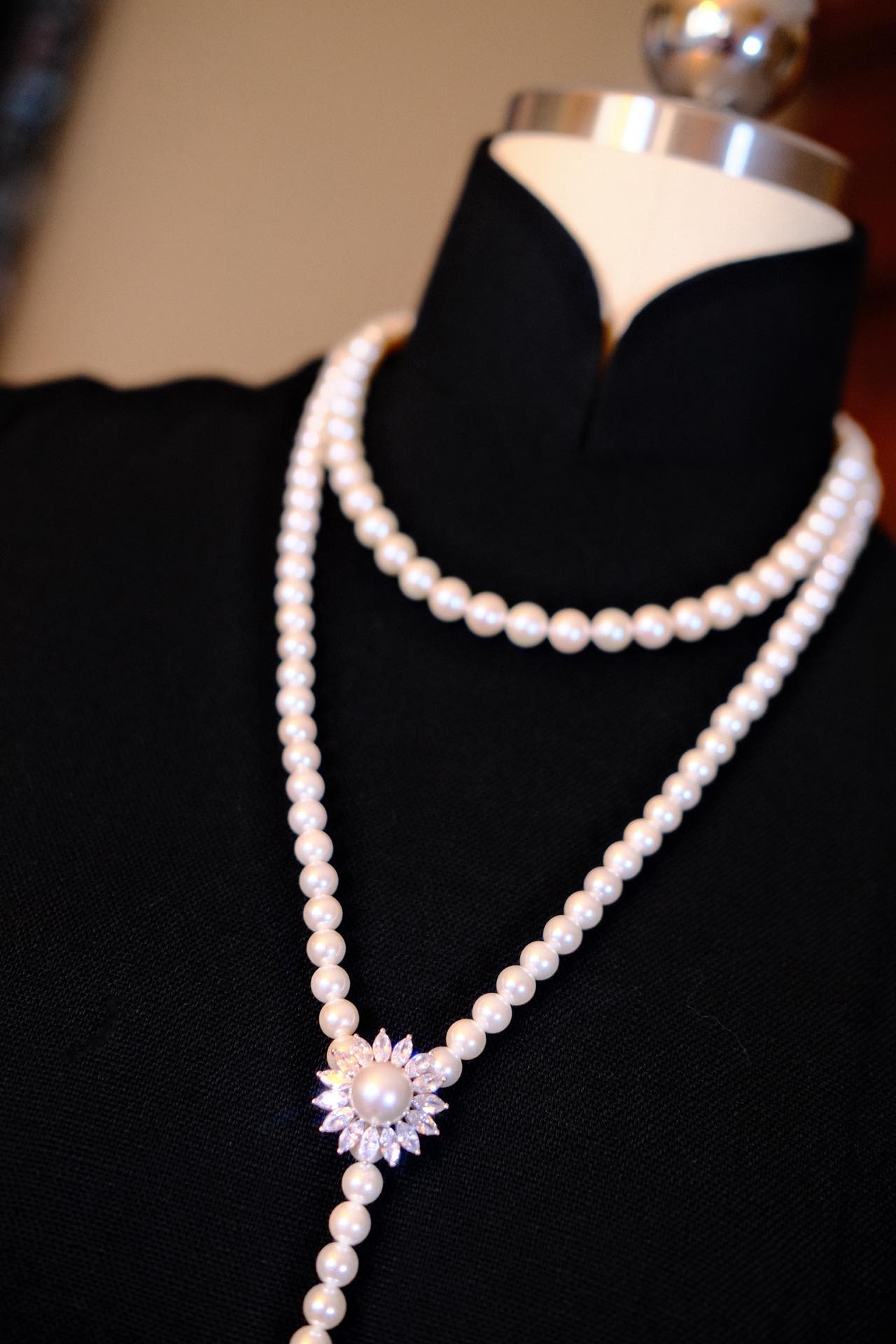
The Lines: The classic sleeveless cut cleanly articulates the shoulders and necklines. It is balanced by a standard-height mandarin collar, accented by an integrated double-strand pearl necklace. The warm, milky luminescence of the pearls against the abyssal backdrop of the black linen establishes a breathtaking visual equilibrium—sharp, executive, yet deeply elegant.
The Contour: The sleek, form-fitting tailoring closely shadows the body’s natural lines, punctuated by subtle side slits that offer effortless movement and grace with every step.
This qipao is another sublime manifestation of Ms. Woo’s philosophy of bridging global narratives through custom attire. As an astute corporate pioneer, she possessed the clarity to scout elite materials across continents; as a woman who mastered the art of living, she knew precisely how to leverage the specialized skills of Hong Kong's master couturiers to shape raw material into highly personal armor.
One can easily picture a mid-century evening: Ms. Woo standing on a Vancouver terrace draped in this midnight-black linen silhouette, holding a glass of wine. As the evening breeze sweeps past, the natural slubs of the woven linen catch the moonlight, casting soft, rich textures. She was not merely wearing a garment; she was inhabiting a lifestyle—one that seamlessly synthesized Eastern elegance with Western modernism.
This qipao remains the most serene artifact in Ms. Woo's archive. It documents a modern woman's rare moments of absolute stillness and composure away from a demanding executive schedule. It is more than an attire; it is a wearable manifesto of personal taste, remaining a timeless testament to quiet luxury that refuses to fade with the passage of time.
From a textile conservation and fashion history perspective, this gown represents a milestone in the history of mid-century design:
The Rarity of Luxury Linen Qipaos: Historically, formal evening qipaos from the 1960s were overwhelmingly made of heavy silk brocades, satins, or velvet. Utilizing premium imported Italian linen—a material traditionally categorized under Western casual luxury resort wear—for a tightly structured, high-collared Eastern silhouette is an extraordinary archival anomaly.
The Mastery of Flax Manipulation: Linen is notoriously prone to severe creasing and lacks the natural elasticity of silk or wool. Tailoring pure flax linen into a razor-sharp, custom-contoured fit through the torso without puckering or pulling at the seams required unparalleled cutting precision. It stands as an exceptional record of how Hong Kong's post-war tailors manipulated non-traditional textiles.
The Aesthetics of De-Ornamentation: Finding a 1960s formal garment that completely rejects embroidery, prints, or closure embellishments in favor of pure form and texture documents the exact historical moment when elite diasporic Chinese women embraced international modernist design doctrines—prioritizing the wearer's tactile experience over public display.