深圳溯源
无法加载取货服务可用情况
衣服尺寸:
胸围/腰围/臀围:90/72/96 厘米
衣长:100 厘米
细节描述:
一、图案解构:流动的文艺复兴
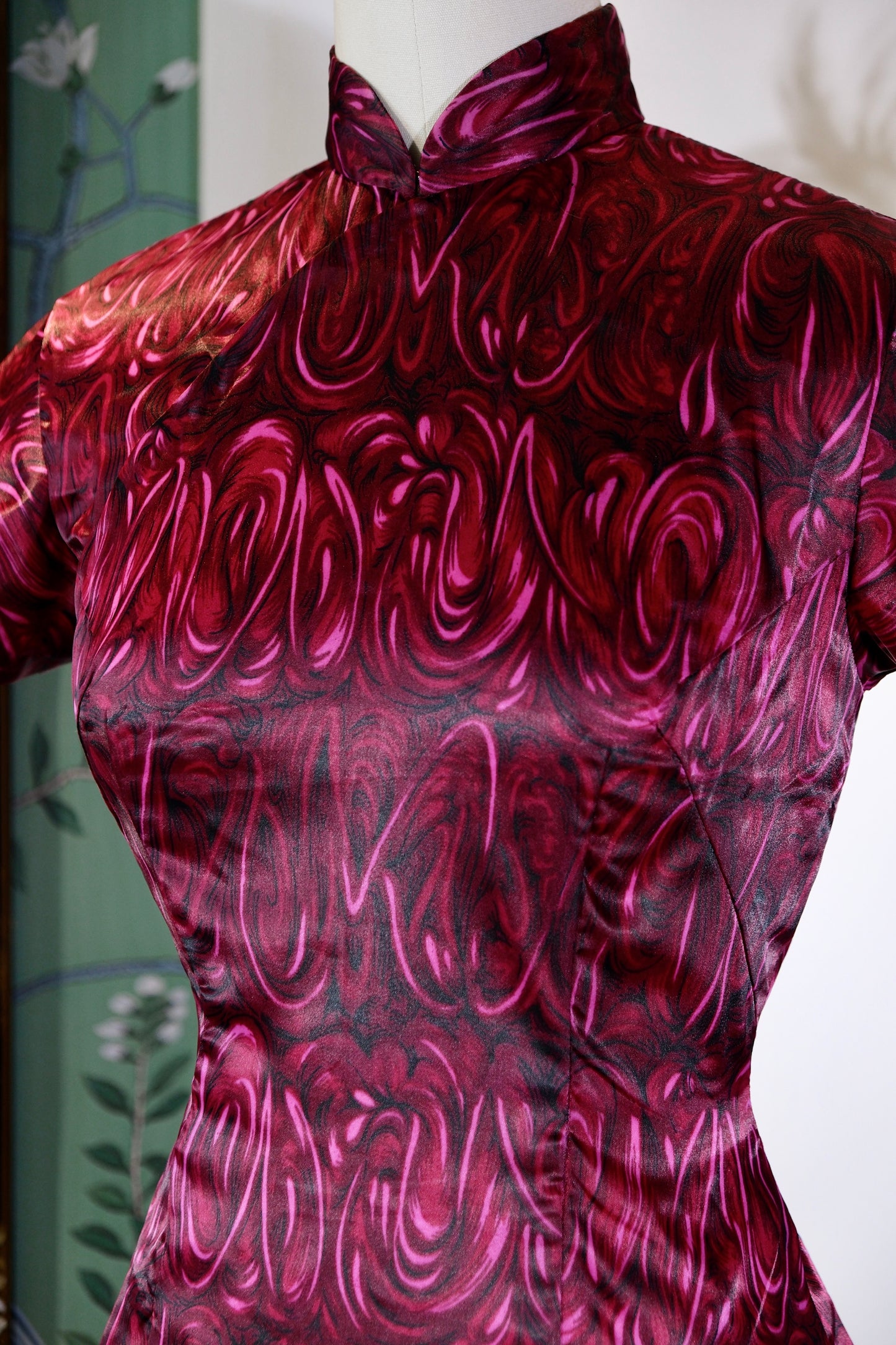
这件旗袍的面料纹样,堪称20世纪60年代意大利抽象艺术的织物化呈现。其图案以深酒红为基底,交织着粉紫与暗金的流动线条,似大理石纹的自然肌理,又如液态金属的凝固瞬间。这种“晕染式抽象”并非具象的花鸟鱼虫,而是通过色彩的渐变与线条的律动,构建出一种“无形的诗意”。
意大利面料设计师彼时正从未来主义与抽象表现主义中汲取灵感,将画布上的笔触转化为织物上的视觉韵律。图案中蜿蜒的曲线既像巴洛克建筑的浮雕纹样,又暗合东方水墨的写意精神,形成东西方美学的微妙对话。这种纹样在60年代的意大利高级时装中偶有出现,但应用于香港旗袍则极为罕见,堪称“跨文化设计的孤本”。
二、历史叙事:香港制造的黄金时代
20世纪60年代的香港,正处于旗袍制作的鼎盛时期。彼时,东西方文化在此交汇,香港裁缝以精湛技艺融合西方立体剪裁与东方传统形制,创造出兼具修身曲线与东方韵味的“海派旗袍”变体。而这件旗袍的独特之处,在于其面料的“全球化基因”——意大利进口的抽象印花面料,经由香港工匠之手,转化为承载东方女性体态的载体。
据《香港纺织业史》记载,60年代香港高端旗袍作坊常从意大利科莫湖地区进口手工印花面料,这类面料因成本高昂,多用于定制礼服。而这件旗袍的廓形(立领、短袖、收腰、及膝下摆)恰是60年代香港中产女性日常着装的典型,既保留了传统旗袍的含蓄,又通过修身剪裁彰显现代女性的独立气质。其稀缺性在于:意大利抽象印花面料与香港本土旗袍工艺的结合,在全球现存古董旗袍中不足百件,且多藏于博物馆或私人藏家手中。
三、艺术风格:跨文化的视觉诗学
从艺术史维度看,这件旗袍的图案可追溯至意大利“空间主义”(Spazialismo)运动。该运动主张打破传统绘画的平面性,通过色彩与线条的流动感营造“空间张力”。面料上的纹样恰似卢西奥·丰塔纳(Lucio Fontana)的“割破画布”系列在织物上的延伸,以抽象线条切割视觉空间,赋予静态面料动态的视觉冲击。
而旗袍本身的形制,则是东方“身体美学”的具象化。其收腰设计强调女性曲线,暗合60年代西方“New Look”的审美潮流;而高立领与短袖则保留了传统旗袍的含蓄,形成“现代性”与“传统性”的微妙平衡。这种跨文化的艺术融合,使这件旗袍超越了服饰本身,成为20世纪中叶全球化背景下“东西方对话”的物质见证。
四、稀缺性:时间的孤本
在全球古董旗袍收藏领域,60年代香港产的意大利抽象印花旗袍堪称“金字塔尖”的存在。其稀缺性体现在三方面:
- 面料稀缺:60年代意大利手工印花面料产量有限,且多用于高级定制,留存至今的完整面料已极为罕见。
- 工艺稀缺:香港老裁缝的立体剪裁技艺(如“归拔”工艺)需数十年经验积累,当代已难复制。
- 历史稀缺:60年代香港旗袍的“中西合璧”风格,在全球化加速的今天,已成为不可再生的文化符号。
正如艺术史学家贡布里希所言:“艺术品是时代的镜子。”这件旗袍不仅是一件衣物,更是一段被织物封存的时光——它见证了意大利抽象艺术的织物化实验,记录了香港制造的黄金时代,更承载了东西方文化碰撞的璀璨火花。在快时尚泛滥的今天,这样的“时间孤本”,无疑是收藏家与艺术爱好者不可多得的瑰宝。
Measurements / Size Guide:
Bust / Waist / Hips: 90/72/96 cm
Total Length: 100 cm
Detailed Description:
The fabric motif of this qipao serves as a textile manifestation of 1960s Italian abstract art. Set against a deep burgundy base, fluid lines of powdery purple and dark gold intertwine, resembling the natural veins of marble or the frozen ripples of liquid metal. This "blurred abstraction" eschews concrete subjects like birds or flowers, instead constructing an "invisible poetics" through color gradients and rhythmic linework.
Italian textile designers of the era drew inspiration from Futurism and Abstract Expressionism, translating painterly brushstrokes into visual rhythms on fabric. The winding curves echo the relief patterns of Baroque architecture while aligning with the freehand spirit of Eastern ink wash painting, creating a subtle dialogue between East and West. While such motifs appeared occasionally in 1960s Italian haute couture, their application in Hong Kong qipaos is exceptionally rare, making this a "sole copy of cross-cultural design."
The 1960s marked the pinnacle of qipao craftsmanship in Hong Kong. As a melting pot of Eastern and Western cultures, Hong Kong tailors used exquisite skills to fuse Western 3D draping with traditional Eastern forms, creating a variant of the "Shanghai-style" qipao that balanced feminine curves with Oriental charm. The uniqueness of this piece lies in its "globalized DNA"—imported Italian abstract print fabric transformed by Hong Kong artisans into a vessel for the Eastern female form.
According to the History of the Hong Kong Textile Industry, high-end workshops in the 1960s frequently imported hand-printed fabrics from Italy’s Lake Como region; due to their exorbitant cost, these were typically reserved for bespoke gowns. The silhouette of this qipao—standing collar, short sleeves, cinched waist, and knee-length hem—is typical of 1960s Hong Kong middle-class attire, preserving traditional modesty while asserting modern independence. Its scarcity is undeniable: fewer than a hundred extant antique qipaos globally feature this combination of Italian abstraction and Hong Kong craftsmanship, most being held in museums or private collections.
From an art history perspective, the pattern traces back to the Italian "Spatialism" (Spazialismo) movement. This movement advocated for breaking the flatness of traditional painting, using the flow of color and line to create "spatial tension." The motif on the fabric acts as an extension of Lucio Fontana’s "Concetto Spaziale" series, slicing through visual space with abstract lines to grant a dynamic impact to static fabric.
The qipao's construction itself is an embodiment of Eastern "body aesthetics." The cinched waist emphasizes the "S-curve," echoing the Western "New Look" trend of the 1960s, while the high collar and short sleeves retain traditional reserve. This cross-cultural fusion elevates the garment beyond mere clothing, making it a material witness to the "East-West dialogue" amidst mid-20th-century globalization.
In the realm of global antique qipao collecting, 1960s Hong Kong-made Italian abstract prints represent the "pinnacle of the pyramid." Their scarcity is defined by three dimensions:
Fabric Scarcity: 1960s Italian hand-printed fabrics were produced in limited quantities for haute couture; intact specimens are now extremely rare.
Craft Scarcity: The 3D tailoring techniques of old Hong Kong tailors (such as the "Gui-Ba" shaping method) required decades of experience and are nearly impossible to replicate today.
Historical Scarcity: The "East-meets-West" style of 1960s Hong Kong has become a non-renewable cultural symbol in our era of accelerating globalization.
As art historian E.H. Gombrich noted: "Art is a mirror of its time." This qipao is not just a garment but a segment of time sealed in textile—it witnessed the experiment of Italian abstract art in fabric, recorded the golden age of Hong Kong manufacturing, and carries the brilliant sparks of cultural collision.