深圳溯源
无法加载取货服务可用情况
衣服尺寸:
胸围/腰围/臀围:104/98/110 厘米
衣长:126 厘米
细节描述:
图案描述:笔尖绽放的东方花事
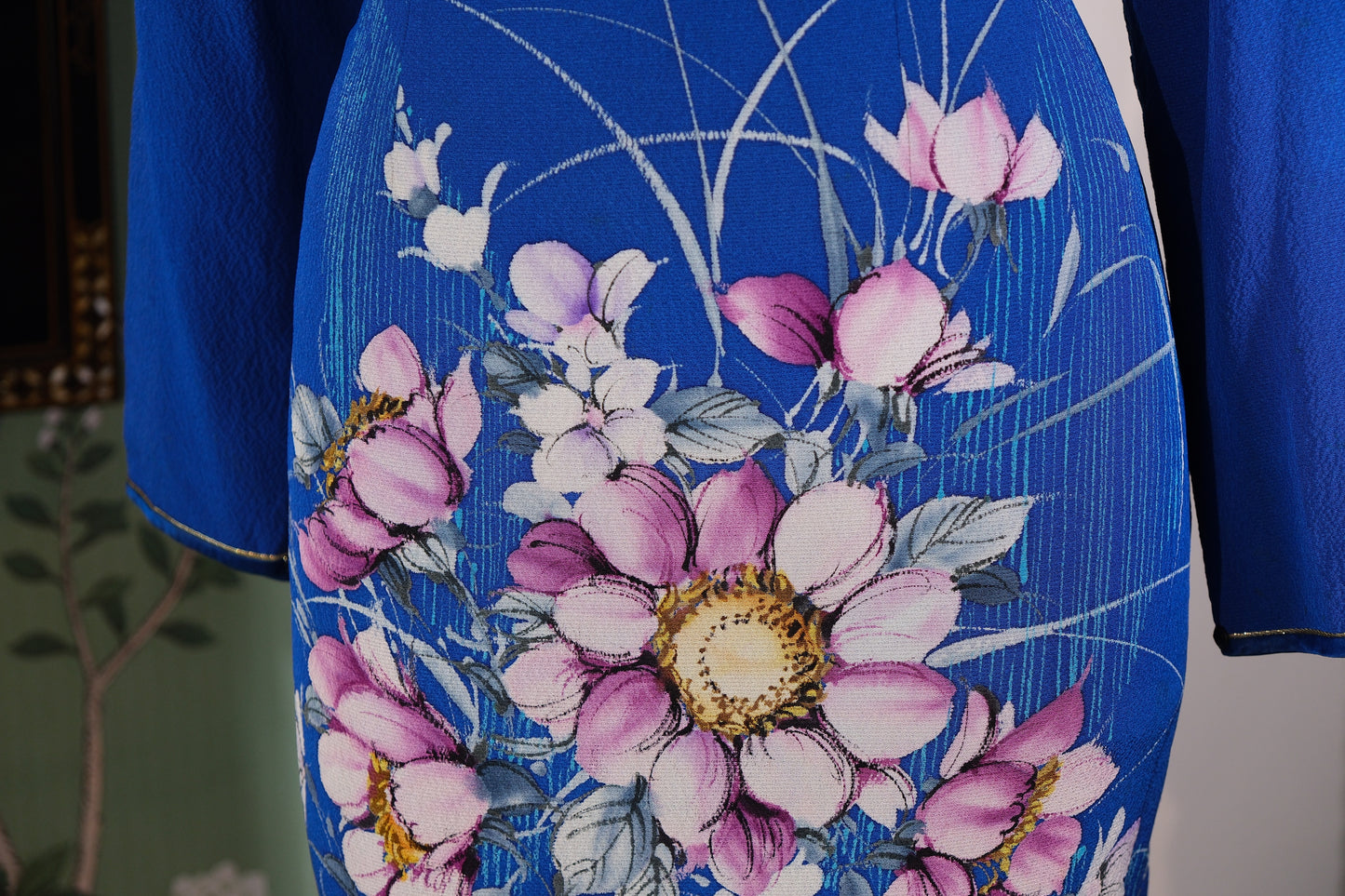
这件六十年代香港产的旗袍,其艺术灵魂凝聚于裙摆至腰际的手绘花丛。图案以传统工笔技法晕染,主体为数朵盛放的牡丹与含苞的玉兰,花瓣以粉紫、淡粉渐变晕染,花蕊则以金线勾勒,透出富贵雍容之气;枝叶以青绿、灰蓝细笔描摹,叶脉清晰如生,间杂几缕银线勾边的兰草,似随风轻曳。
背景以细密的浅蓝竖纹铺陈,如雨后初霁的天空,与花朵的明艳形成虚实相生的意境。这种“花团锦簇而不俗,枝叶扶疏而有序”的构图,深谙中国传统花鸟画“疏可走马,密不透风”的章法,既显蓬勃生机,又含文人雅趣。
古董故事:香江衣坊里的时光印记
上世纪六十年代的香港,是东西方文化碰撞的熔炉,亦是旗袍工艺的“黄金末班车”。彼时,内地传统手工艺南迁,香港衣坊汇聚了苏绣、京绣、手绘等各路匠人。这件旗袍的主人,或许是一位出身书香门第的闺秀,或是商界新贵的夫人——她既向往西式生活的便利,又难舍东方美学的温婉。
衣坊师傅以“一人一版”的量体裁衣方式,选用当时罕见的进口提花绸为底料,再邀画师以矿物颜料逐笔手绘。据《香港服饰史》记载,六十年代手绘旗袍需经“勾线、晕染、固色”三道工序,耗时半月有余,一件成衣的价格相当于普通职员月薪。这种“衣以载道”的制作,让旗袍不仅是蔽体之物,更成为身份与品味的象征。
艺术风格:传统与现代的优雅共振
从服装史视角看,这件旗袍体现了六十年代香港旗袍的“改良基因”:
- 廓形革新:保留传统旗袍的立领、斜襟,但收腰更贴合人体曲线,裙摆略放宽,行动间多了几分现代女性的洒脱。
- 色彩突破:以饱和度极高的宝蓝色为底,打破传统旗袍“素雅为主”的桎梏,呼应六十年代全球流行的“波普色彩”风潮,却以手绘花卉回归东方意境,形成“艳而不俗,丽而有韵”的视觉张力。
- 工艺融合:手绘图案与提花面料的结合,是“锦上添花”的具象化。面料本身的暗纹如流水,手绘花朵似浮于水面,光影流转间,恰如宋代词人晏几道笔下“落花人独立,微雨燕双飞”的诗意场景。
稀缺性:不可复制的时代孤品
在工业化制衣普及的今天,手绘旗袍的稀缺性源于三重“不可复制”:
- 匠人绝响:六十年代手绘旗袍的画师多师承清末民初的宫廷画工,如今这类兼具绘画功底与服饰审美的人才几近绝迹。
- 材料断代:当时使用的进口提花绸与矿物颜料,因环保与成本原因已停产,现存面料多随岁月氧化,如此件般色彩鲜亮者凤毛麟角。
- 时代语境:这件旗袍诞生于香港“前工业化”时期,承载着战后移民文化、中西审美交融的独特记忆,是研究二十世纪东亚服饰变迁的“活化石”。
结语:穿在身上的历史诗行
这件旗袍,是六十年代香江烟云的缩影:宝蓝色是维多利亚港的夜空,手绘花朵是太平山顶的晨露,收腰剪裁是时代女性的觉醒。它不仅是衣物,更是一段凝固的历史,一首穿在身上的诗——当指尖抚过那晕染的花瓣,仿佛能听见半个世纪前衣坊里的剪刀声、画师的低语,以及一位女子穿着它走过石板路时,裙摆与风私语的轻响。
正如《长物志》所言:“物有本末,事有终始,知所先后,则近道矣。”这件旗袍的“道”,在于它以衣为媒,让我们得以触摸一个时代的美学温度,感受传统工艺在岁月长河中的不朽光芒。
Measurements / Size Guide:
Bust / Waist / Hips: 104/98/110 cm
Total Length: 126 cm
Detailed Description:
The artistic soul of this 1960s Hong Kong-made qipao is concentrated in the hand-painted flower cluster stretching from the hem to the waist. Using traditional Gongbi (fine-brush) techniques, the main motifs feature blooming peonies and budding magnolias. The petals are rendered in gradients of purplish-pink and pale rose, with stamens outlined in gold thread to exude an air of opulence and elegance. The branches and leaves are depicted with meticulous strokes in verdant green and ash blue, showing lifelike veins, interspersed with a few blades of orchid grass outlined in silver thread that seem to sway gently in the breeze.
The background is laid out with fine light-blue vertical pinstripes, resembling the sky after a fresh rain, creating a realm where the vividness of the flowers and the serenity of the base coexist in harmony. This composition—"abundant without being gaudy, sparse yet orderly"—deeply understands the traditional Chinese bird-and-flower painting principle of "leaving enough space for a horse to run, yet being dense enough to block the wind." It showcases both vibrant vitality and literati charm.
In the 1960s, Hong Kong was a melting pot of Eastern and Western cultures and represented the "final golden flight" of qipao craftsmanship. During this period, traditional artisans migrated south to Hong Kong, bringing together experts in Suzhou embroidery, Beijing embroidery, and hand-painting. The owner of this qipao might have been a lady from a scholarly family or the wife of a rising business tycoon—someone who yearned for the convenience of a Western lifestyle but could not part with the gentle grace of Oriental aesthetics.
Workshop masters used the "one person, one pattern" bespoke method, selecting the rare imported jacquard silk of the era as the base, then inviting painters to apply mineral pigments stroke by stroke. According to the History of Hong Kong Costume, a hand-painted qipao in the 1960s required three stages: "outlining, gradient shading, and color fixing," taking over half a month to complete. The price of such a garment was equivalent to a month's salary for an average clerk. This "garment as a vessel of the Way" approach ensured the qipao was not just clothing, but a symbol of status and taste.
From the perspective of costume history, this qipao embodies the "reformed genes" of 1960s Hong Kong fashion:
Structural Innovation: While retaining the traditional standing collar and diagonal placket, the waist is more closely fitted to the human curve, and the hem is slightly widened, adding a touch of modern female independence to her movements.
Color Breakthrough: Using a highly saturated royal blue as the base breaks the shackles of traditional "plain and elegant" qipaos. It echoes the global "Pop Art color" trend of the 1960s while returning to an Oriental mood through hand-painted flora, creating a visual tension that is "vivid but not vulgar, beautiful but rhythmic."
Craft Fusion: The combination of hand-painted patterns and jacquard fabric is the personification of "adding flowers to the brocade." The fabric's own dark ripples resemble flowing water, while the hand-painted flowers seem to float on the surface. As light and shadow shift, it evokes the poetic scene from Song Dynasty poet Yan Jidao: "The fallen flowers remain as the person stands alone; the light rain falls as swallows fly in pairs."
In today’s era of popularized industrial garment making, the scarcity of hand-painted qipaos stems from a triple "irreproducibility":
The Vanishing Artisans: Painters of 1960s hand-painted qipaos mostly apprenticed under court painters from the late Qing and early Republican periods. Today, talents possessing both painting foundations and sartorial aesthetics are nearly extinct.
Disconnected Materials: The imported jacquard silk and mineral pigments used at the time have ceased production due to environmental and cost concerns. Most existing fabrics have oxidized with time; finding a piece with colors as bright as this is as rare as "phoenix feathers and unicorn horns."
Historical Context: This qipao was born during Hong Kong's "pre-industrialization" period, carrying unique memories of post-war migrant culture and the fusion of Sino-Western aesthetics. It is a "living fossil" for studying the evolution of 20th-century East Asian costume.
Conclusion: Lines of History Worn on the Body This qipao is a microcosm of the 1960s Hong Kong mists: the royal blue is the night sky of Victoria Harbour, the hand-painted flowers are the morning dew of Victoria Peak, and the cinched waist is the awakening of the era's women. It is not just a garment, but solidified history—a poem worn on the body. When fingertips brush those shaded petals, it is as if one can hear the sound of scissors in the workshop half a century ago, the whispers of the painter, and the light echo of a woman's hem whispering to the wind as she walked across the cobblestones.
As stated in Zhang Wu Zhi: "All things have roots and branches, all affairs have beginnings and ends; knowing what comes first and what follows brings one close to the Way." The "Way" of this qipao lies in using clothing as a medium, allowing us to touch the aesthetic temperature of an era and feel the immortal glow of traditional craftsmanship in the long river of time.