暗夜繁花:一件六十年代花间道真丝夹棉套装的浮沉记
一、工艺:行走的东方织锦画卷
这套上衣与长裤的套装,其核心价值在于面料与细节的极致考究。
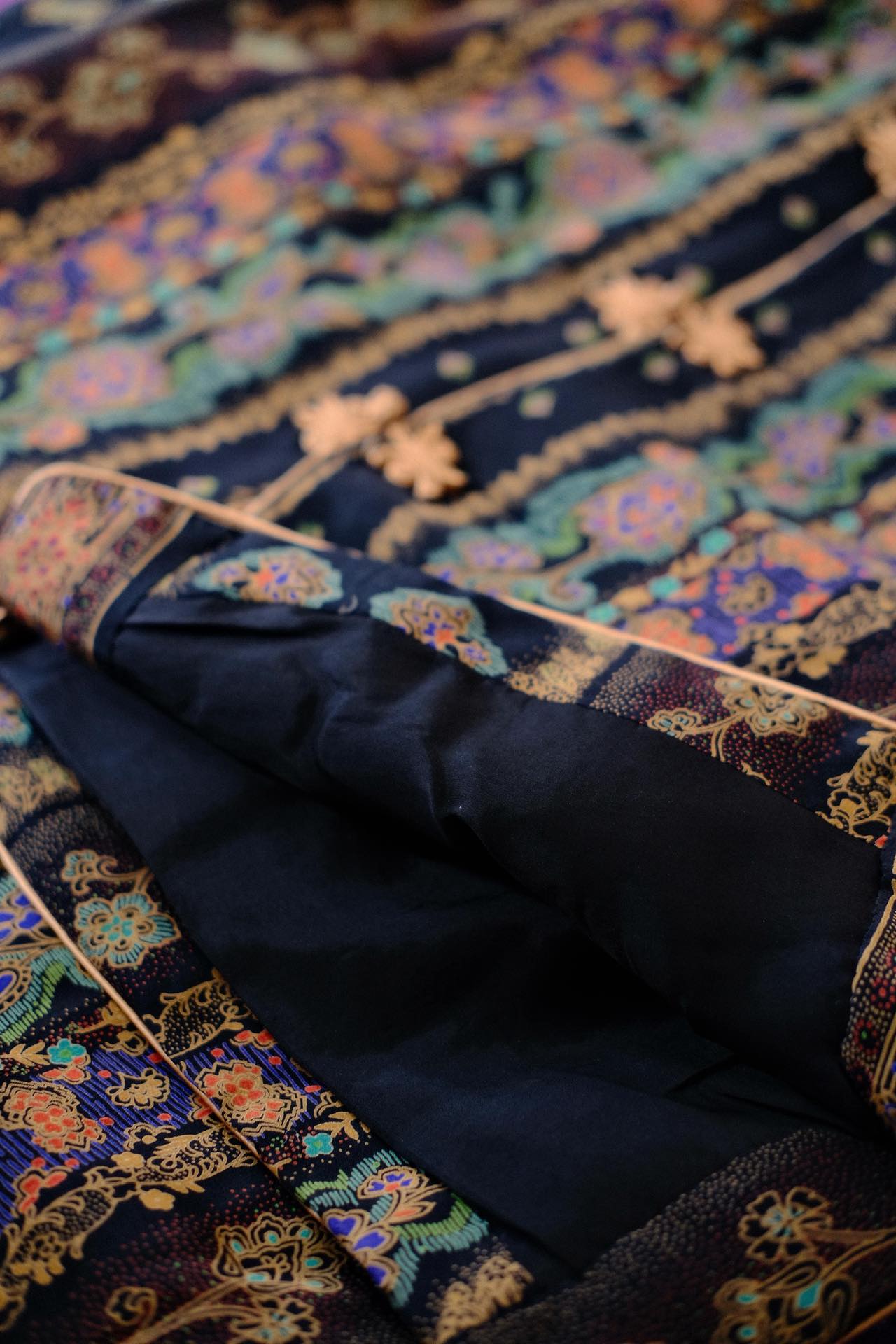
- 花间道纹样:面料通体覆盖着“花间道”纹样,这是一种将花卉、卷草与几何纹样交织的复杂设计。在深邃的黑色底布上,金线勾勒出枝蔓的轮廓,彩色的丝线则填充出花朵的绚烂,形成一种“暗夜繁花”的视觉效果。
- 真丝夹棉:套装采用真丝夹棉工艺,内里填充薄棉,既增加了服装的保暖性,又使其廓形更为挺括。这种工艺在六十年代的香港极为罕见,是当时高级定制工坊为应对秋冬季节而特别开发的。
- 盘扣细节:上衣的对襟处缀有数枚手工盘扣,每一枚都呈花朵形状,与面料的纹样相呼应。这种盘扣的制作需要极高的手工技巧,是传统中式服装的点睛之笔。
二、形制:中西合璧的“现代中式”
这套套装采用上衣与长裤的组合,是六十年代香港“现代中式”风格的典型代表。
- 上衣:立领对襟设计,线条简洁,剪裁合体。这种设计既保留了中式服装的端庄,又融入了西方服装的实用。
- 长裤:阔腿裤型,线条流畅,既增加了穿着的舒适度,又赋予了套装一种现代感与飘逸感。这种“上衣下裤”的组合,在当时是极为前卫的穿着方式,展现了六十年代女性的独立与自信。
三、故事:Woo女士的“日常奢华”
这套套装的主人Woo女士,是加拿大Super Store的老板之一,亦是六十年代“全球买手”的先驱。
- 在六十年代,像Woo女士这样的海外华商,每年必赴欧洲(尤其是意大利和法国)采购最新的面料,再带回香港找最好的裁缝定制。
- 这套套装就是这种生活方式的见证:它既非正式的晚礼服,也非日常的便服,而是介于两者之间的“日常奢华”。Woo女士或许会在白天的商务会议或下午的茶会中穿着它,既展现了她的东方文化底蕴,又彰显了她的现代女性身份。
四、稀缺性:消逝的“港产高定”生态
如今这套套装的珍贵,不仅在于其面料与工艺的绝美,更在于其背后整个生态的消逝。
- 六十年代的香港,曾有数百家旗袍工坊,师傅们以“一人一版”的手工定制闻名。然而随着成衣工业的崛起,这种“欧洲面料+香港工艺”的模式逐渐消失,如今仅存的几件套装,便成了那个时代的珍贵见证。
Blossoms in the Dark: The Ephemeral History of a 1960s Silk-Quilted "Huajiandao" Ensemble
I. Craftsmanship: A Wearable Tapestry of Eastern Brocade
The core value of this matching jacket-and-trousers ensemble lies in the supreme refinement of its textiles and meticulous detailing.
-
The "Huajiandao" Motif: The fabric is covered entirely with a Huajiandao (花间道) pattern—a highly complex design where botanical elements, scrolling vines, and geometric matrices interlace. Set against a deep, nocturnal black base, metallic gold threads sketch the contours of the twisting branches, while vibrant silk threads fill the blossoms, creating a dramatic "Blossoms in the Dark" visual effect.
-
Silk-Quilted Technique: The ensemble utilizes a silk-quilted craftsmanship (Jiamian), lined with a thin, lightweight layer of cotton batting. This design increases thermal insulation while lending a more structured, crisp silhouette to the drape. Such technique was exceptionally rare in the 1960s, specifically developed by high-end bespoke ateliers to navigate the autumn and winter seasons.
-
Frog Button Artistry: The center-front placket of the jacket is adorned with several handmade frog buttons (Pankou), each meticulously shaped into a blossom that echoes the textile's primary motif. Crafting these buttons requires masterful manual dexterity, serving as the definitive punctuation mark of traditional Chinese attire.
II. Silhouette: The "Modern Chinese" Fusion
This coordinated jacket-and-trousers set stands as a textbook representation of the "Modern Chinese" style that defined 1960s metropolitan fashion.
-
The Jacket: Featuring a standing collar and straight symmetric closure (Duijin), the lines remain minimalist and perfectly contoured to the body. This configuration retains the stately poise of traditional garb while integrating Western-influenced practical structures.
-
The Trousers: Designed with a wide-leg profile and fluid lines, the trousers enhance wearing comfort while injecting a contemporary, breezy movement into the overall look. This "top-and-bottom" combination was considered highly avant-garde for its time, mirroring the burgeoning independence and self-assurance of 1960s women.
III. Provenance: Ms. Woo's "Everyday Luxury"
The original custodian of this ensemble, Ms. Woo—a co-founder of the Canadian supermarket giant Superstore—was a visionary pioneer of the mid-century "global buyer" lifestyle.
During the 1960s, overseas Chinese entrepreneurs of her standing regularly journeyed to Europe (particularly Italy and France) to procure the most cutting-edge, top-tier textiles, which they then brought back to Hong Kong to be transformed by master tailors. This ensemble is the living proof of that transnational lifestyle. Neither a formal evening gown nor a simple house dress, it occupies the coveted space of "everyday luxury." Ms. Woo likely wore this during daytime executive meetings or elegant afternoon teas—simultaneously honoring her Eastern cultural roots and asserting her identity as a modern businesswoman.
IV. Scarcity: The Vanished Ecosystem of "Hong Kong Haute Couture"
The rarity of this ensemble extends beyond its striking aesthetics and complex quilting; it rests on the absolute disappearance of the artisanal ecosystem that birthed it.
In 1960s Hong Kong, hundreds of specialized qipao and tailored garment ateliers thrived, where master cutters were celebrated for their bespoke "one person, one pattern" philosophy. With the subsequent rise of industrial mass garment manufacturing, the unique mid-century model of pairing "imported European textiles with master Hong Kong tailoring" gradually went extinct. The few remaining ensembles like this one have transformed into precious historical monuments of a golden age.