深圳溯源
无法加载取货服务可用情况
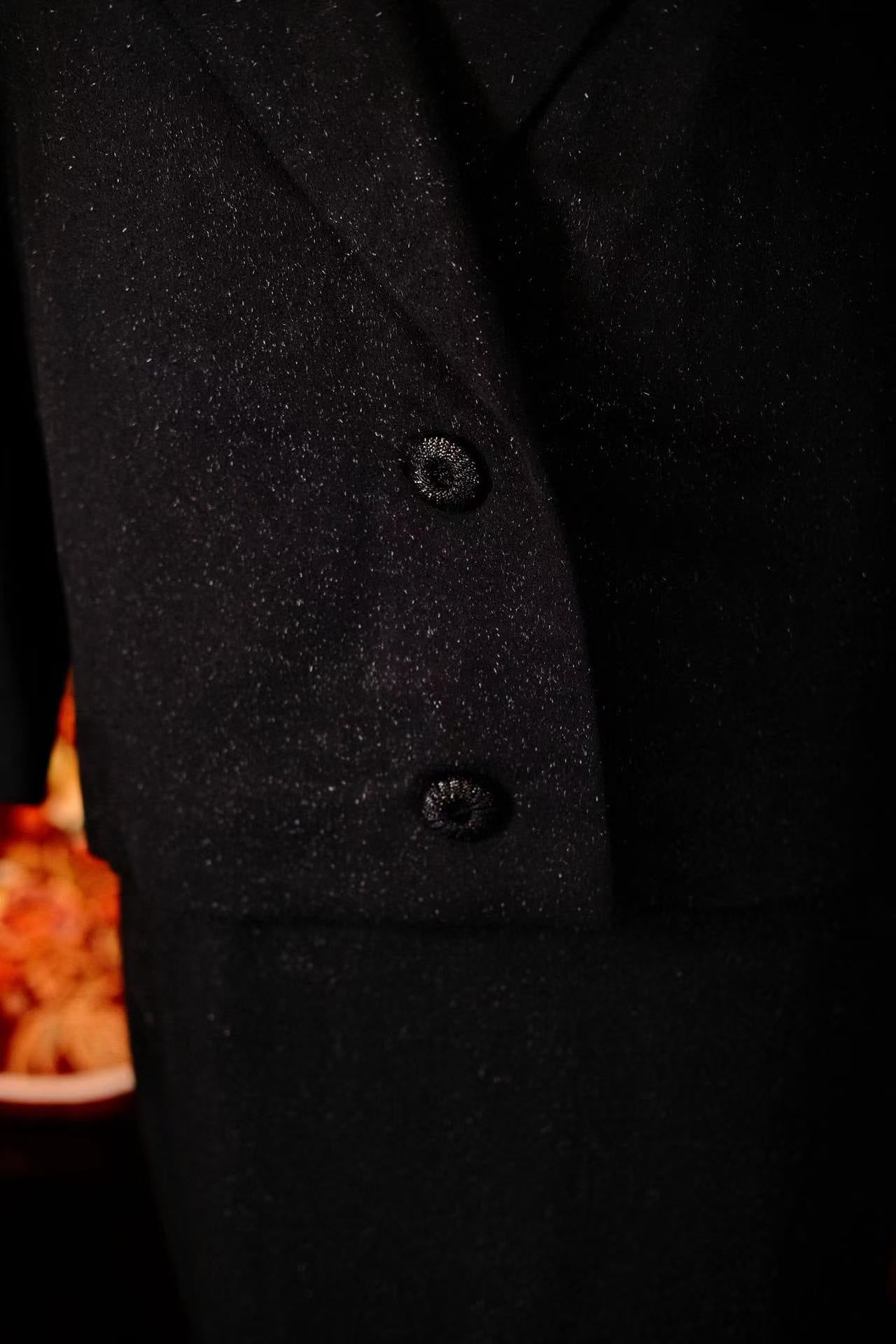
一、面料:银丝入魂,法式粗花呢的东方涅槃
这套旗袍套装的面料,
二、形制:吸烟装的“旗袍化”革命
套装由无袖立领旗袍与翻领西装外套组成,堪称六十年代香港“
三、故事:Woo女士的“双城记”
这套衣服的主人Woo女士,是加拿大Super Store的老板之一,亦是六十年代“全球买手”的先驱。
四、稀缺性:消逝的“港产高定”生态
如今这套套装的珍贵,不仅在于面料与工艺,
The structural foundation of this breathtaking qipao suit resides in its magnificent material canvas: a premium, silver-blended tweed imported from France during the mid-1960s. This fabrication operates as a striking material poem where Eastern mysticism and Western modernity are seamlessly fused.
Upon close inspection, shimmering silver filaments peek fluidly through a deep navy-blue foundation like cosmic stardust across a midnight sky, creating an atmospheric visual depth akin to moonlight reflecting off a cold, still pool. This distinctive composition masterfully balances the rich, rough texture of heritage tweed with a crisp, futurist luster born from the strategic integration of metallic threads.
During the 1960s, this specific blend sat at the absolute zenith of European haute couture. Only a handful of specialized workshops in the South of France possessed the technical mastery required to cleanly interweave metallic silver wire with premium wool fibers. While its production cost easily rivaled the finest silks, it became an elite, hidden status symbol of the aristocracy due to the mid-century "Space Age" fascination with metallic finishes. As fashion historian Valerie Steele eloquently remarked, "Fabric is the soul of clothing." These silver threads do not merely ornament the surface; they capture a brilliant cross-cultural resonance between the technological obsessions of the Cold War era and the serene restraint of classical Eastern design.
The structural framework of this ensemble comprises an integrated sleeveless, standing-collar qipao paired with a coordinating tailored blazer—representing the absolute pinnacle of "East meets West" design experimentation in 1960s Hong Kong.
The interior foundational qipao deliberately discards traditional fabric frog closures (Pankou) in favor of a sleek, minimalist mandarin collar and an unbroken asymmetric placket line (Xiejin). This streamlined approach perfectly mirrored the shifting desires of intellectual Hong Kong women during the era who sought to strip away superfluous ornamentation in pursuit of modern simplicity.
Conversely, the outerwear jacket completely replicates the iconic architectural lines of Le Smoking (the classic smoking suit)—featuring wide tailored lapels, a sharply contoured waistline, and sophisticated three-quarter sleeves. Yet, it hides an artistic mystery within its details, masterfully repurposing a traditional symbol of masculine Western corporate authority into an uncompromising declaration of Eastern feminine grace. This compelling "outer-Western, inner-Eastern" structural matrix beautifully illustrates the philosophy of sociologist Pierre Bourdieu, who noted that "Taste is a weapon of class." Ms. Woo brilliantly weaponized the qipao as a spear of cultural heritage and the tailored blazer as a shield of corporate authority, carving out a highly unique avenue of self-expression amid a chaotic global landscape.
The custodian of this artifact, Ms. Woo, operated as a co-director of a major Canadian enterprise, standing as a definitive pioneer within the early jet-age network of global luxury procurement and international lifestyle management.
As remembered by her family, Ms. Woo made regular, calculated sourcing journeys to Paris to personally secure advanced, trend-setting textile volumes, subsequently routing these precious materials back to Hong Kong where her trusted master tailors transformed the raw yardage into bespoke, custom silhouettes engineered precisely to her anatomical measurements. This exact methodology served as the definitive style cipher for mid-century Hong Kong's elite class: utilizing European fabric innovation to project global cultural literacy, and old-world Hong Kong craftsmanship to guarantee absolute anatomical fit.
Her transoceanic trajectory (Paris–Hong Kong–Canada) functions as a captivating micro-history of Chinese capital and cultural mobility during the Cold War era. Paris provided the raw avant-garde inspiration, Hong Kong exported the elite artisan technique, and Canada operated as the executive terminal—with the hybrid qipao serving as the vital material bridge unifying all three landscapes. As the fashion historian Anne Hollander observed, "Clothing is an extension of the body." Ms. Woo’s selection operates beautifully as a concrete manifestation of personal refinement and cultural authority on the global stage.
The modern rarity of this two-piece set extends far beyond its raw material worth or its unique mineral aesthetics; it stands as a pristine archive of a highly specialized, completely vanished sartorial ecosystem.
During the 1960s, Hong Kong’s custom apparel trade thrived across hundreds of master ateliers who engineered garments based on a strict "one person, one pattern" blueprint philosophy, where senior artisans meticulously draped rare European imported fabrics to match individual anatomical requirements down to the millimeter.
With the subsequent global ascension of mechanized, mass-market ready-to-wear production scales, this resource-heavy, time-intensive synthesis of European textile technology and custom Hong Kong craftsmanship permanently dissolved. Archival records from the Hong Kong textile industry indicate that during this entire decade, the total volume of premium French tweed imported to the region amounted to fewer than one hundred bolts, and craftsmen possessing the dexterity required to manipulate structural silver-wire blends were exceptionally few. This Le Smoking qipao suit survives as a living artifact of that bygone golden era—a physical testament to Hong Kong's mid-century brilliance as the "Paris of the East," permanently preserving the globalized wave of female self-awakening and absolute, uncompromising artistry.