深圳溯源
60年代 - 流金岁月:一件六十年代港产织金旗袍的时尚叙事 | 1960s - Golden Years: A Fashion Narrative of a 1960s Hong Kong-Made Gold-Woven Qipao
60年代 - 流金岁月:一件六十年代港产织金旗袍的时尚叙事 | 1960s - Golden Years: A Fashion Narrative of a 1960s Hong Kong-Made Gold-Woven Qipao
无法加载取货服务可用情况
流金岁月:一件六十年代港产织金旗袍的时尚叙事
衣服尺寸:
胸围/腰围/臀围:100/84/104 厘米
衣长:126 厘米
细节描述:
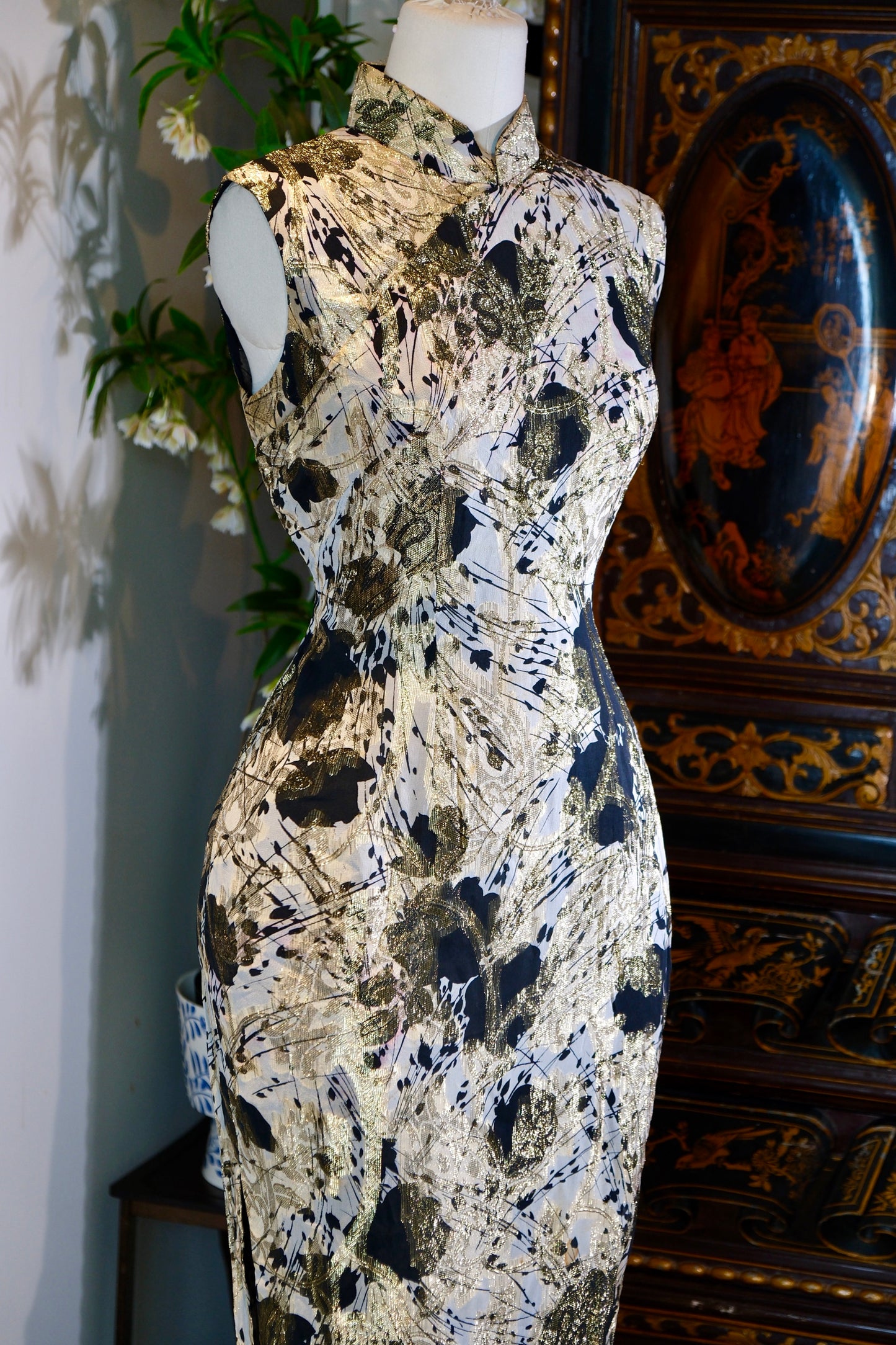
当指尖划过这件旗袍,织金提花在光线下流转出的,是六十年代香港与意大利交织的时尚密码。这件诞生于1960年代的香港古董旗袍,以意大利进口织金提花面料为骨,以海派旗袍的剪裁为魂,在时光的沉淀中,成为一件“穿在身上的艺术史”。
一、图案:抽象泼墨与织金工艺的交响
旗袍的面料图案,是一场东西方美学的对话。主体纹样以抽象泼墨为灵感,黑色与金色的线条如狂草般肆意挥洒,似水墨在宣纸上晕染开的瞬间被定格,又似西方抽象表现主义的笔触——这种“非具象”的设计,在六十年代的香港时装中极为先锋。而织金工艺的运用,则让图案有了立体的呼吸感:金色丝线在提花织机中穿梭,形成若隐若现的花卉轮廓(或可解读为变形的牡丹与藤蔓),与泼墨线条交织,既保留了传统织锦的华贵,又注入了现代艺术的灵动。
二、故事:香港制造的黄金时代与意大利面料的东渡
这件旗袍的“身世”,藏着六十年代香港时装业的传奇。彼时的香港,是“东方好莱坞”与“远东时装之都”的交汇点:一方面,上海裁缝师傅带着海派旗袍的精湛技艺南迁,将“归拔”工艺(通过熨烫塑造立体曲线)融入旗袍制作;另一方面,香港作为自由港,成为欧洲面料进入亚洲的枢纽。意大利的织金提花面料,正是在这样的背景下“东渡”——它们或经威尼斯的织机织就,带着文艺复兴时期织物工艺的血脉,被香港的时装店(如“上海衫”或“永安公司”)购入,再由本地裁缝根据客人的身形量身定制。
这件旗袍的无袖设计(六十年代香港旗袍的典型特征,区别于三十年代长袖或短袖),以及高领、斜襟、侧衩的经典结构,都指向一个特定的穿着场景:或许是某位名媛在半岛酒店的下午茶,或许是富商太太出席慈善晚宴的战袍。它的面料稀缺性,更在于“意大利进口织金提花”在当时的珍贵——六十年代的香港,普通市民仍以棉布、人造丝为衣料,而进口织金面料需通过特殊渠道获取,且提花织机的生产效率极低,一件旗袍的面料往往需数周才能织就。正如服装史学家瓦莱丽·斯蒂尔(Valerie Steele)在《旗袍:从宫廷到红毯》中所言:“六十年代的香港旗袍,是殖民地精英阶层‘用衣着宣示身份’的产物,其面料的异域性与工艺的地域性,共同构成了‘香港制造’的独特魅力。”
三、艺术风格:现代主义浪潮中的东方优雅
从艺术风格看,这件旗袍是“现代主义”与“东方主义”的碰撞。抽象泼墨图案,呼应了六十年代全球艺术界的“去具象化”潮流——彼时,杰克逊·波洛克(Jackson Pollock)的滴画、赵无极的抽象水墨正风靡欧美,而香港的设计师将这种艺术语言转化为面料纹样,让旗袍摆脱了传统花卉、龙凤的“符号化”装饰,成为“穿在身上的现代艺术”。而织金工艺的华贵感,又平衡了抽象图案的“先锋性”,使其不至于流于前卫的极端,反而呈现出一种“克制的奢华”——这正是六十年代香港时装的美学核心:在传统与现代之间寻找平衡,用西方工艺表达东方韵味。
稀缺性更体现在“时代不可复制性”上。六十年代后,随着成衣工业的兴起与香港制造业的转型,这种“意大利面料+香港手工定制”的旗袍逐渐式微。如今存世的六十年代港产织金旗袍,多数因面料老化、工艺失传而难以保存,而这件旗袍历经半世纪仍色泽鲜亮、剪裁挺括,堪称“活化石”。它不仅是件衣服,更是一本打开的时尚史:翻开它,能看到意大利织机的轰鸣、香港裁缝铺的熨斗蒸汽,以及那个东西方文化激烈碰撞又温柔交融的黄金时代。
结语:一件旗袍,半部时尚史
这件六十年代意大利进口织金提花香港产古董旗袍,是时光的馈赠,也是艺术的结晶。它的图案是抽象与传统的对话,它的身世是香港制造的传奇,它的风格是现代主义浪潮中的东方优雅。当我们在博物馆或私人收藏中凝视它时,看到的不仅是一件衣服,更是一个时代的呼吸——那是六十年代的风,吹过香港的街道,带着意大利面料的华贵,落在旗袍的织金提花上,凝成永恒的流金岁月。
Golden Years: A Fashion Narrative of a 1960s Hong Kong-Made Gold-Woven Qipao
Measurements / Size Guide:
Bust / Waist / Hips: 100/84/104 cm
Total Length: 126 cm
Detailed Description:
As your fingertips glide across this garment, the gold-woven jacquard reveals the shifting fashion codes of 1960s Hong Kong and Italy. Born in the 1960s, this Hong Kong antique qipao uses imported Italian gold-woven jacquard as its "bone" and the tailoring of "Shanghai-style" (Haipai) qipao as its "soul." Through the precipitation of time, it has become a piece of "wearable art history."
I. Pattern: A Symphony of Abstract Ink-Wash and Gold-Weaving
The textile pattern is a dialogue between Eastern and Western aesthetics. Inspired by abstract ink-wash painting, black and gold lines are splashed with the abandon of "wild cursive" calligraphy—capturing the exact moment ink permeates rice paper, yet reminiscent of Western Abstract Expressionist brushstrokes. This non-figurative design was remarkably avant-garde for 1960s Hong Kong fashion. The gold-weaving technique gives the pattern a three-dimensional "breath": gold threads traverse the jacquard loom to form shimmering, elusive floral silhouettes (interpretable as stylized peonies and vines). Intertwined with the ink-wash lines, it preserves the opulence of traditional brocade while injecting the vitality of modern art.
II. Story: The Golden Age of "Made in Hong Kong" and the Eastward Journey of Italian Fabrics
The "lineage" of this qipao hides the legend of the 1960s Hong Kong fashion industry. At that time, Hong Kong was the intersection of the "Hollywood of the East" and the "Fashion Capital of the Far East." On one hand, Shanghainese master tailors migrated south, bringing the exquisite techniques of Haipai qipao—including the "Gui-Ba" process (shaping 3D curves through masterful steam ironing). On the other hand, as a free port, Hong Kong became the hub for European fabrics entering Asia.
Italian gold-woven jacquard made its "eastward journey" in this context. These fabrics, perhaps woven on Venetian looms carrying the lineage of Renaissance textile crafts, were purchased by Hong Kong fashion establishments (such as "Shanghai Shirts" or the "Wing On Company") and then custom-tailored to a client's specific measurements. This sleeveless design—a typical feature of 1960s Hong Kong qipao, distinct from the long or short sleeves of the 1930s—along with the high collar, diagonal closure, and side slits, points to a specific social setting: perhaps a socialite’s afternoon tea at The Peninsula Hotel or a businessman’s wife’s "armor" for a charity gala. The rarity lies in the preciousness of "imported Italian gold-woven jacquard" at the time. In 1960s Hong Kong, while ordinary citizens wore cotton or rayon, imported gold fabrics were acquired through specialized channels, and the low efficiency of jacquard looms meant a single qipao’s fabric could take weeks to weave.
III. Artistic Style: Oriental Elegance Amidst the Wave of Modernism
Artistically, this qipao is a collision between Modernism and Orientalism. The abstract ink-wash pattern echoes the global "de-figuration" trend of 1960s art—the era when Jackson Pollock's drip paintings and Zao Wou-Ki’s abstract ink works were taking Europe and America by storm. Hong Kong designers translated this artistic language into textile motifs, allowing the qipao to shed the "symbolic" decorations of traditional dragons and phoenixes to become "wearable modern art." The opulence of the gold-weaving balances this "avant-garde" nature, preventing it from drifting into extreme radicalism and instead presenting a "restrained luxury"—the aesthetic core of 1960s Hong Kong fashion: finding balance between tradition and modernity, using Western craftsmanship to express Eastern charm.
The scarcity is further defined by its "unrepeatable era." After the 1960s, with the rise of the ready-to-wear industry and the transformation of Hong Kong’s manufacturing, the "Italian fabric + Hong Kong handmade bespoke" model gradually faded. Most surviving 1960s Hong Kong-made gold-woven qipaos are difficult to preserve due to fabric aging or lost techniques; however, this piece remains vibrant in color and crisp in cut—a "living fossil."
Conclusion: One Qipao, Half a History of Fashion This 1960s antique qipao—imported Italian gold-woven jacquard made in Hong Kong—is a gift of time and a crystallization of art. Its pattern is a dialogue between the abstract and the traditional; its history is the legend of "Made in Hong Kong"; and its style is the Oriental elegance amidst the wave of modernism. To gaze upon it is to feel the breath of an era—the 1960s wind blowing through the streets of Hong Kong, carrying the luxury of Italian fabric, settling upon the gold-woven jacquard to condense into eternal "Golden Years."
分享