深圳溯源
无法加载取货服务可用情况
衣服尺寸:
胸围/腰围/臀围:106/92/110 厘米
衣长:110 厘米
细节描述:
当指尖抚过这袭旗袍的缎面,仿佛触到了六十年代香港午后的阳光——暖调的光晕里,浮动着油画笔触般的浓烈与温柔。这件诞生于英殖末期的港产古董旗袍,以衣为纸,以针为笔,将东西方美学的碰撞与融合,凝练成一曲流动的视觉诗篇。
一、图案:油画笔触下的热带狂想
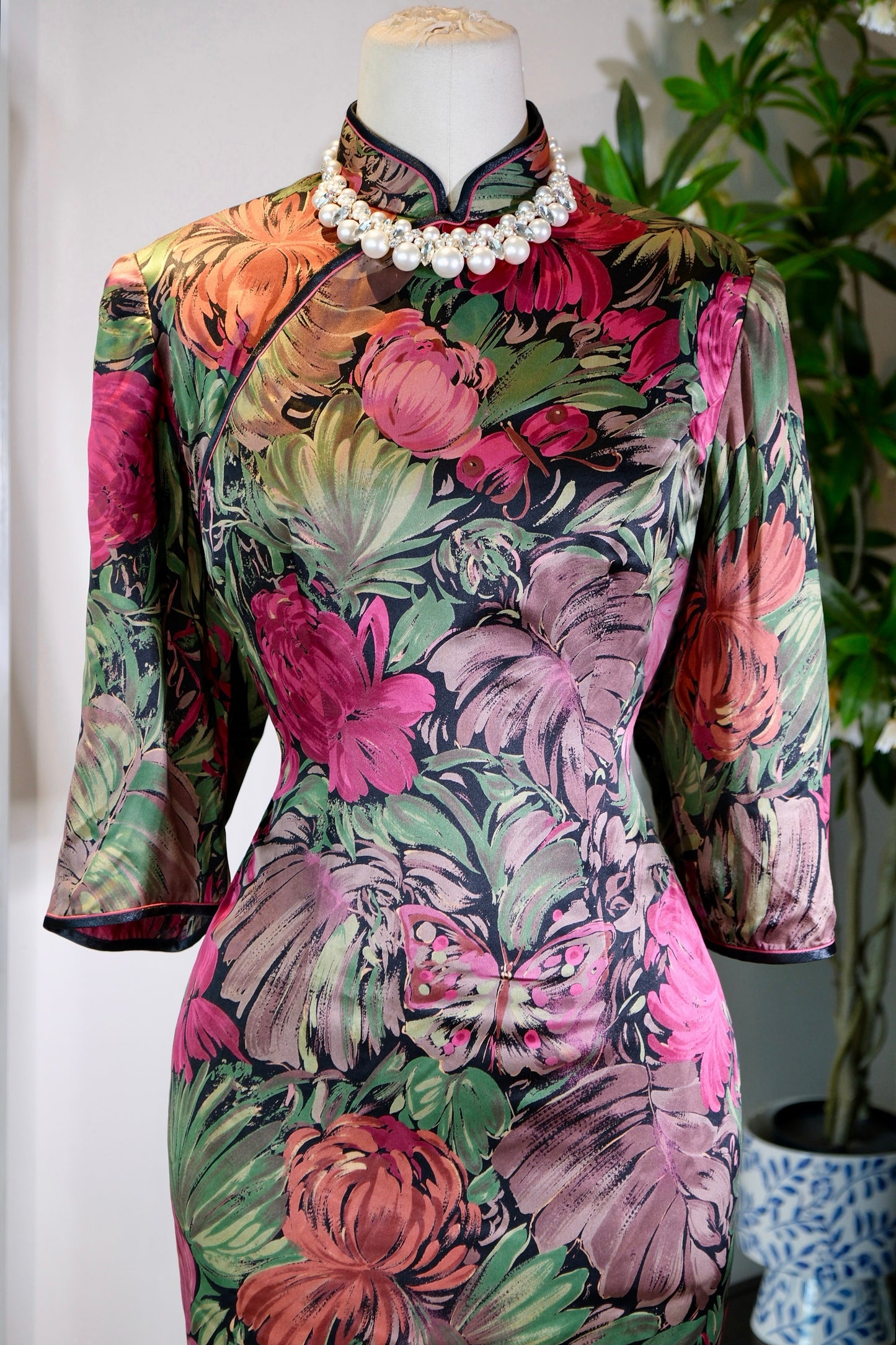
旗袍的图案是一场色彩的盛宴:玫红与橙粉的牡丹、芙蓉在墨绿底色上肆意绽放,花瓣边缘晕染着水彩般的渐变,仿佛刚从画布上摘下的鲜活;叶片则以深浅不一的绿调铺陈,笔触粗犷如印象派的点彩,却又暗合中国传统工笔的细腻脉络。最妙的是几只粉蝶翩跹其间,翅膀上的斑点如颜料泼洒,与花卉形成动静相生的韵律——这并非机械印染的规整,而是手工绘稿的温度,每一寸花纹都带着匠人呼吸的痕迹。
这种“油画风格”的诞生,恰是六十年代香港文化杂交的缩影。彼时西方现代艺术思潮涌入,本土工匠大胆将油画的光影层次与色彩张力引入传统丝绸纹样,既保留了“花团锦簇”的东方吉祥寓意,又注入了西方绘画的写意精神。正如艺术史家柯律格所言:“香港设计在殖民语境中,始终以‘挪用’与‘重构’书写着自己的现代性。”
二、故事:旗袍里的港岛往事
旗袍的立领、斜襟与七分袖,是典型的六十年代港式改良:领口高度适中,既承袭了民国旗袍的含蓄,又因应热带气候的透气需求;收腰剪裁贴合曲线,却未如五十年代那般紧绷,透露出女性意识的微妙觉醒。缎面的光泽与厚重感,暗示着它曾属于一位体面的香港女性——或许是中环写字楼的白领,或许是聚光灯下的明星,在霓虹初上的年代,穿着它赴一场茶舞或婚宴,裙摆扫过太平山顶的晚风,留下浮光掠影的传奇。
古董衣的稀缺性,在于它是“不可复制的时间胶囊”。六十年代的香港旗袍业正值黄金期,但随着工业化浪潮与西式服装的普及,这种手工绘稿、量身裁剪的精品逐渐式微。如今存世的港产古董旗袍,多因保存不易而残损,像这样图案完整、色彩鲜亮者,堪称“行走的博物馆藏品”。
三、艺术:东西美学的和解之书
从艺术风格看,这件旗袍是“东方主义”与“现代主义”的奇妙和解。花卉题材本是中国传统纹样的经典,但此处的花朵不再追求工笔的写实,而是以油画的厚涂法表现体积感,叶片则借鉴了野兽派的色彩对比;蝴蝶作为“福迭”的吉祥符号,被赋予了装饰艺术的几何美感。这种“不中不西,亦中亦西”的特质,恰如张爱玲笔下“民国女子”的着装哲学:“他们初开的衣,是他们的创世纪。”
更难得的是,旗袍的每一个细节都在诉说“手工时代的尊严”:领口的滚边细密如发,针脚均匀得仿佛机器所为,实则是老师傅手持镊子一点点熨烫定型;袖口的弧度经过反复调整,确保抬手时的优雅线条。这种对工艺的极致追求,在快时尚泛滥的今天,显得尤为珍贵。
四、结语:衣以载道,时光不朽
这件六十年代港产油画旗袍,不仅是一件衣物,更是一部穿在身上的文化史。它见证了香港作为“东方之珠”的多元与包容,承载了那个时代女性对美的追求与自我表达,更以稀缺的艺术价值,成为连接过去与未来的美学桥梁。当我们在博物馆的展柜前凝视它,看到的不仅是花纹与剪裁,更是一个时代的心跳——热烈、鲜活,永不褪色。
“衣不如新,人不如故”,但这件古董旗袍,却因岁月的沉淀而愈发迷人。它是浮世的繁花,是时光的叙事,更是属于所有热爱美与历史的人,一份不可多得的珍藏。
Measurements / Size Guide:
Bust / Waist / Hips: 106/92/110 cm
Total Length: 110 cm
Detailed Description:
As fingertips brush against the satin of this cheongsam (qipao), one can almost feel the afternoon sunlight of 1960s Hong Kong—a warm halo floating with the intensity and tenderness of oil painting brushstrokes. Born during the twilight of the British colonial era, this antique garment uses fabric as paper and needles as pens, condensing the collision and fusion of Eastern and Western aesthetics into a flowing visual poem.
The pattern is a feast of color: peonies and hibiscuses in magenta and orange-pink bloom wantonly against a dark green base, their petal edges blurring with watercolor-like gradients, as if freshly plucked from a canvas. Leaves are laid out in varying shades of green, with strokes as bold as Impressionist pointillism, yet secretly aligning with the delicate veins of traditional Chinese Gongbi style. Most exquisite are the pink butterflies dancing among them, the spots on their wings appearing like splattered pigments, creating a rhythmic harmony of movement and stillness. This is not the cold regularity of mechanical printing, but the warmth of a hand-drawn draft—every inch carries the breath of a master artisan.
The birth of this "oil painting style" is a microcosm of Hong Kong's cultural hybridization in the 1960s. As modern Western art movements surged in, local craftsmen boldly introduced the light-and-shadow layers and color tension of oil painting into traditional silk motifs. This preserved the auspicious Oriental meaning of "clusters of blossoms" while injecting the expressive spirit of Western painting. As art historian Craig Clunas noted: "In a colonial context, Hong Kong design consistently wrote its own modernity through 'appropriation' and 'reconstruction.'"
The standing collar, diagonal bodice, and three-quarter sleeves are quintessential 1960s Hong Kong refinements. The collar height is moderate, inheriting the modesty of Republican-era qipaos while catering to the breathability required by a tropical climate. The cinched tailoring contours the curves without the suffocating tightness of the 1950s, revealing a subtle awakening of female consciousness. The luster and weight of the satin suggest it once belonged to a woman of standing—perhaps a white-collar professional in Central or a star under the limelight, heading to a tea dance or wedding as the neon lights flickered on, leaving a shimmering legend in the evening breeze of Victoria Peak.
The scarcity of antique clothing lies in its nature as an "irreproducible time capsule." While Hong Kong’s qipao industry was in its golden age, the wave of industrialization and Western attire eventually led to the decline of such hand-drawn, bespoke masterpieces. Today, surviving Hong Kong antiques are often damaged by age; a specimen with such complete patterns and vivid colors is truly a "walking museum piece."
Artistically, this qipao is a marvelous reconciliation between Orientalism and Modernism. While floral themes are classical Chinese motifs, the flowers here abandon traditional realism for the volume of oil impasto techniques, and the leaves borrow the color contrasts of Fauvism. The butterfly, an auspicious symbol for "blessings," is granted the geometric beauty of Art Deco. This "neither East nor West, yet both" quality echoes Eileen Chang’s philosophy on the dress of women in that era: "Their first clothes were their Book of Genesis."
More remarkably, every detail speaks of the "dignity of the manual age": the piping on the collar is as fine as hair, with stitches so even they appear mechanical, yet were actually ironed into shape millimeter by millimeter by an old master with tweezers. The curvature of the cuffs was adjusted repeatedly to ensure elegant lines when raising a hand. This pursuit of perfection is exceptionally precious in today's era of fast fashion.
This 1960s Hong Kong-made oil painting qipao is more than a garment; it is a wearable cultural history. It witnesses Hong Kong’s pluralism and inclusivity as the "Pearl of the Orient," carries the pursuit of beauty and self-expression of the women of that era, and serves as an aesthetic bridge between past and future with its rare artistic value. When we gaze upon it, we see not just patterns and tailoring, but the heartbeat of an era—passionate, vivid, and never-fading.
"New clothes are better, but old friends are dearer," yet this antique qipao only grows more charming with the sediment of time. It is a flourishing flower of the floating world, a narrative of time, and a rare treasure for all who love beauty and history.