深圳溯源
无法加载取货服务可用情况
烬染朱华:
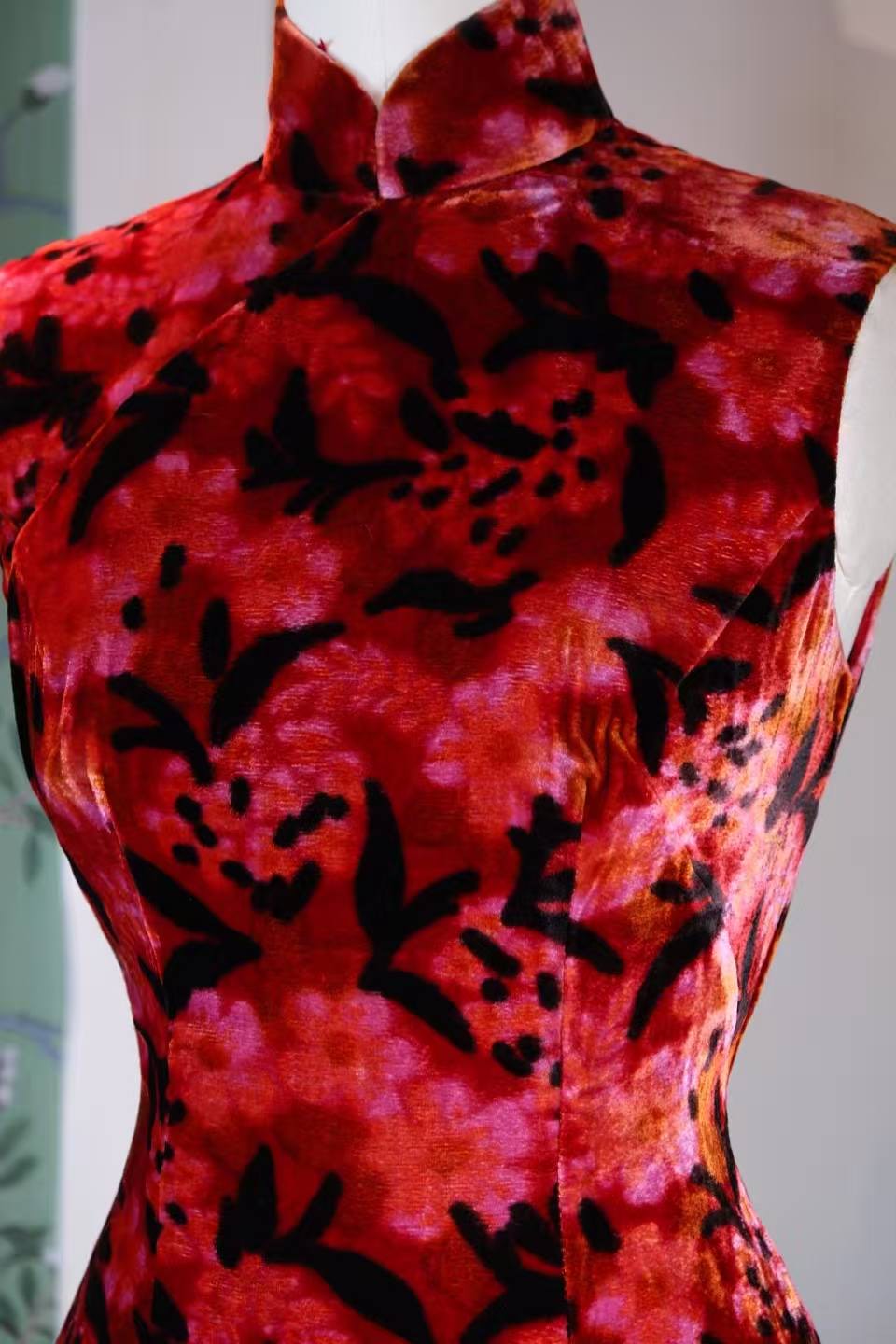
当目光触及这件沉睡于时光匣中的旗袍,首先被攫住的,
其上泼洒的黑色纹样,是写意与写实的精妙平衡。细观之,
从工艺维度审视,这件旗袍的稀缺性更显珍贵。
在形制与美学的交汇处,这件旗袍更显时代烙印。
今日,当我们凝视这件沉睡几十年的古董旗袍,
When one's gaze touches this cheongsam, dormant within its time capsule, what first arrests the attention is the red base, almost like molten sunset gold. The Taiwanese textile artisans of the 1960s used velvet as their silk canvas, distilling the Oriental aesthetic qualities of "sincerity" (chicheng) and "opulence" (huagui) into the warp and weft. This almost burning red is not a mechanical color card replica but is imbued with the breath of traditional dyeing and weaving techniques—it may originate from layers of vegetable dye blending, or subtly conform to the natural texture left by the jiaoxie (tie-dye) technique. Every transition in color and tone is irreversible, much like the changing glaze of kiln-fired ceramics.
The black pattern splashed across the surface is a masterful balance between freehand expression (xieyi) and realism (xieshi). Upon close inspection, it is not a rigid floral atlas, but an abstract rendering using the brushwork of Chinese ink wash, condensing the unfurling of branches and the curling of petals into abstract lines. The leaves' form lies between the banana plant and the orchid, their edges possessing the vigor of the feibai (flying white) calligraphy technique. The flower clusters resemble a re-imagining of the peony and plum blossom, some budding, others fully open. Their staggered density subtly aligns with the compositional principle of "arranging branches and distributing leaves" in the Mustard Seed Garden Manual of Painting. This aesthetic pursuit of the "space between similarity and dissimilarity" (似与不似之间) echoes Su Shi’s philosophy regarding literati bamboo painting: "One must first have the complete bamboo in the mind." The piece thus weaves the scholarly ink-wash spirit into the fabric, making the garment a wearable landscape scroll.
Examined from a craftsmanship perspective, the scarcity of this cheongsam is even more precious. Taiwan’s velvet printing technology in the 1960s was precisely at the transition stage between traditional hand-printing and modern mechanical printing. The black pattern on the cheongsam lacks the sharp, jagged edges of mechanical printing; instead, it exhibits the subtle blurring of manual stencil printing—a technique confirmed by the "wood block printing" process recorded in the History of Taiwanese Textiles. The velvet weaving itself required mulberry silk for the warp and gold threads for the weft, interwoven repeatedly on iron looms. Its luster, as light flows over it, presents a fantastic sheen of "crimson glow scattering across fine silk" (zhu xia san qi). This time- and labor-intensive weaving method gradually declined with the rise of synthetic fibers in the 1970s.
At the confluence of form and aesthetics, this cheongsam bears the imprint of its era. The lines of the stand collar and diagonal closure are clean and sharp, without excessive embellishment, relying on the fabric's own texture and the pattern's tension for effect. This "less is more" design philosophy subtly aligns with the aesthetic principle of "The great gui jade scepter is not carved, for its quality is already beautiful" from the Classic of Rites: Ritual Vessels—when the material and pattern are stunning enough, redundant decoration is unnecessary. The sleeveless cut reveals the modernization shift in Taiwanese women's apparel during the 1960s, incorporating more practicality for daily wear while retaining the traditional cheongsam silhouette.
Today, as we gaze upon this antique cheongsam, dormant for decades, it has transcended its utilitarian function to become a solidified visual epic. The black brushstrokes that wander across the red velvet surface are both a tribute by Taiwanese textile artisans to tradition and an exploration of modern aesthetics. It is like an heirloom from the past, carrying the grace of the sixties, and in its sedimentation of time, increasingly revealing the weight of the word "vintage"—an irreplicable combination of skill, aesthetics, and the spirit of an era, deserving to be gently dusted off, placed under the spotlight, and shared for the world to witness its burning splendor.