深圳溯源
无法加载取货服务可用情况
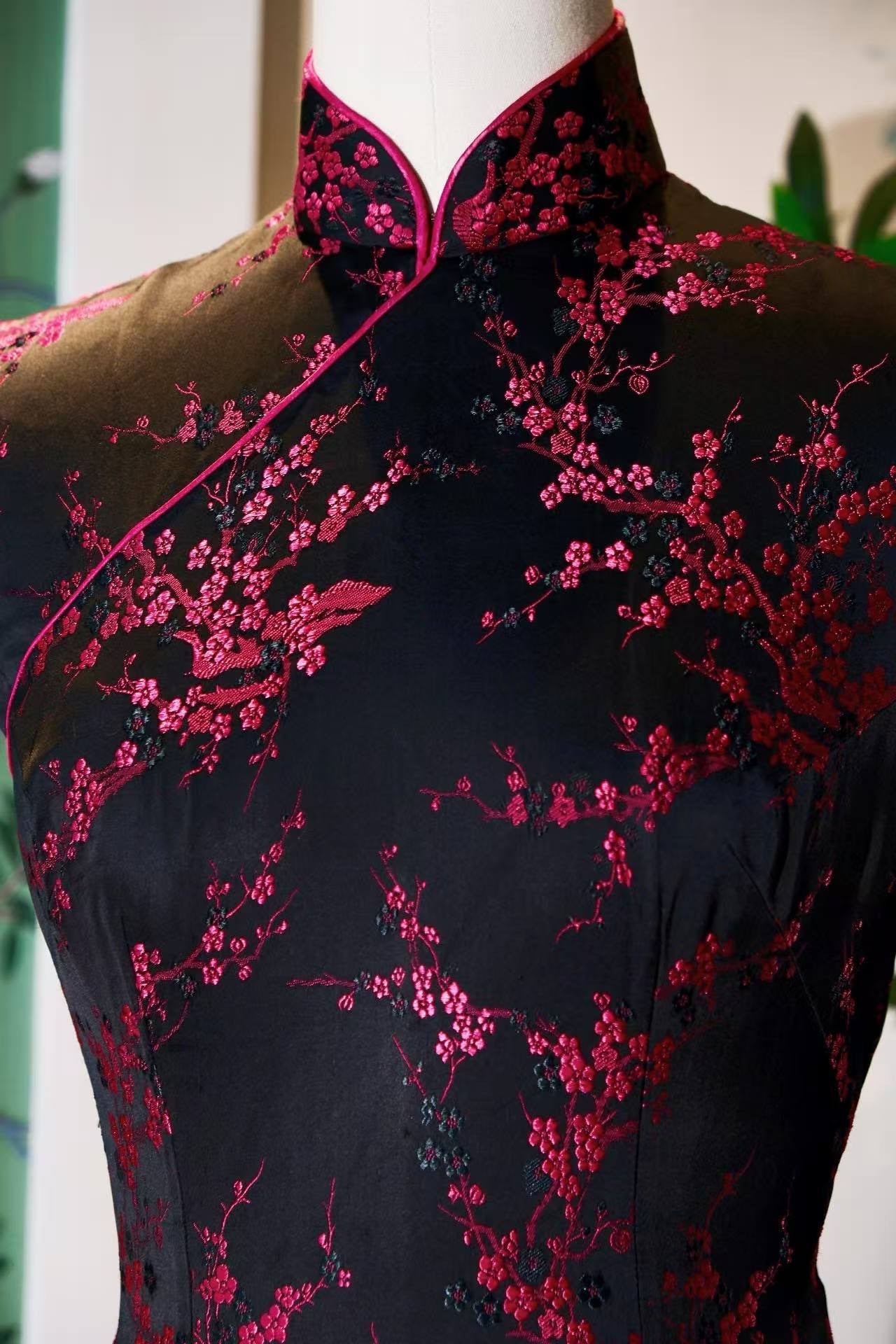
廿四桥上觅暗香:六十年代玫红梅花提花织锦缎旗袍。
若将民国三十七年《申报》所载“沪上时兴宋锦旗袍,
旗袍通体以梅纹为饰,其构图深得宋代院体画精髓。
提花部分以双股玫红桑蚕丝作纬线,在墨色经面上形成浮雕效果。
当霓虹闪烁的都市霓裳迭代成快消符号,
If one places the statement recorded in the Shen Bao newspaper in 1948—"Shanghai style favors Song brocade cheongsams, especially those with plum and bamboo motifs"—into the context of the 1960s, it becomes a marvelous annotation. This collection piece uses dark ink-colored brocade as the ground, with rose-red jacquard weaving the sparse, oblique shadows of plum branches. Furthermore, the line incense piping (线香绲) technique outlines the collar and cuffs, perfectly capturing the soul of the plum blossom—"proud against snow and defying frost, easily conquering the cold"—from the Song Dynasty poet Yang Wujiu’s Liu Shao Qing, condensed into an inch of fabric.
The cheongsam is entirely decorated with plum motifs, whose composition deeply inherits the essence of Song Imperial Academy painting. The turning points of the branches reveal the brushwork described in the Xuanhe Huapu: "painting the plum with thin, sturdy lines as its bones, with sparse, oblique shadows." The flowers are grouped and staggered, following the exact formula of "five petals clustered, stamens distinctly visible" seen in the Song Dynasty Kesi (Tapestry Weaving) Plum Blossoms and Cold Sparrows preserved in the Palace Museum. Notably, the rose-red petals create a strong visual tension against the dark ink ground, aligning with the coloring secret from the Mustard Seed Garden Manual of Painting: "Red plum must be set off by thick dark ink for its cold beauty to be fully realized." Upon close examination, the plum branches at the collar show a spiral ascending momentum, subtly implying the auspicious meaning of "success in three examinations" (连中三元); the plum blossoms at the waist are distributed in a scattered pattern, echoing the aesthetic proposition of the Ming Dynasty Records of Superfluous Things that "a scattering of flower shadows engenders a lively spirit." This design, which fuses the intent of literati painting with garment patterns, was only produced by the top workshops making silk gauze cheongsams in 1960s Shanghai.
The jacquard weaving utilizes double-strand rose-red mulberry silk as the weft, creating a relief effect on the dark ink warp surface. Microscopic observation reveals the splitting of the silk thread at the edge of the petals, which is remarkably similar to the Su Embroidery technique of "splitting the silk threads and dividing the colors, leaving no trace of the needle" recorded in the Qing Dynasty Xuehuan Xiupu preserved in the Suzhou Museum. This creation, which integrates the aesthetic principles of brocade weaving and embroidery, represents the pinnacle of the Shanghai-style cheongsam craftsmanship of the 1960s.
While the metropolitan "rainbow robes" (霓裳) are quickly replaced by fast-fashion symbols, this ink-colored plum motif cheongsam, dormant for sixty years, uses brocade as paper and silk thread as ink to write the permanence of Oriental aesthetics in the curve of the collar. It is not only a specimen of material cultural heritage but also a solidified time capsule, allowing the observer to touch that elegant era where one "cut ice-white silk, gently folded several layers, and lightly applied a rouge-like wash."