深圳溯源
无法加载取货服务可用情况
一、序章:跨越山海的定制之旅
在20世纪60年代的黄金岁月里,时尚不仅仅是衣着,
正如她的儿子所述,Woo女士的生活轨迹横跨欧亚北美。
二、面料之美:法式粗花呢的温柔触感
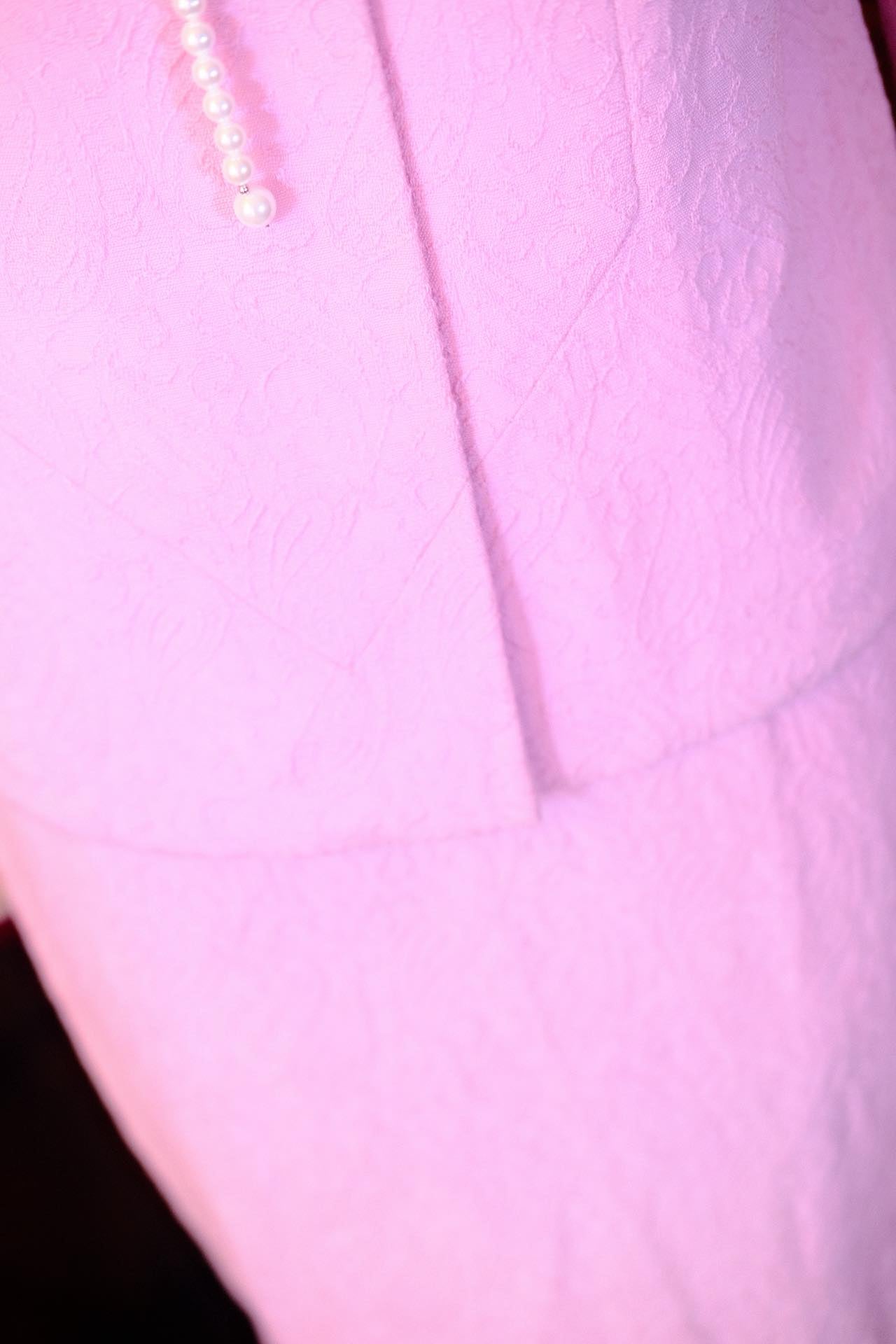
这套套装的灵魂,在于其选用的法国进口粗花呢。
- 独特的肌理:仔细观察面料表面,可以看到细腻的凹凸纹理。
- 时代的印记:在60年代,
三、设计解析:新中式的极简美学
这套服装由“圆领短外套”与“内搭旗袍”组成,
- 外披:圆领短外套
外套采用了极简的圆领设计,摒弃了传统的翻领,
- 内搭:修身旗袍
内里的旗袍完美承接了外套的色调,面料似乎带有隐约的暗纹,
四、结语:永不褪色的东方茉莉
这套粉色粗花呢套装,是Woo女士时尚品味的缩影。
如今,当我们凝视这件古董衣,仿佛能看到半个世纪前,
During the golden era of the 1960s, high fashion transcended mere apparel, operating as a dynamic, global lifestyle defined by cross-border mobility. This breathtaking pink two-piece ensemble stands as a pristine personal artifact from the archival wardrobe of Ms. Woo, a co-director of a major Canadian enterprise and a legendary figure in mid-century style.
As remembered by her son, Ms. Woo’s executive and personal trajectories spanned across Europe, Asia, and North America. Each year, she embarked on deliberate sourcing journeys to Europe to personally secure the most advanced, premium textile volumes of the season. These precious material acquisitions were subsequently routed back to Hong Kong, where her trusted master tailors transformed the raw yardage into bespoke, custom silhouettes engineered precisely to her anatomical measurements. This ensemble represents the absolute culmination of that exact "French textile technology plus Hong Kong custom tailoring" matrix—functioning not merely as a garment, but as a tangible passport to a golden age of globalized elegance.
The conceptual soul of this ensemble resides in its premium, vintage-grade tweed canvas imported directly from France. Diverging sharply from the heavy, dark-toned, or aggressive wools traditionally associated with heritage weaving, this textile presents an exceptionally rare and mesmerizing pastel pink coloration:
The Dimensional Topography: Upon close inspection, the surface reveals a highly sophisticated, low-relief tactile depth. This jacquard-like interlacing technique prevents the singular pink palette from registering as superficially sweet, instead imbuing the fabric with rich, light-absorbing shadow gradients and an immaculate, high-end matte finish.
The Mid-Century Chronological Marker: During the 1960s, this specific breed of lightweight yet structurally proud tweed sat at the absolute zenith of international high fashion, championed by global style icons like First Lady Jacqueline Kennedy. Ms. Woo’s exceptional eye allowed her to capture this elite Western trend telemetry and masterfully recontextualize it within an Eastern framework.
The structural framework of this ensemble comprises a coordinating minimalist round-neck cropped jacket paired with an integrated foundation qipao dress. This specific two-piece configuration served as the definitive dress code for formal high-society presentations in mid-century Hong Kong, perfectly balancing ceremony with rich visual dimension:
The Outer Layer: The Minimalist Cropped Jacket: The outerwear coat adopts a streamlined, round-neck architecture that deliberately discards conventional Western suiting lapels in favor of a modern, softened geometric line. The body drafting lines are clean and fluid, minimizing traditional darts to yield a sophisticated H-line boxy contour—a structural philosophy that represented a progressive liberation of the female posture during the era. Most remarkably, the center-front opening implements an invisible hook-and-eye or open-front philosophy, allowing the premium French wool to drape naturally, projecting an aura of calm composure and effortless authority as the wearer moves.
The Foundation Layer: The Contoured Qipao: The interior gown flawlessly mirrors the chromatic theory of the jacket, crafted from a coordinating silk or fine wool ground that possesses a subtle, understated self-patterned weave. The high, upright mandarin collar remains impeccably crisp, establishing a sophisticated visual dialogue with the open round neckline of the jacket to form a classic square-within-a-circle geometric contrast. The traditional side slits of the skirt remain clean and precise, introducing a subtle flash of continuous movement that balances Eastern restraint with the sharp definition of a modern executive uniform.
This pastel pink tweed ensemble survives as a flawless crystallization of Ms. Woo’s extraordinary design literacy. It masterfully synthesizes the romanticism of French textile engineering, the unyielding precision of old-world Hong Kong pattern-drafting, and the serene poise inherent to classical Eastern aesthetics. It documents her legacy as a pioneering, globetrotting female entrepreneur commanding respect on the international corporate stage, while permanently recording her deep appreciation for pure, brilliant coloration.
Gazing upon this pristine antique garment today offers a portal through time—revealing a pioneering female entrepreneur navigating the streets of Vancouver and the high-stakes galas of Hong Kong wrapped in a cloud of pink dawn, commanding her world with absolute intelligence, grace, and unmatched style authority.