深圳溯源
无法加载取货服务可用情况
衣服尺寸:
胸围/腰围/臀围:94/78/96 厘米
衣长:115 厘米
细节描述:
【一眼千年:纹样的诗情画意】
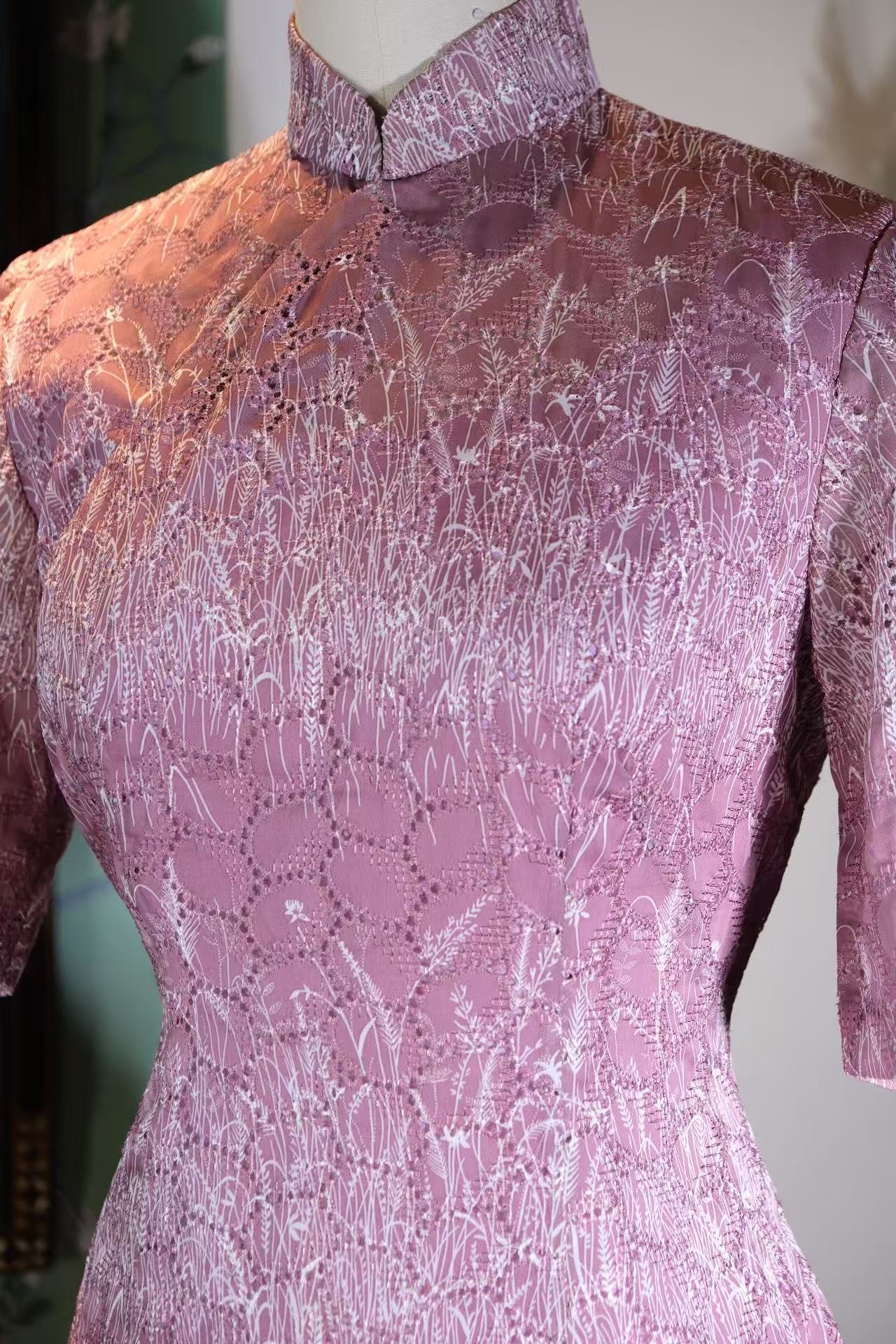
当你凝视这件旗袍,目光首先会被那如烟似雾的粉紫色调所俘获。
衣服上的图案,是整件作品的灵魂所在。
- 构图:图案以细密的白色线条勾勒,呈现出一种“乱中有序”
- 工艺:这并非简单的印花,而是“机绣蕾丝”工艺的杰作。
【回溯岁月:衣中藏着的台湾往事】
这件旗袍产自上世纪六十年代的台湾,那是一个特殊而迷人的年代。
彼时,随着上海及江浙一带的名门望族迁徙至台,
这件旗袍,正是那个“中西合璧”时代的缩影:
1. 剪裁的进化:它保留了旗袍经典的高立领与侧边开衩,
2. 面料的革新:采用机绣蕾丝,
【艺术与稀缺:不可复制的孤品】
从艺术史的角度看,这件旗袍具有极高的研究价值。
正如张爱玲在《更衣记》中所言:“对于不会说话的人,
【结语】
这不仅仅是一件衣服,它是凝固的时光,是流动的历史。
当你穿上它,你穿上的不仅是粉紫色的面料,
珍藏此衣,便是珍藏了一段被遗忘的东方美学记忆。
Measurements / Size Guide:
Bust / Waist / Hips: 94/78/96 cm
Total Length: 115 cm
Detailed Description:
When you gaze upon this qipao, your eyes are first captured by the misty, fog-like lavender-pink hue. This is not the garish brightness of modern industrial dyes, but a "Morandi Pink-Purple" unique to that era—warm as jade and imbued with the quietude of old times.
The patterns are the soul of this piece. Moving away from the traditional bold reds and greens of clustered blossoms, it adopts a highly modern "Abstract Botanical Motif":
Composition: Outlined with dense white lines, the pattern presents a "ordered chaos" reminiscent of natural wildness. These lines resemble reeds swaying in a breeze or a meadow clearing after rain. Without concrete flowers, it evokes the hazy poetic imagery of "the color of grass seen from afar, yet vanishing upon closer look."
Craftsmanship: This is no simple print, but a masterpiece of "Machine-Embroidered Lace." Upon close inspection, the white lines are not merely flat on the fabric; the density of the needlework creates a relief-like texture. This semi-transparent quality allows the warmth of the skin to peek through faintly, perfectly blending Oriental modesty with Western lace romance—a true embodiment of "floating fragrance."
Produced in 1960s Taiwan, this qipao hails from a unique and fascinating era. During this time, as prominent families from Shanghai and the Jiangsu-Zhejiang regions migrated to Taiwan, the tailoring techniques of the "Shanghainese Style" took root on the island. 1960s Taiwan stood on the eve of an economic takeoff, where the social atmosphere preserved the elegant legacy of the Republican era while beginning to embrace the surge of Western culture.
This qipao is a microcosm of that "East meets West" epoch:
The Evolution of Tailoring: It retains the classic high mandarin collar and side slits, emphasizing the curves of the waist and hips. However, the sleeves are designed as slightly wider mid-length sleeves—a modern experiment at the time that remained decent yet added a touch of lightness.
Fabric Innovation: The use of machine-embroidered lace indicates that Taiwan’s textile industry was beginning to integrate industrial production with traditional aesthetics. At the time, such fabric was not only expensive but also avant-garde, a "magnificent attire" reserved for socialites at balls or high-society gatherings.
From the perspective of art history, this qipao holds immense research value. As Eileen Chang noted in Chronicle of Changing Clothes: "To those who cannot speak, clothes are a language; what one carries with them is a pocket drama." Every stitch and thread of this garment speaks of the aesthetic awakening of women in the 1960s. It discards the heavy stacking of complex embroidery in favor of a "less is more" aesthetic of negative space. This minimalist inclination predated international fashion trends by twenty years.
Conclusion: This is more than a garment; it is solidified time and fluid history. To wear it is to wear the breeze of a 1960s Taiwan street and the elegant echoes of a peerless era. To treasure this piece is to preserve a forgotten memory of Oriental aesthetics.