深圳溯源
无法加载取货服务可用情况
衣服尺寸:
胸围/腰围/臀围:96/84/104 厘米
衣长:105 厘米
细节描述:
一、衣上无花,自有乾坤
初见此袍,最摄人心魄处,恰在于它的“无”。
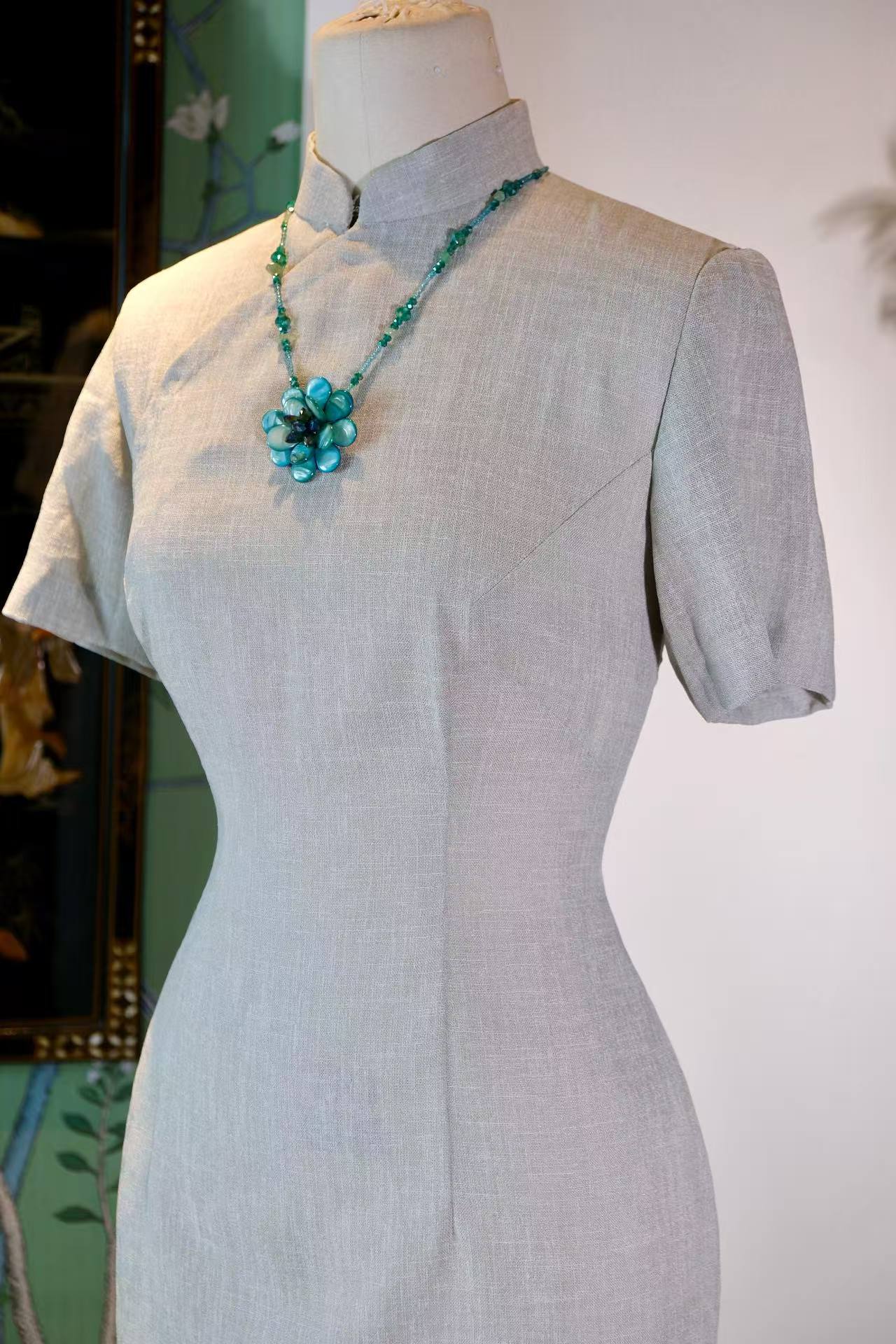
它摒弃了传统旗袍繁复的织锦、刺绣或印花,通体呈现出一种极为素净的浅灰蓝调。这并非单调,而是一种高级的留白。其面料采用上世纪六十年代极为考究的西装级亚麻,经纬之间,依稀可见天然纤维粗粝而温润的肌理。这种肌理本身就是最好的图案——它如同宣纸上的水痕,又似岁月风化的岩层,在光影流转间,呈现出一种名为“素以为绚”的东方美学。
二、香江剪影,流金岁月
这件旗袍诞生于上世纪六十年代的香港,那是东西方文化激烈碰撞又完美融合的黄金时代。
彼时的香港,既有老上海的遗风,又受英伦风尚的浸润。这件旗袍便是那个时代的缩影。它保留了中式旗袍经典的立领与右衽大襟,但在剪裁上,却大胆引入了西式立体剪裁的精髓。
- 腰线的收束极尽贴合,精准地勾勒出女性的S型曲线,这不再是传统平裁旗袍的含蓄遮掩,而是对女性身体自信的现代展示。
- 袖型采用了微微蓬起的短袖,既保留了东方的圆润,又带有一丝西式礼服的端庄。
- 亚麻西装料的使用,更是那个时代摩登女性的象征。她们走出深闺,步入职场与社交场,需要一种既体面、透气,又具挺括感的着装。这种面料在当时多用于男士高级西装,将其用于旗袍,足见当年制作者与穿着者的不凡品味与身份。
我们或许可以构想:半个世纪前,在太平山顶的露台,或在皇后大道的某个转角,曾有一位风华绝代的女子,身着此袍,佩戴着如今系于其上的蓝花项链,在香江的晚风中,留下过惊鸿一瞥。
三、风骨天成,孤品难求
从艺术风格而言,此袍属于典型的“海派”余韵与“港式”改良的结合体。它褪去了清末旗袍的宽博大袖,也未染七十年代迪斯科的浮躁艳丽,它定格在六十年代那份独有的、知性的优雅之中。
- 稀缺性在于面料:历经半世纪,亚麻面料极易脆化或磨损,能保存至今且色泽依旧清丽者,凤毛麟角。
- 稀缺性在于工艺:传统的归拔工艺,全靠裁缝手工塑形,使平面布料产生立体弧度,这种费时费力的手工技艺在现代成衣工业中已近乎绝迹。
- 稀缺性在于意境:在当今喧嚣的时尚界,这样一件“静”得下来、“雅”得进去的古董衣,不仅是衣物,更是一件可穿戴的博物馆级藏品。
“清水出芙蓉,天然去雕饰。”这件六十年代亚麻西装料旗袍,便是这样一首凝固的诗。它不争不抢,却自有一股穿透时光的力量,等待着懂它的人,续写未完的故事。
Measurements / Size Guide:
Bust / Waist / Hips: 96/84/104 cm
Total Length: 105 cm
Detailed Description:
At first glance, the most soul-stirring quality of this cheongsam (qipao) lies precisely in its "emptiness."
It eschews the intricate brocades, embroideries, and prints of traditional qipaos, presenting instead a remarkably serene pale grayish-blue tone. Far from being monotonous, this is a form of high-level Liu Bai (minimalist white space). The fabric utilizes an exquisite, suit-grade linen from the 1960s; between its warp and weft, one can faintly see the coarse yet warm texture of natural fibers. This texture is the pattern itself—resembling watermarks on Xuan paper or weathered rock strata. In the shifting light, it manifests the Eastern aesthetic known as "plainness as the ultimate splendor" (Su Yi Wei Xuan).
Born in 1960s Hong Kong, this qipao emerged during a golden era where Eastern and Western cultures collided fiercely yet merged perfectly.
Hong Kong at that time retained the legacy of Old Shanghai while being steeped in British style. This qipao is a microcosm of that era. It preserves the classic standing collar and right-side large lapel (Dajin), but in its tailoring, it boldly introduces the essence of Western three-dimensional cutting.
The Cinched Waist: Contouring with extreme precision to the female S-curve, this is no longer the reserved concealment of traditional flat-cut qipaos, but a modern display of confidence in the female body.
The Sleeves: Featuring slightly puffed short sleeves, they retain Eastern roundedness while carrying the dignified air of Western formal gowns.
Suit-Grade Linen: The use of linen typically reserved for high-end men's tailoring was a symbol of the modern "New Woman." As they stepped out of the domestic sphere into offices and social arenas, they required attire that was respectable, breathable, and structured. Using such fabric for a qipao speaks volumes of the extraordinary taste and status of both the maker and the wearer.
One might imagine a woman of peerless grace half a century ago, perhaps on a terrace at Victoria Peak or at a corner on Queen's Road, wearing this very gown and the blue floral necklace currently paired with it, leaving a fleeting, breathtaking glimpse in the Hong Kong evening breeze.
Artistically, this gown represents the perfect fusion of "Shanghainese" legacy and "Hong Kong" refinement. It has shed the wide sleeves of the late Qing dynasty and avoided the boisterous flamboyance of 1970s disco, freezing instead the unique, intellectual elegance of the 1960s.
Scarcity of Fabric: After half a century, linen fabric is prone to embrittlement or wear. To find a piece preserved so well, with its color still clear and elegant, is as rare as "phoenix feathers."
Scarcity of Craft: The traditional Gui Ba (iron-shaping) process relies entirely on the tailor's manual labor to sculpt flat cloth into three-dimensional curves. This time-consuming handicraft has nearly vanished in today's industrial garment industry.
Scarcity of Mood: In today's clamorous fashion world, an antique garment that can remain so "quiet" and "refined" is not merely clothing—it is a wearable, museum-grade collectible.
"Like a lotus rising from clear water, naturally free from adornment." This 1960s linen-suit qipao is a solidified poem. It does not compete, yet it possesses a power that pierces through time, waiting for someone who understands its soul to continue the story.