深圳溯源
无法加载取货服务可用情况
如果说驼色套装是Woo女士行走商界的沉稳底色,
一、视觉的盛宴:蕾丝与剪绒的几何变奏
这套套装最令人过目难忘的,是其大胆而精妙的色彩与材质运用。
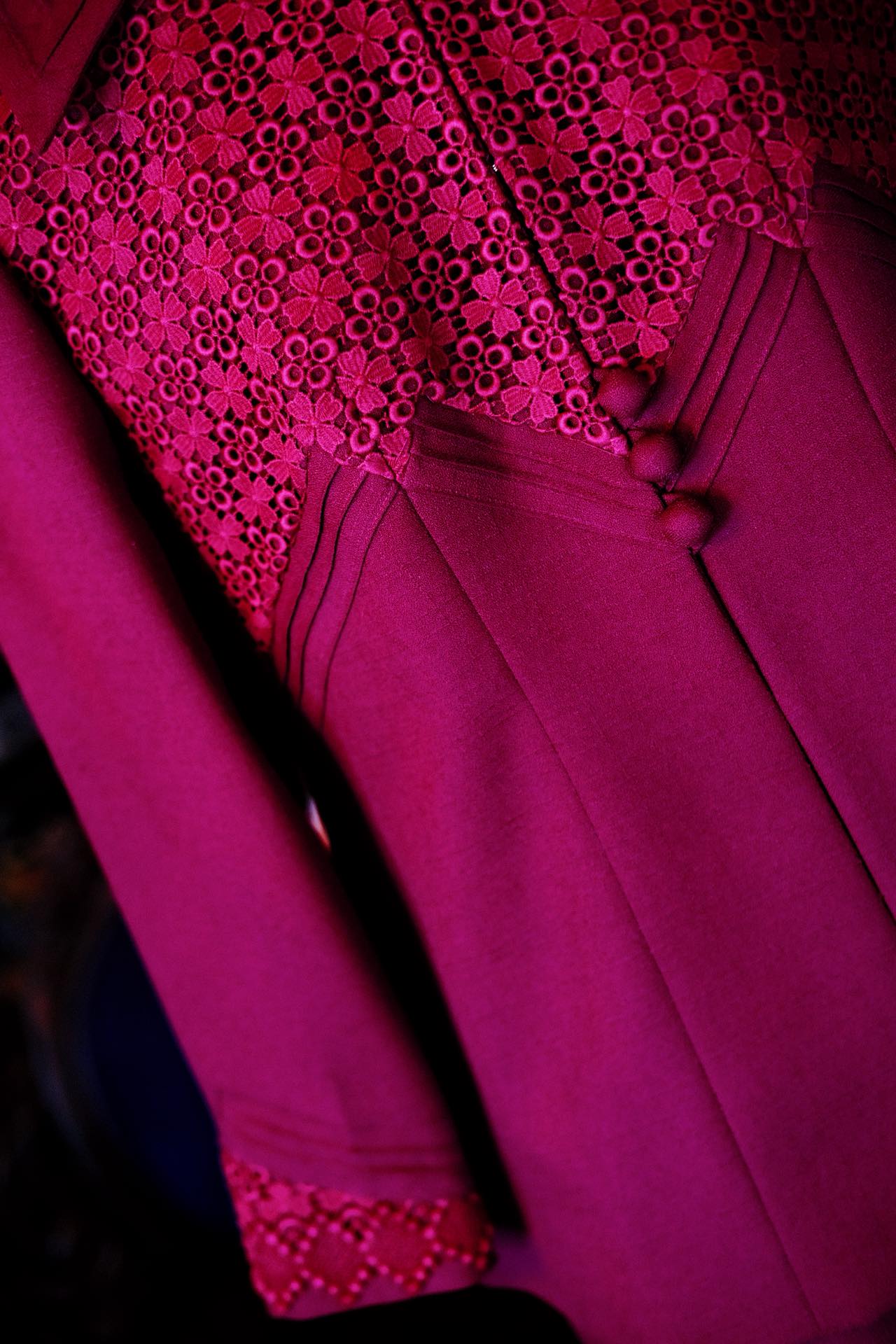
- 色彩:它采用了一种极为少见的“皇家紫”或“洋红”色调。
- 材质拼接:
- 工艺细节:
- 剪绒褶裥:在蕾丝下方与腰部连接处,设计师运用了数道平行的“
- 包布盘扣:门襟处点缀着三枚同色系的包布琵琶扣,造型圆润饱满。
- 领口与袖口:宽大的西装翻领上同样装饰着蕾丝贴花,
二、衣以载道:九龙太子道上的时尚传奇
衣服内衬的一枚标签,为我们揭开了这件华服的身世之谜——“
这不仅仅是一个地址,更是一个时代的符号。六十年代的太子道,
Woo女士的故事在这里得到了最生动的注脚。她虽然远渡重洋,
这套衣服,是Woo女士作为“世界公民”的另一面:在加拿大,
三、稀缺性:不可复制的黄金年代孤品
从收藏的角度来看,这套衣服的价值不可估量:
- 保存状态:历经半个多世纪,面料依然色泽鲜艳,蕾丝未见破损,
- 设计孤品:这并非工厂流水线的大货,
- 历史见证:它见证了六十年代香港作为“东方好莱坞”
拥有这套衣服,不仅是拥有了一件美丽的古董,
If the camel suit was the grounded foundation of Ms. Woo’s corporate presence, then this purplish-red lace-spliced ensemble—crafted by the renowned "Mee Lee Company" (美麗公司) in Hong Kong—marks her most dazzling high-society highlight of the 1960s. This rich, mysterious shade of violet not only asserts the noble status of its wearer but reads like a love letter to the golden era of the "Paris of the East"—passionate, intricate, and bursting with vitality.
The most unforgettable aspect of this ensemble is its bold, masterly combination of vibrant color and contrasting material textures:
The Chromatic Statement: The garment utilizes a rare "Royal Purple" or heavy magenta hue. In the 1960s, such high-saturation tones were an absolute fashion manifesto—possessing traditional Eastern opulence while channeling the vivid palette of Western Pop Art.
Material Splicing: The designer ingeniously contrasts the ethereal transparency of lace with the substantial weight of tailored wool. The expansive lace panel across the chest features a classical "Plum Blossom Mesh" (Wangyan Meihua) motif, balancing Western romanticism with the Eastern symbol of resilience and the "Five Blessings."
Architectural Artistry:
Sheared-Plush Pleating (Jianrong Zhejian): Where the lace meets the waist, several parallel lines of hand-folded pleats form crisp, piano-key-like structural ridges, granting the jacket an exquisite architectural dimension.
Fabric-Wrapped Frog Buttons: The placket is punctuated by three perfectly rounded, self-fabric wrapped Pipa frog buttons. This quintessential Chinese element anchors the garment’s Eastern lineage.
Symmetrical Appliqué: The wide Western lapels and cuffs are adorned with matching lace trim, creating a beautifully cohesive visual loop.
A woven label stitched into the lining reveals the true provenance of this magnificent couture piece: "Mee Lee Company, 157C Prince Edward Road, Kowloon."
This is more than an address; it is the definitive coordinate of an era. In the 1960s, Prince Edward Road was the prestigious residential vein of the Kowloon Peninsula and a bustling hotbed for Hong Kong’s premier dressmakers. The name "Mee Lee" (literally meaning Beautiful Company) carries the straightforward, elegant simplicity of mid-century branding. It represents the pinnacle of Hong Kong's tailoring golden age and the discerning demands of elite global clients like Ms. Woo.
Ms. Woo's narrative finds its most vivid footnote here. Though she crossed oceans to build a Canadian empire, her roots, lifestyle, and social etiquette remained deeply tethered to Hong Kong. She chose not to blindly accept Western dress, but instead returned to Hong Kong's most fashionable avenue—allowing masters who intimately understood the East Asian female form to reshape tradition through cutting-edge design languages (lace splicing and geometric framing).
This ensemble reveals another facet of her identity as a true "World Citizen": in Canada, she was the iron-willed supermarket pioneer; but clad in this royal violet, she was the enigmatic, elegant elite from the East.
From a curatorial and archival perspective, the historical value of this ensemble is extraordinary:
Museum-Grade Preservation: To survive over half a century with its vivid coloration completely unfaded and its delicate lace structurally flawless is an exceptional anomaly in textile conservation.
Bespoke Exclusivity: This is not a factory ready-to-wear piece, but a commissioned work from a celebrated mid-century Hong Kong fashion house. Utilizing large-scale lace panels on a structured outerwear jacket was an avant-garde design leap for the 1960s, resulting in an exceptionally low survival rate.
Cultural Artifact: It archives the brilliance of 1960s Hong Kong when it reigned as a global fashion capital, while charting the sociological ascension of diasporic Chinese women into the upper echelons of international society.
To possess this ensemble is to hold a physical manifestation of courage, elite taste, and a legendary chapter of transnational sartorial history.