深圳溯源
无法加载取货服务可用情况
衣服尺寸:
胸围/腰围/臀围:98/86/106 厘米
衣长:105 厘米
细节描述:
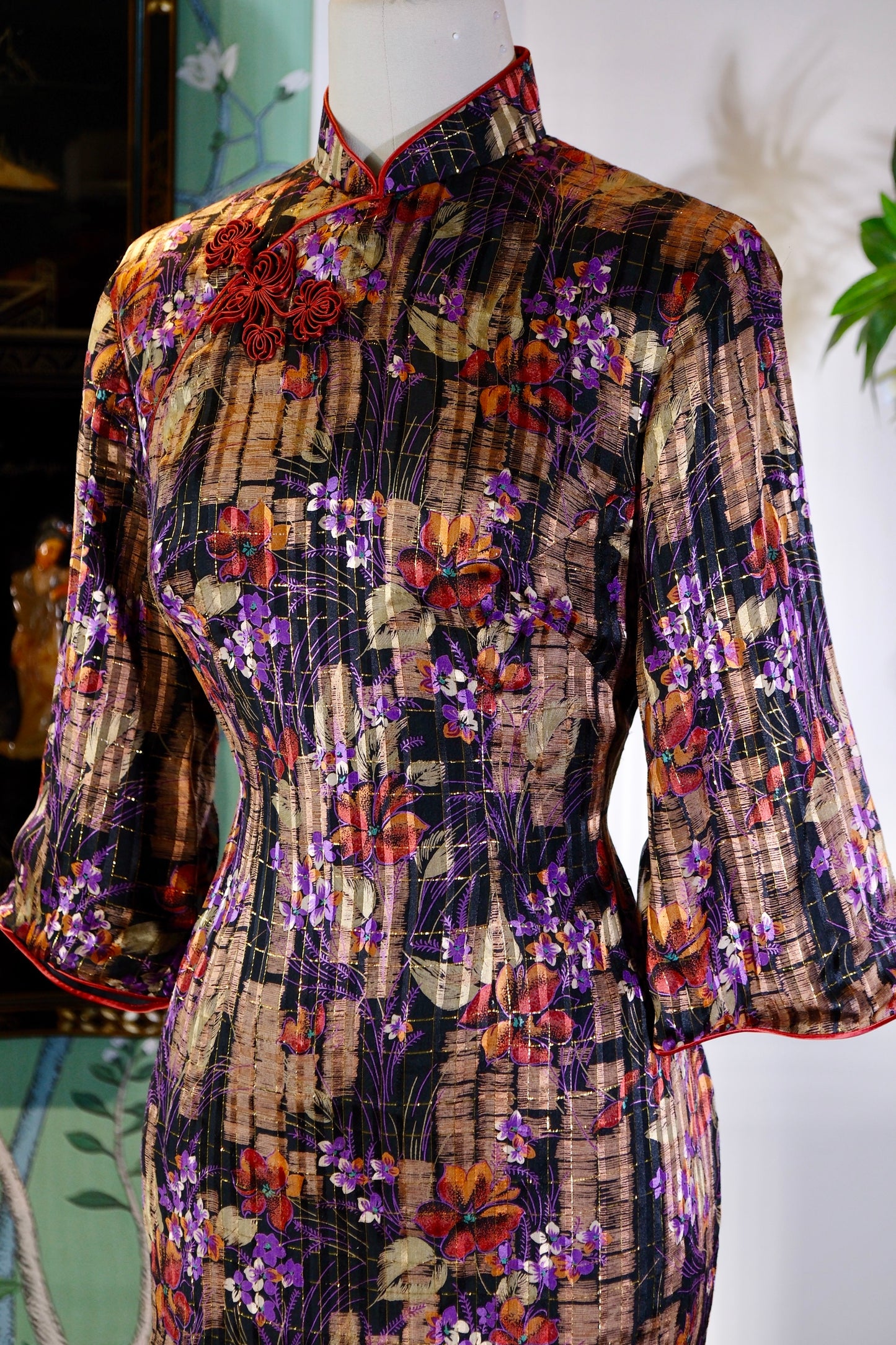
当指尖抚过这件六十年代香港产旗袍的织金面料时,仿佛触碰到时光的肌理。这件由意大利进口面料制成的古董衣,以深色为底,缀满紫红相间的花卉纹样,金线织就的格纹若隐若现,如《天工开物》所言“织金为彩,灿若云霞”,将东方传统纹样与西方纺织工艺巧妙融合,成就了一段跨越时空的艺术对话。
图案:东西方美学的共生密码
旗袍上的花卉图案并非简单的堆砌,而是暗合了中国传统“折枝花卉”的构图智慧。紫色鸢尾与红色牡丹错落有致,既保留了宋代院体画“格物致知”的写实精神,又融入了西方Art Deco风格的几何秩序感。金线织就的格纹背景,如同《营造法式》中的“格子门”纹样,以规整的线条分割空间,使繁复的花卉图案在视觉上获得平衡。这种“以金为骨,以花为魂”的设计,正是六十年代香港作为东西方文化交汇点的生动注脚。
故事:香港裁缝的黄金时代
六十年代的香港,是旗袍制作的黄金年代。彼时上海裁缝南迁,将海派旗袍的精致剪裁与香港本土的多元文化相融合,创造出既保留传统韵味又符合现代审美的新式旗袍。这件旗袍的意大利进口面料,见证了当时香港作为国际贸易港的繁荣——欧洲的高级面料通过海运抵达维多利亚港,再由本地裁缝以“归拔”工艺塑形,最终成就这件“中西合璧”的杰作。正如张爱玲在《更衣记》中所写:“旗袍的衣料,是时代的镜子”,这件旗袍的面料选择,正是那个时代香港开放与包容的缩影。
稀缺性:织金工艺的绝唱
意大利进口的织金面料,在六十年代已是奢侈品。这种面料采用古老的“金线织造”工艺,将真丝与金箔复合成线,再与彩色丝线交织,每寸面料都需耗费大量工时。随着工业化生产的普及,这种费时费力的手工织金工艺逐渐式微,使得存世的六十年代织金旗袍凤毛麟角。更难得的是,这件旗袍保留了完整的传统工艺:手工盘扣以“秋日菊”造型呈现,领口与袖口的红色滚边采用“嵌线”工艺,每一处细节都彰显着“慢工出细活”的匠人精神。
艺术风格:复古与现代的交响
从艺术风格来看,这件旗袍既保留了传统旗袍的“S”型曲线剪裁,又在袖型上做了创新——喇叭袖的设计打破了传统旗袍的拘谨,增添了几分六十年代的摩登气息。这种“传统为体,现代为用”的设计理念,与同时期的西方高级定制时装不谋而合,却又独具东方韵味。正如艺术史家贡布里希所言:“艺术史是风格的历史”,这件旗袍正是六十年代东方时尚风格的绝佳代表。
当我们在博物馆的展柜中看到这件旗袍时,它不仅是一件衣物,更是一部凝固的历史。它见证了香港的黄金年代,承载了东西方文化的交融,也记录了织金工艺的辉煌。正如《诗经》所云:“锦衣狐裘,颜如渥丹”,这件旗袍的美,不仅在于其华丽的面料与精致的工艺,更在于它所承载的时代记忆与文化价值——这,正是古董衣最动人的地方。
Measurements / Size Guide:
Bust / Waist / Hips: 98/86/106 cm
Total Length: 105 cm
Detailed Description:
When your fingertips brush across the woven gold (Zhijin) fabric of this 1960s Hong Kong-made qipao, it feels as though you are touching the very texture of time. Crafted from antique Italian imported silk, this garment features a deep-toned base adorned with lush violet and crimson floral motifs. Subtle golden threads form an underlying lattice, embodying the sentiment from Tiangong Kaiwu: "Woven gold creates colors as brilliant as sunset clouds." It is a masterful fusion of traditional Oriental patterns and Western textile artistry—a dialogue of art spanning time and space.
The floral designs are not mere embellishments but align with the compositional wisdom of traditional Chinese "broken-branch blossoms" (Zhezhi). The staggered violet irises and red peonies retain the realistic spirit of Song Dynasty academy painting while integrating the geometric order of Western Art Deco. The gold-woven lattice background mirrors the "lattice door" (Gezimen) patterns found in the Yingzao Fashi (State Building Standards), using structured lines to balance the complex florals. This design of "gold as the bone and flowers as the soul" is a vivid footnote to 1960s Hong Kong as a cultural crossroads.
The 1960s represented the pinnacle of Hong Kong qipao craftsmanship. As Shanghainese tailors migrated south, they blended the exquisite "Haipai" cut with Hong Kong’s multiculturalism. The Italian imported fabric of this piece testifies to Hong Kong’s prosperity as an international port; high-end European textiles arrived via Victoria Harbour, only to be shaped by local masters using the "stretching and shrinking" (Gui-Ba) technique. As Eileen Chang noted in A Record of Changing Clothes: "The fabric of a qipao is the mirror of an era." This choice of material epitomizes the openness and inclusivity of 1960s Hong Kong.
Italian woven gold fabric was already a luxury in the 1960s. This process involves composite threads of silk and gold leaf interlaced with colored silk—a labor-intensive craft where every inch requires immense man-hours. With the rise of industrial mass production, this "slow craft" faded, making surviving 1960s woven gold qipaos exceptionally rare. Furthermore, this piece retains complete traditional details: hand-fashioned "Autumn Chrysanthemum" flower buttons (Pankou) and red "piping" (Kuan-Xian) along the collar and cuffs, showcasing the meticulous spirit of "fine work through slow labor."
Artistically, this qipao preserves the classic "S-curve" silhouette but innovates with its sleeve shape—the bell sleeves break the traditional reserve, adding a touch of 1960s modernism. This philosophy of "Tradition as the Body, Modernity as the Use" aligns with Western Haute Couture of the same era yet remains uniquely Oriental. As E.H. Gombrich stated: "The history of art is a history of styles." This qipao is a definitive representative of 1960s Oriental fashion.
As the Book of Songs says: "In brocade robes and fox furs, a face like vermilion." The beauty of this qipao lies not just in its magnificent fabric, but in the era-defining memories and cultural values it carries—the most moving essence of any antique garment.