深圳溯源
无法加载取货服务可用情况
衣服尺寸:
胸围/腰围/臀围:88/74/98 厘米
衣长:95 厘米
细节描述:
在浩瀚的服装史长河中,有些衣物并非仅仅是蔽体之物,它们更像是一枚枚凝固的时间胶囊,封存着特定时代的美学密码与工艺智慧。眼前这袭诞生于上世纪六十年代台湾的玫红色机绣旗袍,便是这样一件穿越时空而来的瑰宝。
图案描述:繁花似锦的几何诗篇
这袭旗袍最摄人心魄之处,在于其面料上繁复而精致的刺绣图案。若以传统文学的笔触描绘,这并非寻常的写意花鸟,而是一种极具装饰主义风格的“宝相花纹”变体。
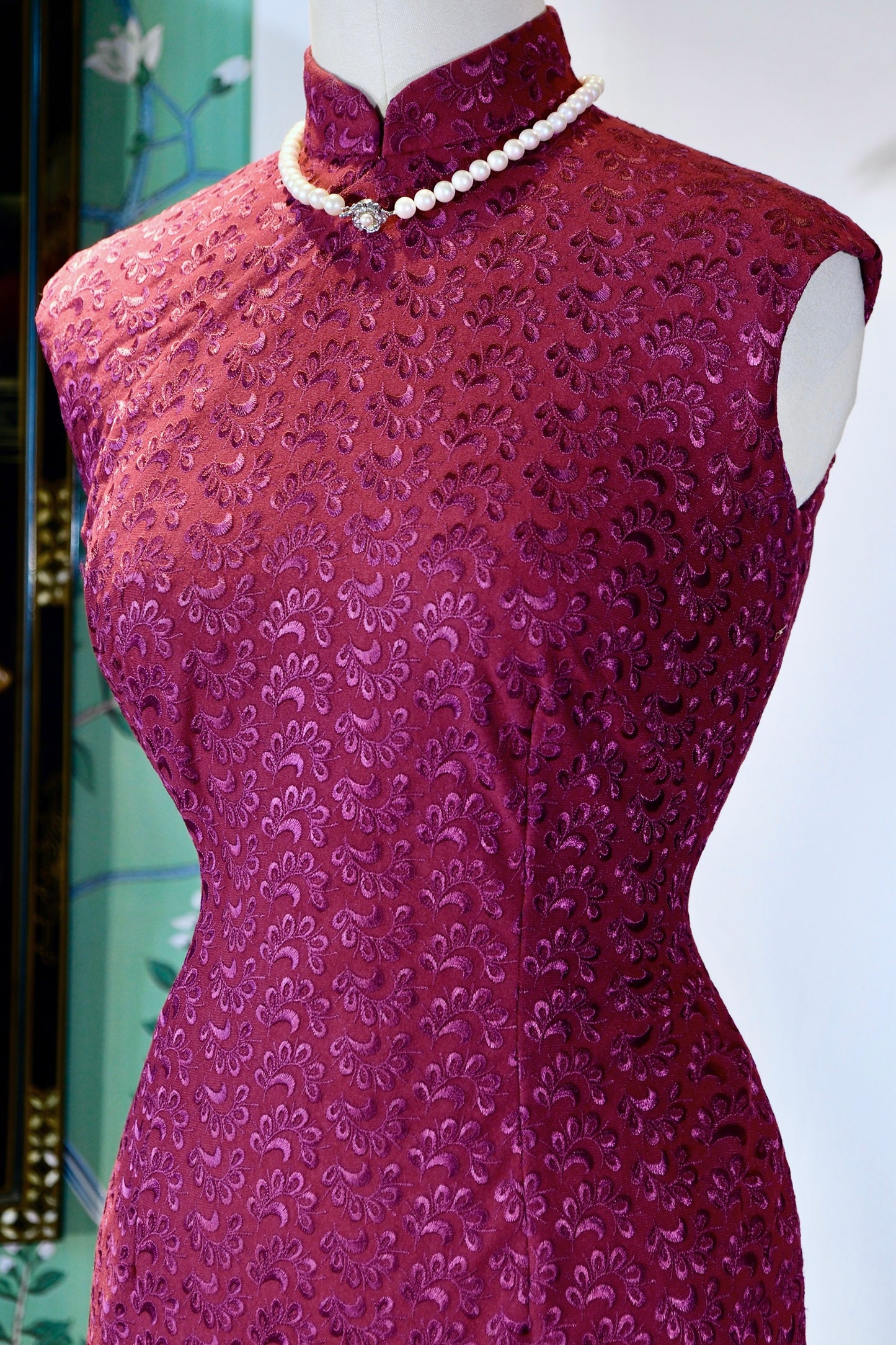
- 纹样肌理:整件旗袍通体覆盖着密集的刺绣,采用了当时极为先进的机绣工艺。图案以卷草纹为骨架,穿插着抽象化的花叶形态,形成了一种连绵不绝、循环往复的视觉韵律。这种纹样在古典语境中可称之为“缠枝”或“万寿藤”,寓意着生生不息。
- 光影交织:深紫红色的底料沉稳而华贵,其上覆盖的亮粉色绣线,在光线下呈现出一种浮雕般的立体感。这种“色地起花”的工艺,使得图案在暗处隐而不发,明处则流光溢彩,宛如“紫陌红尘拂面来”的盛景。
- 工艺特征:值得注意的是,六十年代的机绣并非如今日般粗糙,而是保留了一种独特的“拙朴感”。针脚细密规整,却又带有一种机械与手工结合的温度,每一针每一线都像是在诉说着那个工业初兴年代的严谨与浪漫。
故事与溯源:宝岛风华的流金岁月
上世纪六十年代,是台湾旗袍发展的黄金时代,也是东西方文化剧烈碰撞与融合的时期。
- 历史背景:彼时,随着国民政府迁台,大量江浙沪的裁缝师傅将海派旗袍的精髓带到了台湾。不同于上海时期的妖娆与市井气,台湾旗袍在保留修身剪裁的同时,更多地融入了一种端庄与学院派的清雅。
- 这袭旗袍的主人:我们可以想象,这袭旗袍或许曾属于一位驻台外交官的夫人,或是某位书香门第的千金。在那个没有快时尚的年代,拥有一件如此重工的机绣旗袍,是身份与品味的象征。它可能曾出现在台北圆山大饭店的晚宴上,伴着爵士乐轻轻摇曳;也可能曾在东吴大学的毕业典礼上,见证过一位少女的高光时刻。
- 稀缺性:随着时间推移,这种高克重、满工刺绣的面料已极难寻觅。当年的机绣设备多已淘汰,而这种特定的玫红色染料与绣线配比,更是那个时代的绝响。它是一件不可复制的孤品。
艺术风格:中西合璧的装饰美学
从艺术风格上审视,这袭旗袍完美诠释了“中学为体,西学为用”的美学理念。
- 剪裁:它采用了经典的无袖高领设计,领口紧扣,展现出东方女性颈部的修长与含蓄;而腰身的收省剪裁,则明显受到了西方立体剪裁的影响,勾勒出曼妙的S型曲线。正如张爱玲在《更衣记》中所言:“各人住在各人的衣服里。”这袭旗袍,便是一个优雅的灵魂居所。
- 色彩:玫红色(Magenta)在色彩心理学中代表着热烈与高贵,而在传统色谱中,它介于“妃色”与“洋红”之间,既有传统的喜庆,又不失现代的摩登。
- 意境:整衣无一处不精致,却又无一处在炫耀。它像是一首工整的律诗,平仄押韵,格律严谨,却又在字里行间流淌着无尽的情思。
结语
这不仅仅是一袭旗袍,这是一段可以被触摸的历史,是一幅行走的画卷。它承载着六十年代台湾的温度,凝结着那个时代工匠的心血。穿上它,你穿上的不仅是华服,更是一段关于优雅、关于传承、关于时光的传奇。
Measurements / Size Guide:
Bust / Waist / Hips: 88/74/98 cm
Total Length: 95 cm
Detailed Description:
In the vast river of costume history, some garments are more than mere coverings; they are like frozen time capsules, sealing within them the aesthetic codes and artisanal wisdom of a specific era. This rose-crimson (Magenta) machine-embroidered Qipao, born in 1960s Taiwan, is exactly such a gem that has traveled through time and space.
Pattern Description: A Geometric Poem of Blooming Splendor
The most arresting feature of this Qipao lies in the intricate and exquisite embroidery patterns upon its fabric. Described through the lens of traditional literature, these are not ordinary freehand flora and fauna, but rather a variant of the "Baoxiang Floral Motif" (an idealized, composite floral pattern) rendered in a highly Deco-decorative style.
Pattern Texture: The entire Qipao is covered in dense embroidery, utilizing the most advanced machine-embroidery technology of the time. The patterns use scrolling vines (Juan-cao) as the skeleton, interspersed with abstracted floral and leaf forms, creating a continuous and cyclical visual rhythm. In a classical context, this motif can be called "Scrolling Tendrils" or "Longevity Vines," symbolizing eternal vitality.
Interplay of Light and Shadow: The deep violet-red base fabric is steady and regal, overlaid with bright pink embroidery threads that present a relief-like three-dimensionality under the light. This "Pattern on Colored Ground" (Se-di Qi-hua) technique allows the pattern to remain subtle in shadow while becoming resplendent in light, evoking a grand scene of "crimson petals drifting through the bustling streets."
Craftsmanship Characteristics: Notably, machine embroidery in the 1960s was not as crude as today’s mass production; it retained a unique "honest simplicity." The stitches are fine and orderly, yet possess a warmth born from the union of machine and hand, with every needle and thread narrating the rigor and romance of the early industrial age.
Story and Provenance: The Golden Years of Island Elegance
The 1960s marked the golden age of Qipao development in Taiwan—a period of intense collision and fusion between Eastern and Western cultures.
Historical Background: At that time, as the Nationalist government relocated to Taiwan, a large number of master tailors from the Jiangnan and Shanghai regions brought the essence of the "Haipai" (Shanghai-style) Qipao to the island. Distinct from the seductive and worldly vibe of the Shanghai period, Taiwanese Qipaos retained the slim-fit cut while integrating a sense of dignified and academic refinement.
The Owner of this Qipao: One can imagine that this Qipao might have belonged to the wife of a diplomat stationed in Taiwan, or a daughter of a scholarly lineage. In an age without fast fashion, owning such a heavy-work embroidered Qipao was a symbol of status and taste. It might have appeared at a banquet at the Grand Hotel Taipei, swaying gently to jazz music, or at a graduation ceremony at Soochow University, witnessing a young woman's moment of glory.
Scarcity: With the passage of time, this high-gram-weight, fully-embroidered fabric has become extremely difficult to find. The machine-embroidery equipment of that era has mostly been decommissioned, and the specific ratio of rose-crimson dye to embroidery thread is an echo of the past. It is an irreplaceable "one-of-a-kind" piece.
Artistic Style: A Decorative Aesthetic of East Meets West
From an artistic perspective, this Qipao perfectly interprets the aesthetic philosophy of "Chinese Essence, Western Application."
Tailoring: It adopts the classic sleeveless, high-collar design with a tightly fastened neckline, showcasing the slender and reserved neck of the Eastern woman. The waist darts and shaping clearly show the influence of Western three-dimensional tailoring, outlining a graceful S-curve. As Eileen Chang noted in Chronicle of Changing Clothes: "Each person lives in their own clothes." This Qipao is indeed an elegant dwelling for the soul.
Color: Magenta represents passion and nobility in color psychology. In the traditional Chinese spectrum, it sits between "Fei" (consort crimson) and "Yang-hong" (Western red), possessing both traditional festivity and modern sophistication.
Mood: The entire garment is exquisite in every detail, yet nowhere is it boastful. It is like a well-structured regulated poem (Lüshi), following strict tonal patterns and rhymes, yet flowing with endless sentiment between the lines.
Conclusion
This is not just a Qipao; it is a piece of history that can be touched, a walking scroll of art. It carries the warmth of 1960s Taiwan and condenses the painstaking effort of that era's craftsmen. To wear it is to wear more than fine clothing—it is to wear a legend of elegance, heritage, and time.