深圳溯源
无法加载取货服务可用情况
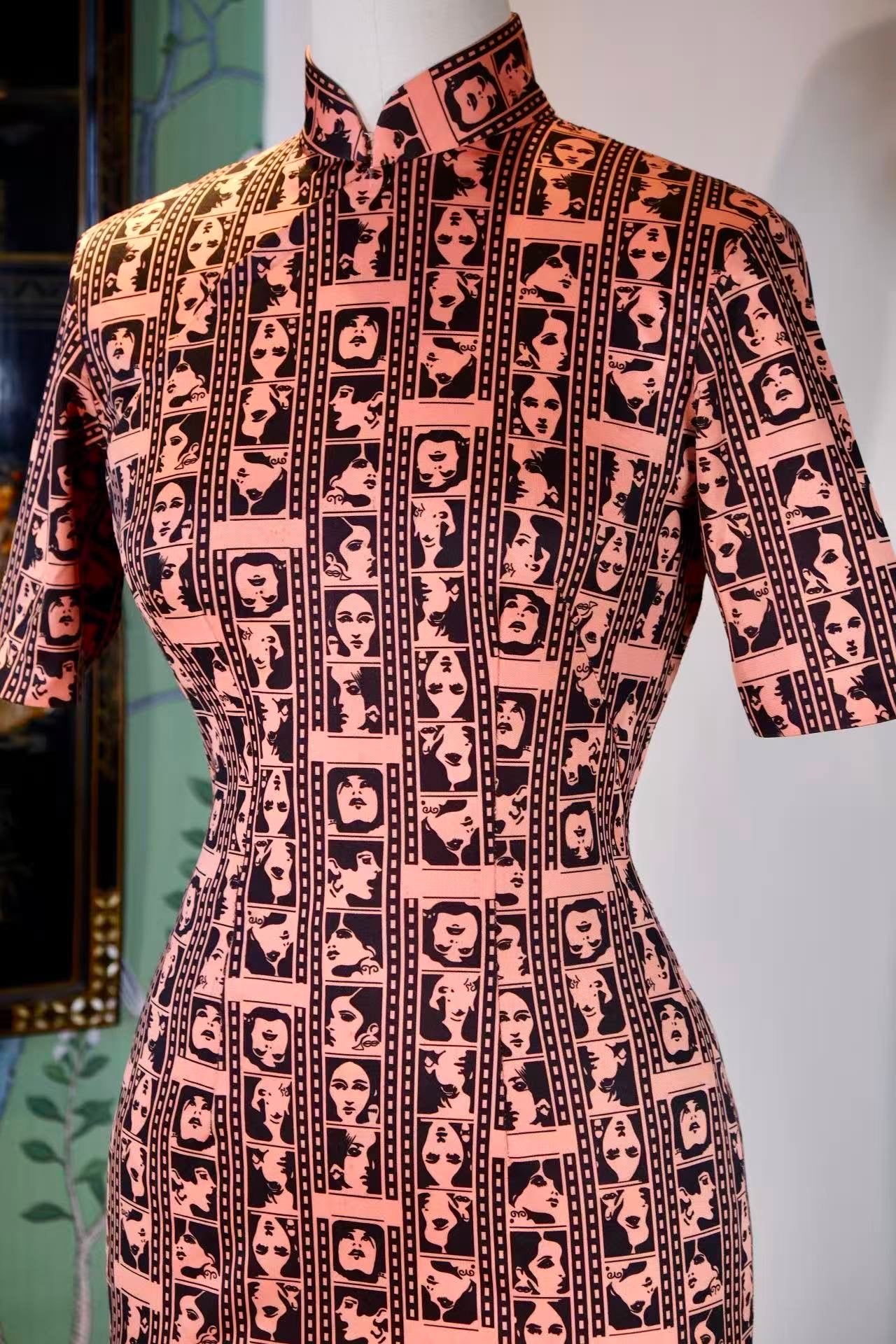
胶片上的诗篇:六十年代香港波普旗袍
当安迪·沃霍尔的金宝汤罐头正在纽约美术馆引发争议,
胶片上的蒙太奇:面孔的重复与解构
凝视这件旗袍,首先攫取观者心神的,是那铺天盖地、
此种“重复”的美学,恰与六十年代波普艺术的核心精神遥相呼应。
都市丽人的镜像:香港的摩登身份
追溯其文化渊源,六十年代的香港,
它不再描绘传统刺绣中常见的花鸟鱼虫或吉祥纹样,
工艺与时光的绝响:稀缺性的见证
从服装史的学术视角审视,这件旗袍的稀缺性更显珍贵。
它不仅是服装史中“新潮旗袍”的典范,
总而言之,这件六十年代香港产的波普风格旗袍,
While Andy Warhol’s Campbell’s Soup cans were sparking controversy in New York galleries, the master tailors along the shores of Hong Kong were using nimble needles and thread to inject the lifeblood of Pop Art into the most classic vessel of Oriental fashion: the Qipao. This rare antique piece is a "wearable cinematograph"—its fabric a visual poem written in celluloid.
To gaze upon this Qipao is to be seized by a recurring, polyphonic print. The designer used the sprocket holes of film as the warp and the countenances of silent-film starlets as the weft, weaving a fluid visual montage. Countless rectangular frames are linked tightly, like a strip of negative pulled slowly from a camera. Within each frame lies a stylized female face—glancing back with a smile, lost in contemplation, or with lips slightly parted. Rendered in a high-contrast palette of black and pink, these motifs freeze, decompose, and reconstruct silver-screen imagery onto soft fabric.
This aesthetic of "repetition" echoes the core spirit of 1960s Pop Art. Much like Warhol’s repetitive Marilyn Monroe portraits, the myriad faces on this Qipao dissolve individual uniqueness into an exploration of celebrity symbolism in the age of mass media. Every inch of fabric is a frozen moment of light and shadow; every wearing is a private film screening.
In the 1960s, Hong Kong sat at the golden intersection of East and West. The post-war economic boom gave rise to a new middle class, and the burgeoning film industry—led by studios like the Shaw Brothers—turned screen goddesses into fashion icons for the urban woman. The patterns on this Qipao are a precise mirror of this era’s psyche.
Departing from traditional motifs of birds, flowers, or auspicious symbols, this garment boldly prints elements of modern technology and the entertainment industry—the "film strip"—directly onto the cloth. It is both a tribute to the Golden Age of Hollywood and an expression of Hong Kong’s cultural confidence as the "Oriental Hollywood." The woman wearing it donned the entire glamour of the Hong Kong entertainment circuit, embodying the poise of a modern metropolis.
From a historical perspective, the scarcity of this piece is profound. Though Hong Kong’s garment industry was transitioning from workshops to industrialization, the precision of this print and the sophisticated "suitable fit" that emphasizes the feminine silhouette reveal the pinnacle of Hong Kong’s tailoring prowess. That the patterns remain sharp and the colors vivid after half a century is a rarity among printed textiles of that period.
This is more than a masterpiece of the "Trendy Qipao" (新潮旗袍); it is an invaluable artifact for studying the visual and material culture of 1960s Hong Kong. It stands as a witness to an era where women broke free from traditional constraints to embrace modernity and self-expression. Every stitch and every swatch of fabric carries a collective memory of Hong Kong, of cinema, and of beauty.
"In essence, this 1960s Hong Kong-made Pop Art Qipao is a work of art that transcends the boundaries of everyday attire. It freezes the fluidity of cinema upon a static medium and elevates the symbols of mass culture into a deeply personal fashion statement. It is history made wearable—a Pop poem printed on silk. Its singular artistic charm and rare historical significance make it a coveted treasure for any vintage connoisseur or cultural researcher."