深圳溯源
无法加载取货服务可用情况
衣服尺寸:
胸围/腰围/臀围:90/78/98 厘米
衣长:100 厘米
细节描述:
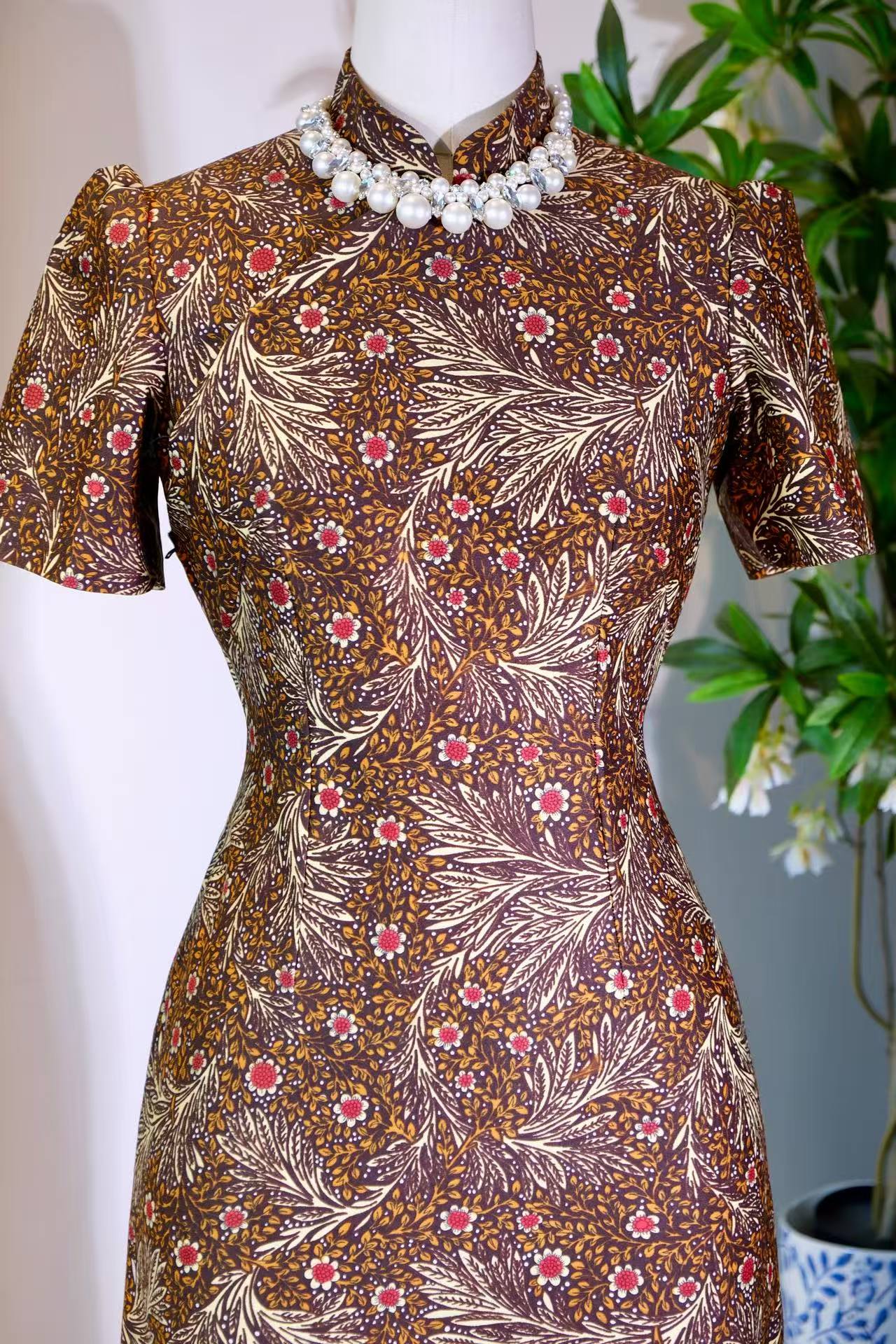
一、纹样考据:从《楚辞》走出的“蔓草纹”
这袭旗袍的纹样,实为“蔓草纹”的当代演绎。其图案以棕褐为底,米白线条勾勒出卷曲舒展的草叶,间缀粉白小花,恰如《诗经·郑风》“野有蔓草,零露漙兮”的视觉化呈现——草叶如波浪般连绵不绝,小花似晨露点缀其间,暗合“蔓草”象征的“生生不息”之意。
这种纹样并非偶然:六十年代香港纺织业正处黄金期,设计师将传统“卷草纹”(源自唐代宝相花)简化为更现代的几何线条,既保留“草色入帘青”的东方意境,又呼应西方“波普艺术”的抽象美学。棕褐底色沉稳如土地,粉白小花则似“犹抱琵琶半遮面”的含蓄,与张爱玲笔下“束身旗袍,流苏披肩,阴暗的花纹里透露着阴霾”的冷艳形成反差,更显温婉。
二、形制密码:泡泡袖里的“东西碰撞”
旗袍的泡泡袖是六十年代香港时尚的缩影。彼时香港作为“东方好莱坞”,电影明星如林黛、乐蒂常穿改良旗袍亮相,泡泡袖正是对西方“New Look”廓形的本土化改造——既保留旗袍的收腰曲线,又以蓬松袖型平衡传统旗袍的拘谨,暗合《花样年华》中苏丽珍“旗袍是她的第二层皮肤”的隐喻:既要端庄,也要呼吸。
三、稀缺性:港制古董衣的“时代孤本”
这件旗袍的稀缺性,藏在两个细节里:
- 工艺密码:面料为棉质提花,经纱显花工艺使图案立体如浮雕,而现代数码印花难以复刻这种“手工感”。更难得的是,整件旗袍无拼接痕迹,说明当年裁剪时面料损耗率超30%——这在物资匮乏的六十年代,是“奢侈”的代名词。
- 文化断层:七十年代后,香港时尚转向西式成衣,旗袍逐渐退出日常。这件成衣恰好定格了“传统与现代”的最后交汇点,正如学者李欧梵所言:“六十年代的香港,是东方的巴黎,旗袍是流动的盛宴。”
四、故事想象:谁曾穿过它?
或许它属于一位香港女教师:清晨乘天星小轮过海,旗袍下摆扫过船舱木椅,泡泡袖在讲台前扬起粉笔灰;或许它是某位商贾千金的订婚礼服,粉白小花暗合“百年好合”的寓意,棕褐底色则显家族沉稳。如今,它静卧于展柜,像一封未拆的家书,等待新的主人续写故事。
结语:穿在身上的“时间胶囊”
这件旗袍,是六十年代香港的“时间胶囊”——它装着《楚辞》的蔓草、西方的泡泡袖、港岛的晨雾,更装着那个时代女性对“美”的执着:既要传统底蕴,也要现代自由。正如柯灵所言:“旗袍的玄妙在领,在襟,在这与那之间。”而这袭蔓草纹旗袍,恰在“传统与现代之间”,开出了永不凋零的花。
Measurements / Size Guide:
Bust / Waist / Hips: / / cm
Total Length: cm
Detailed Description:
The motif of this cheongsam (qipao) is a contemporary interpretation of the "Creeping Vine" (Mancao) pattern. Against a brownish-tan base, cream-white lines outline curling, spreading grass leaves, interspersed with tiny pinkish-white blossoms. It is a visual realization of the lines from the Classic of Poetry: "In the wild there are creeping vines, with falling dew so heavy"—the leaves flow like unceasing waves, and the flowers are like morning dew, subtly echoing the symbolism of "endless vitality."
This pattern is no coincidence: in the 1960s, Hong Kong's textile industry was in its golden age. Designers simplified the traditional "Scrolling Grass" motif (derived from the Tang Dynasty's Baoxiang flower) into modern geometric lines. This retained the Eastern mood of "the green of the grass reflects through the curtains" while responding to the abstract aesthetics of Western Pop Art. The brownish-tan base is as steady as the earth, while the pink-white flowers exude a "veiled" restraint—a warm contrast to the cold glamour described by Eileen Chang.
The puff sleeves of this qipao are a microcosm of 1960s Hong Kong fashion. As the "Hollywood of the East," Hong Kong’s cinema stars like Lin Dai and Betty Loh Ti often appeared in modernized qipaos. The puff sleeve was a localized adaptation of the Western "New Look" silhouette—retaining the cinched waist while using voluminous sleeves to balance the traditional qipao's stiffness. It aligns with the metaphor of Su Li-zhen in In the Mood for Love: "The qipao is her second skin"—one that demands both dignity and room to breathe.
The scarcity of this piece is hidden within two specific details:
The Craftsmanship Code: The fabric is a cotton jacquard. The warp-thread patterning gives the design a 3D, relief-like texture that modern digital printing simply cannot replicate. More impressively, the garment shows no拼接 (patchwork) traces, meaning the fabric wastage during cutting exceeded 30%—a true synonym for "luxury" in the resource-scarce 1960s.
Cultural Discontinuity: After the 1970s, Hong Kong fashion shifted toward Western ready-to-wear, and the qipao gradually withdrew from daily life. This piece perfectly freezes the final intersection of "tradition and modernity." As scholar Leo Ou-fan Lee noted: "Hong Kong in the 1960s was the Paris of the East, and the qipao was a moveable feast."
Perhaps it belonged to a Hong Kong schoolteacher, crossing the harbor on the Star Ferry at dawn, her hem brushing the wooden seats, her puff sleeves stirring chalk dust at the lectern. Or perhaps it was an engagement dress for a merchant's daughter—the pink-white blossoms symbolizing a "hundred years of harmony," the brown base reflecting a family's stability. Today, it lies quietly in the display, like an unopened letter from home, waiting for a new owner to continue its story.
This qipao is a time capsule of 1960s Hong Kong—it contains the vines of the Songs of Chu, the puff sleeves of the West, the morning mists of the Island, and the persistent pursuit of "beauty" by women of that era. As Ke Ling famously said: "The mystery of the qipao lies in the collar, the lapel, and the space between this and that." This creeping vine qipao blossoms eternally in that very space between tradition and modernity.