深圳溯源
无法加载取货服务可用情况
衣服尺寸:
胸围/腰围/臀围:98/88/100 厘米
衣长:106 厘米
细节描述:
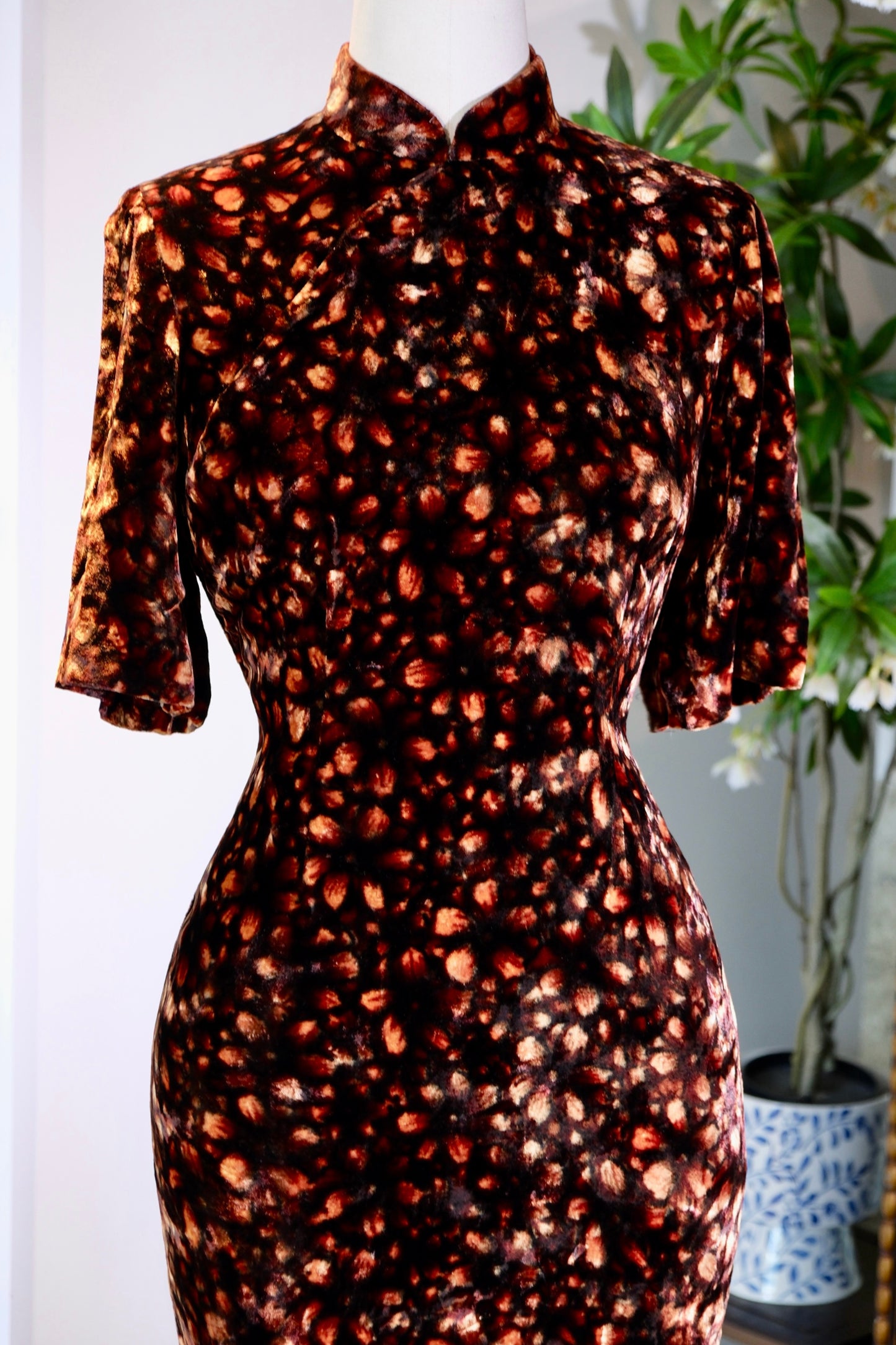
当指尖触碰到这件金丝绒旗袍的瞬间,仿佛触摸到了时光的肌理。深棕与金褐交织的绒面,在光线下流转着温润的光泽,如同被岁月浸染的琥珀,封存着半个世纪前的风华。这件1960年代台湾产的金丝绒古董旗袍,不仅是衣橱里的藏品,更是一部穿在身上的“文化诗学”,每一寸针脚都在诉说着那个时代的审美密码与工艺传奇。
一、图案:自然肌理与东方写意的对话
旗袍表面的图案并非传统的花卉或几何纹样,而是以抽象化的“自然肌理”为灵感——深浅不一的棕褐色斑点,如秋叶脉络、如古木年轮、如墨色在宣纸上的自然晕染,呈现出一种“似与不似之间”的写意之美。这种图案设计打破了1950年代旗袍常见的具象花卉或吉祥纹样的程式化表达,转而追求一种更具现代感的“抽象自然主义”,与同期西方抽象表现主义艺术思潮形成微妙呼应,却又深深扎根于东方美学的“气韵生动”。
绒面的短密绒毛在光线折射下,会随着穿着者的动作产生“流动的光影”,仿佛将一片秋日的森林穿在了身上,既有材质的奢华感,又不失自然的灵动性。
二、故事:1960年代台湾的“旗袍黄金时代”
1960年代的台湾,正处于经济起飞与文化转型的交汇期。旗袍作为女性日常着装的主流,既是传统服饰的延续,也是现代审美探索的载体。彼时台湾的旗袍制作,汇聚了从大陆迁台的顶尖裁缝(如上海“红帮裁缝”的传人),他们将海派旗袍的修身剪裁与台湾本土的面料工艺相结合,形成了独具特色的“台式旗袍”风格。
这件旗袍的“台湾产”身份,更暗含着特殊的历史语境:1949年后,大量大陆工匠与设计师迁台,带来了上海、苏州等地的传统服饰技艺,而台湾本地的丝绸、金丝绒等面料产业也在这一时期逐渐成熟。这件旗袍的诞生,正是两岸工艺融合的见证——它可能出自台北“永乐町”的老裁缝铺,或是台南某家传承三代的旗袍工坊,每一针一线都凝聚着匠人对“合身”与“雅致”的极致追求。
三、艺术风格:海派剪裁与东方材质的“黄金比例”
从剪裁上看,这件旗袍完美体现了1960年代“新式旗袍”的特征:立领高度适中(约3-4厘米),既保留传统韵味,又避免拘谨;袖型为“微喇中袖”,袖口略宽,既修饰手臂线条,又增添了几分飘逸感;腰身收至极致,臀部自然外扩,下摆开衩至小腿中部,行走时若隐若现的腿部线条,恰如《红楼梦》中“行动处似弱柳扶风”的古典意象,却又带着现代女性的自信与舒展。
尤为难得的是,这件旗袍的版型并非“一刀切”的工业化生产,而是通过“归拔”工艺(通过熨烫使面料产生立体弧度)实现“量体裁衣”的效果。这种工艺要求裁缝对布料的经纬走向、人体曲线有着精准把控,正如《考工记》所言“天有时,地有气,材有美,工有巧,合此四者,然后可以为良”,这件旗袍正是“材”与“工”的完美统一。
四、稀缺性:金丝绒旗袍的“时代绝唱”
金丝绒作为一种奢华面料,在1960年代的台湾并非易得之物。其制作工艺复杂,需经过织造、割绒、染色、整理等多道工序,且绒面易磨损、难保存,因此存世的古董金丝绒旗袍极为稀少。这件旗袍历经半个世纪,绒面仍保持完整光泽,无明显褪色或虫蛀,堪称“保存奇迹”。
从文化价值看,1970年代后,随着成衣工业的兴起与西方服饰的冲击,手工旗袍逐渐退出日常穿着,成为“礼服”或“收藏品”。而这件1960年代的台湾金丝绒旗袍,正处于手工旗袍的“黄金尾声”——它既保留了传统工艺的精髓,又融入了现代设计的简约,是研究20世纪东亚服饰史不可多得的实物标本。
结语:穿在身上的“时光博物馆”
这件旗袍,是1960年代台湾女性优雅生活的缩影,是两岸工艺交融的见证,更是东方美学在现代服饰中的一次诗意表达。它不需要繁复的装饰,仅凭金丝绒的质感、抽象图案的写意、修身剪裁的韵律,便足以让人感受到“衣以载道”的深厚内涵。正如张爱玲所言:“衣服是一种言语,随身带着的袖珍戏剧。”这件古董旗袍,正是时光写给现代的一封情书,等待着懂它的人,续写新的故事。
Measurements / Size Guide:
Bust / Waist / Hips: 98/88/100 cm
Total Length: 106 cm
Detailed Description:
The moment my fingertips touch this silk velvet cheongsam (qipao), I feel the very texture of time. The interweaving of deep brown and golden-tan velvet shimmers with a warm luster under the light, like amber steeped in years, sealing the elegance of half a century ago. This 1960s Taiwanese-made vintage cheongsam is more than a wardrobe collectible; it is a "cultural poetics" worn on the body, with every stitch whispering the aesthetic codes and technical legends of its era.
The patterns on the surface are not traditional flowers or geometric motifs but are inspired by abstract "natural textures"—variegated brownish spots resembling the veins of autumn leaves, the rings of ancient trees, or the natural bleeding of ink on Xuan paper. It presents a "freehand beauty" that exists between likeness and unlikeness. This design breaks away from the stylized expression of concrete floral or auspicious patterns common in the 1950s, pursuing a more modern "abstract naturalism." It subtly echoes the Western Abstract Expressionist trends of the same period while remaining deeply rooted in the "rhythmic vitality" (Qi Yun Sheng Dong) of Eastern aesthetics.
Under the refraction of light, the short, dense pile produces "flowing shadows" with the wearer's movement, as if one is wearing an autumn forest. It possesses the luxury of the material without losing the agility of nature.
In the 1960s, Taiwan was at the intersection of economic takeoff and cultural transformation. As the mainstream of daily wear for women, the cheongsam was both a continuation of tradition and a vessel for modern aesthetic exploration. At that time, qipao making in Taiwan gathered top tailors who had migrated from the mainland (such as descendants of the Shanghai "Hongbang Tailors"). They combined the slim-fit tailoring of the Shanghainese style with Taiwan's local fabric craftsmanship, forming the unique "Taiwanese Cheongsam" style.
The "Taiwan-made" identity of this piece carries a specific historical context: after 1949, a large number of mainland artisans and designers brought traditional skills from Shanghai and Suzhou to Taiwan, while local textile industries for silk and velvet gradually matured. This cheongsam is a witness to the fusion of craftsmanship from both sides of the Strait—it may have originated from an old tailor shop in Taipei’s "Yongle Town" or a workshop in Tainan spanning three generations. Every thread embodies the artisan’s ultimate pursuit of "fit" and "elegance."
In terms of silhouette, this cheongsam perfectly embodies the characteristics of the "New Style Qipao" of the 1960s: a standing collar of moderate height (approx. 3-4 cm) that retains traditional charm without being restrictive; "slightly flared mid-sleeves" that flatter the arms while adding a touch of ethereal grace; an extremely cinched waist and naturally contoured hips; and side slits reaching the mid-calf. The faint silhouette of the legs during movement evokes the classical imagery of "moving like a weak willow swaying in the breeze," yet with the confidence and ease of a modern woman.
Notably, the fit is achieved not through industrial mass production but through the "iron-shaping" (Gui Ba) process—using steam and heat to create a three-dimensional curvature in the fabric. This requires the tailor to have precise control over the warp and weft of the cloth and the human curve. As The Artificers' Record states: "When the season is right, the earth has spirit, the material is beautiful, and the work is skillful—combine these four, and one creates a superior vessel." This cheongsam is the perfect unity of "material" and "skill."
Silk velvet was a luxury material and not easily obtained in 1960s Taiwan. Its production is complex, involving weaving, cutting, dyeing, and finishing; furthermore, the pile is easily worn and difficult to preserve. Consequently, surviving vintage silk velvet cheongsams are extremely rare. That this piece has maintained its complete luster after half a century, with no obvious fading or moth damage, is a "miracle of preservation."
Culturally, after the 1970s, handcrafted cheongsams gradually withdrew from daily wear due to the rise of the ready-to-wear industry and the impact of Western fashion. This 1960s Taiwanese velvet cheongsam stands at the "Golden Twilight" of the handcrafted era—it preserves the essence of traditional craft while integrating the simplicity of modern design, making it an indispensable physical specimen for studying 20th-century East Asian costume history.