深圳溯源
无法加载取货服务可用情况
衣服尺寸:
胸围/腰围/臀围:82/60/92 厘米
衣长:100 厘米
细节描述:
一、纹样解码:织金葱与流动的金属诗篇
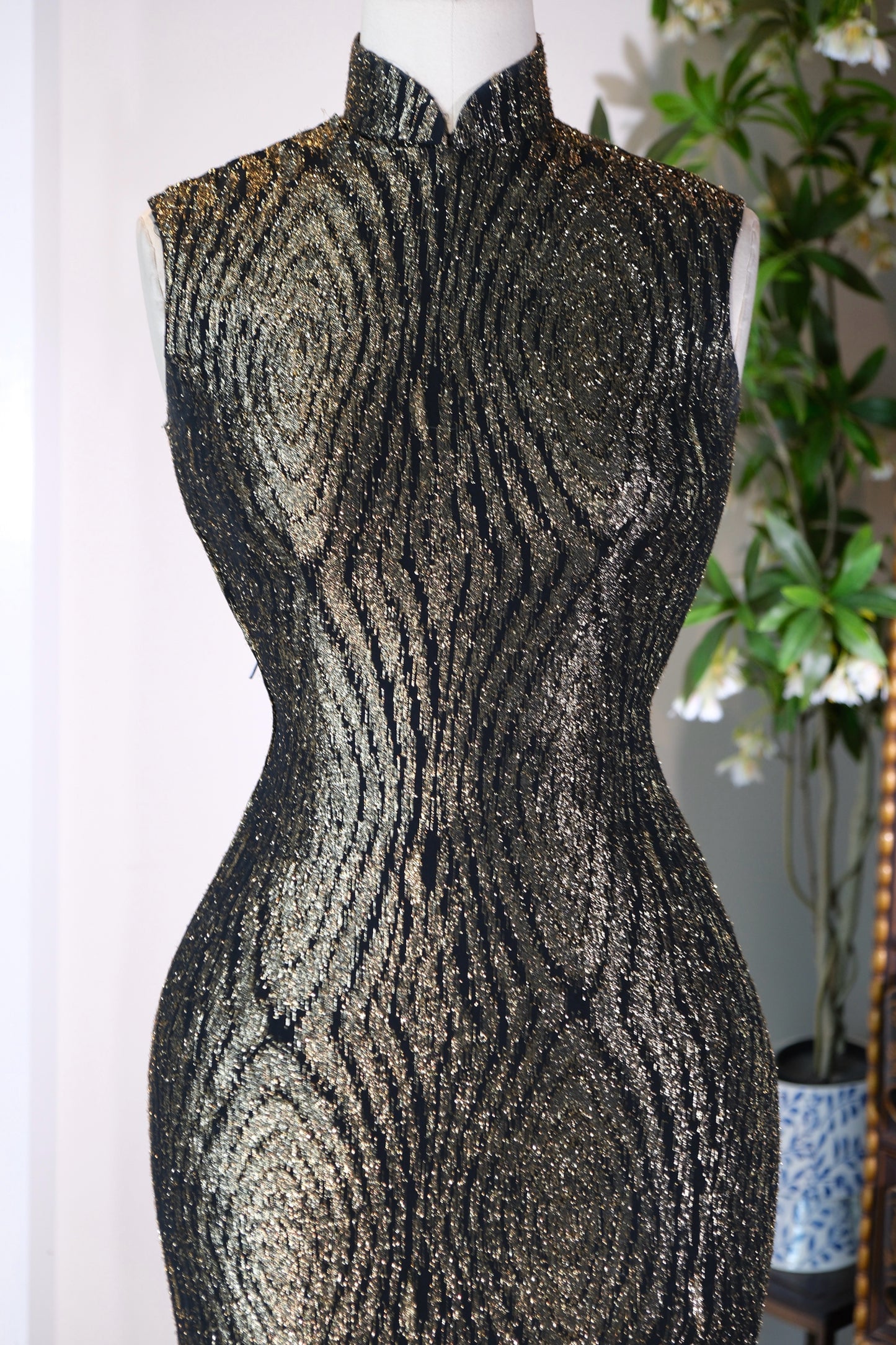
这件诞生于上世纪六十年代香港工坊的无袖高领旗袍,以织金葱工艺织就出一幅流动的“金属水墨”。黑底为宣,金线作墨,经纬间穿梭出不规则的波浪纹——似暗夜中粼粼的江水,又如风过林梢时抖落的碎金,在光影交错中呈现出“浮光跃金,静影沉璧”(范仲淹《岳阳楼记》)的视觉韵律。金葱丝线并非简单的平铺直叙,而是通过织机的精密咬合,形成微妙的浮雕质感:近观可见丝缕间闪烁的星点,远望则如鎏金泼洒于墨玉之上,既保留了传统云锦的华贵基因,又融入了现代主义对抽象线条的迷恋,堪称“传统织造技艺与现代审美意识的混血儿”。
二、历史切片:殖民地语境下的东方霓裳
六十年代的香港,正处于东西方文化碰撞的熔炉期。作为当时亚洲重要的成衣出口港,本地工坊在传承苏杭织锦技艺的基础上,大胆吸纳西方立体剪裁与装饰艺术风格。这件旗袍的无袖设计突破了传统旗袍的保守轮廓,高领与收腰的剪裁则延续了“海派旗袍”对女性曲线的礼赞,而织金葱面料的选择,恰是那个年代“东方主义”时尚浪潮的缩影——西方世界对神秘东方的想象,催生了对“闪亮中国风”的狂热追捧,香港工匠遂以金葱为笔,在传统纹样中注入摩登气息,让这件旗袍成为“东方遇见西方”的物质见证。
三、稀缺性注脚:消逝的工艺与不可复制的时代
织金葱工艺在六十年代后逐渐式微,原因有三:其一,金葱丝线成本高昂,且对织机精度要求苛刻,现代工业化生产难以复刻其手工质感;其二,六十年代香港制衣业虽繁荣,但专注于高端定制的工坊数量有限,存世量本就稀少;其三,这种融合传统与现代的设计风格,恰是特定历史时期的产物——彼时香港尚未完全被全球化时尚体系同化,工匠仍有空间在“中西之间”探索独特的视觉语言。正如艺术史家贡布里希所言:“艺术的生命在于其不可重复性”,这件旗袍的每一道金线,都是那个黄金时代的绝唱。
四、艺术风格:装饰艺术的东方变奏
从艺术史维度审视,这件旗袍的纹样可归为“装饰艺术运动”的东方变奏。装饰艺术强调几何线条、金属质感与奢华材料的结合,而这件旗袍的波浪纹虽非严格的几何图形,却通过金葱的闪烁效果与黑白对比,达成了类似的视觉冲击力。更值得玩味的是,其纹样的“流动性”暗合了中国传统绘画“气韵生动”的美学追求,让西方的装饰语言在东方的面料上获得了新的生命。这种“跨文化转译”的尝试,使其超越了单纯的服装范畴,成为一件“可穿戴的艺术品”。
五、故事余韵:从旗袍到时光的容器
想象六十年代的香港,一位身着此旗袍的女子走过中环的石板路,金葱在路灯下流转如星,她或许是参加晚宴的名媛,或许是出席画廊开幕的艺术家——这件旗袍不仅是她的华服,更是她身份的宣言:既拥抱东方的典雅,又不拒西方的摩登。如今,当我们凝视这件古董衣,看到的不仅是织金葱的璀璨,更是一个时代的呼吸:那是香港作为“东方之珠”初露锋芒的年代,是传统工艺与现代设计碰撞出火花的年代,也是东方女性开始以自信姿态登上世界舞台的年代。
这件六十年代港产织金葱旗袍,以其稀缺的工艺、独特的历史语境与跨文化的艺术风格,成为服装史上不可多得的“时光标本”。它告诉我们:真正的古董衣,从来不只是布料与针脚的集合,而是凝固的历史、流动的诗,以及人类对美的永恒追求。
Measurements / Size Guide:
Bust / Waist / Hips: 82/60/92 cm
Total Length: 100 cm
Detailed Description:
This sleeveless, high-collared cheongsam (qipao), born in a 1960s Hong Kong workshop, uses gold-lamé craftsmanship to weave a flowing "metallic ink wash." The black base serves as the Xuan paper, and the gold threads act as the ink, weaving irregular wave patterns through the warp and weft—resembling the shimmering ripples of a river at night, or the scattered gold dust shaken from treetops by the wind. In the interplay of light and shadow, it presents the visual rhythm of "floating light jumping like gold, and quiet shadows sinking like jade" (from Fan Zhongyan’s Memorial to Yueyang Tower). The gold-lamé threads are not simply laid flat; through the precise interlocking of the loom, they form a subtle relief texture. Up close, one can see the shimmering stardust between the threads; from afar, it appears as if molten gold has been splashed onto dark jade. It retains the noble genes of traditional Yunjin cloud brocade while embracing the modernist fascination with abstract lines, making it a "hybrid of traditional weaving techniques and modern aesthetic consciousness."
Hong Kong in the 1960s was a melting pot of Eastern and Western cultural collision. As a major garment export hub in Asia, local workshops inherited the weaving techniques of Suzhou and Hangzhou while boldly absorbing Western 3D tailoring and Art Deco styles. The sleeveless design of this cheongsam breaks the conservative silhouette of traditional qipaos, while the high collar and cinched waist continue the "Shanghainese style" celebration of the feminine curve. The choice of gold-lamé fabric is a microcosm of the "Orientalism" fashion wave of that era—the Western world's imagination of the mysterious East fueled a craze for "shimmering Chinoiserie." Hong Kong artisans used lamé as their brush, injecting a modern aura into traditional motifs, making this garment a material witness to "East meets West."
The gold-lamé craft gradually declined after the 1960s for three reasons: first, the cost of gold-lamé thread was high, and the precision required of the looms was demanding, making it difficult for modern industrial production to replicate its artisanal texture. Second, although Hong Kong's garment industry flourished in the 1960s, the number of workshops focusing on high-end custom couture was limited, making surviving pieces inherently rare. Third, this design style—a fusion of tradition and modernity—is a product of a specific historical period when Hong Kong had not yet been fully assimilated by the globalized fashion system, and artisans still had the space to explore a unique visual language "between East and West." As art historian E.H. Gombrich noted: "The life of art lies in its unrepeatability." Every gold thread in this cheongsam is a swan song of that Golden Age.
Viewed from the dimension of art history, the pattern of this cheongsam can be classified as an Eastern variation of the Art Deco movement. Art Deco emphasizes the combination of geometric lines, metallic textures, and luxurious materials. While the wave patterns here are not strictly geometric, they achieve a similar visual impact through the shimmer of the lamé and the black-and-gold contrast. More interestingly, the "fluidity" of the pattern aligns with the aesthetic pursuit of "rhythmic vitality" (qiyun shengdong) in traditional Chinese painting, allowing Western decorative language to gain new life on Eastern fabric. This attempt at "cross-cultural translation" elevates it beyond mere clothing into a "wearable work of art."
Imagine a woman in 1960s Hong Kong, walking along the stone-paved paths of Central in this cheongsam, the gold lamé shimmering like stars under the streetlights. She might be a socialite attending a gala or an artist at a gallery opening. This cheongsam was not just her finery but a manifesto of her identity: embracing Eastern elegance without rejecting Western modernity. Today, as we gaze upon this antique garment, we see more than just the brilliance of the gold lamé; we see the pulse of an era. It was a time when Hong Kong first began to shine as the "Oriental Pearl," when traditional craft and modern design sparked brilliance, and when Eastern women began to step onto the world stage with a posture of confidence.
With its rare craftsmanship, unique historical context, and cross-cultural artistic style, this 1960s Hong Kong-made gold-lamé cheongsam stands as an extraordinary "temporal specimen" in fashion history. It tells us that true antique clothing is never just a collection of fabric and stitches, but solidified history, flowing poetry, and humanity’s eternal pursuit of beauty.