深圳溯源
无法加载取货服务可用情况
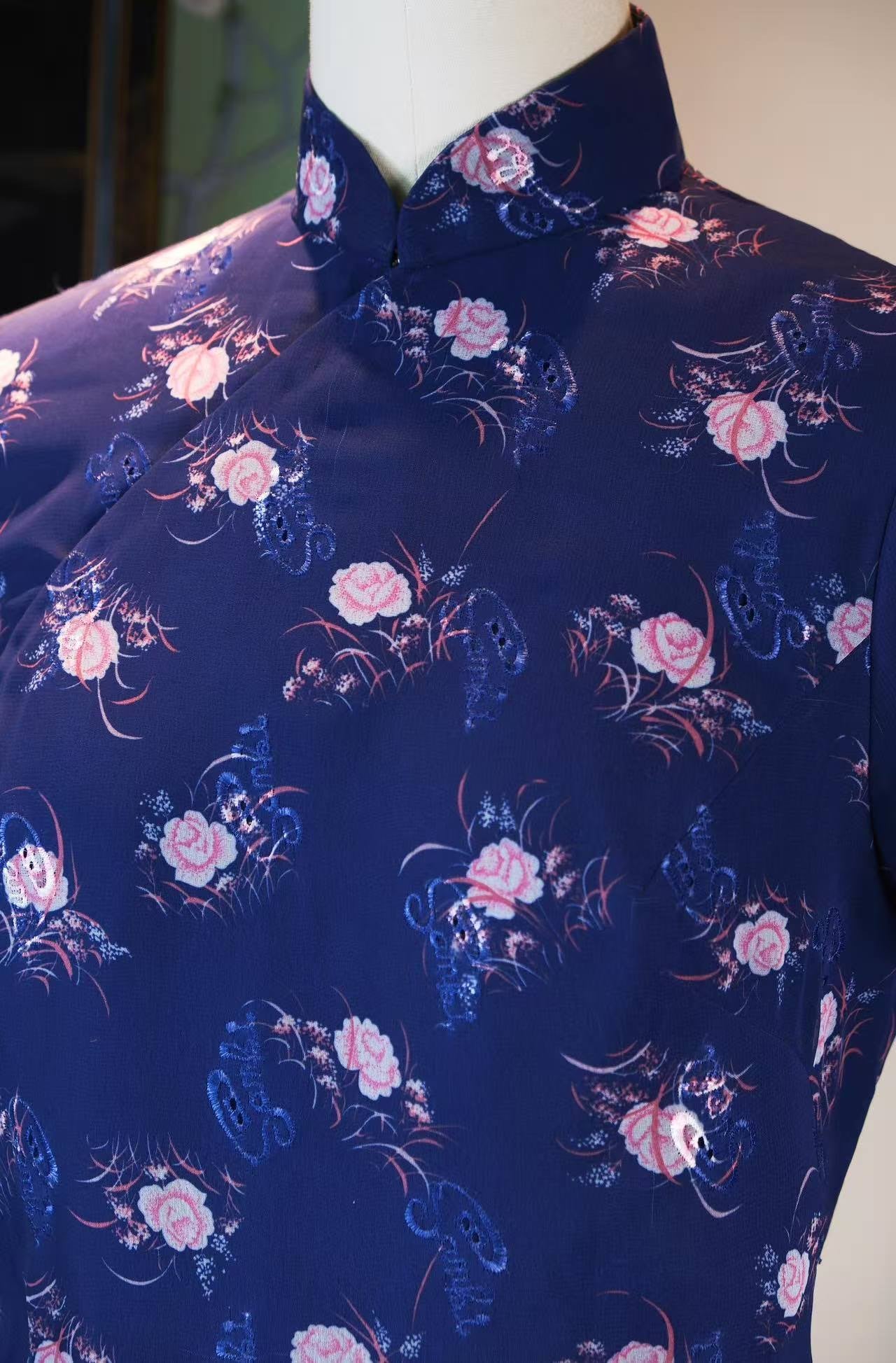
阴丹士林蓝喷绘印花机绣旗袍
“丹林士者,色如青天,质若流云。”
衣袂翩跹处,粉白蔷薇与流云纹缠枝共生,恰似《诗经·郑风》“
那些看似随意的“S”形枝蔓,实则暗藏玄机——
二方连续的纹样布局,让人想起《周礼·考工记》中“画缋之事,
存世稀若晨星的六零年代台湾机绣旗袍,每一件都是时光的信物。
正如沈从文先生所言“衣者,史也”,
着此一袭,便似与张爱玲笔下的白流苏擦肩,与林海音《城南旧事》
Indanthrene Blue: A 1960s Taiwan Airbrushed and Machine-Embroidered Qipao
The Indelible Spirit of Indigo "Indanthrene Blue is a color like the clear sky, with a texture like drifting clouds." In the history of Oriental costume during the 1960s, Indanthrene Blue was the master of all hues. This vat-dyed indigo, which remains steadfast through the passage of time, echoes the ancient definition from Shuowen Jiezi: "Qing (Blue) represents life; it is the color of things as they begin to grow." It possesses a profound vitality within its depth and a literati spirit within its stillness. Using this color as a base, the Taiwanese workshop seems to have condensed the misty rains of Jiangnan onto fabric, fusing the elegance of Song and Yuan dynasty paintings with the modern Haipai (Shanghai-style) charm of that era.
A Dialogue of Air and Needle Among the fluttering sleeves, pink-and-white roses coexist with scrolling cloud motifs—a poetic reimagining of the verses from the Book of Songs: "On the mountains are the sturdy firs, in the marshes are the lotus flowers." Artisans used an airbrushing technique to dapple the petals, giving each blossom a hazy, "tear-stained" ethereal quality. They then utilized machine embroidery to outline the stems, with stitches as fine and agile as gossamer silk. This aligns with the philosophy of the Kao Gong Ji (The Record of Trades): "Heaven has its seasons, Earth has its Qi, materials have their beauty, and craftsmanship has its skill."
Modernity Within Tradition The seemingly casual "S-shaped" vines are, in fact, masterfully designed. Based on the Ming Dynasty’s scrolling lotus patterns, they transform solemnity into liveliness, skillfully merging classical gravity with modern aesthetic interest. This hazy beauty—where flowers look like clouds and clouds like flowers—is a testament to the 1960s Taiwanese craft of "upholding tradition while creating the extraordinary."
A Walking Silk Painting The two-way continuous pattern layout recalls the records in the Rites of Zhou: "The art of painting and embroidery is a harmony of the five colors." To touch the fabric is to feel the gentle grace of a bygone era: socialites wearing such garments, whispering in the corridors of Taipei’s Zhongshan Hall or leaning against the railings in the twilight of Keelung Port, perfectly enacting the Eastern woman’s art of "concealing and revealing."
An Amber of Cultural Genes As the scholar Shen Congwen famously said, "Clothing is history." This qipao is not merely a garment; it is a "walking ink-and-color silk painting." It records the ingenuity of the Taiwanese textile industry while carrying the spiritual core of the "Unity of Dao and Object" (Dao Qi He Yi). While modern trends shift in clamor, it remains silent, telling of an eternal elegance that never fades. Wearing it is like brushing past Bai Liusu from Eileen Chang’s novels or sitting across from Yingzi in Lin Haiyin’s Memories of Old Beijing. It is a living cultural gene, allowing anyone fortunate enough to encounter it to feel the temperature of that golden age amidst the interlacing of indigo and pink.