深圳溯源
无法加载取货服务可用情况
衣服尺寸:
胸围/腰围/臀围:100/92/112 厘米
衣长:100 厘米
细节描述:
在时间的尘埃里,总有一些物件,如同被岁月精心封存的琥珀,凝固了某个时代的风华与呼吸。眼前这件诞生于上世纪六十年代香港的提花缎古董旗袍,便是一件承载着双重历史记忆的稀世珍品。它的价值,不仅在于其经典的“港工”剪裁,更在于其面料本身——一段来自民国时期的绮丽旧梦。
一、 图案解构:吉光片羽间的祥瑞密码
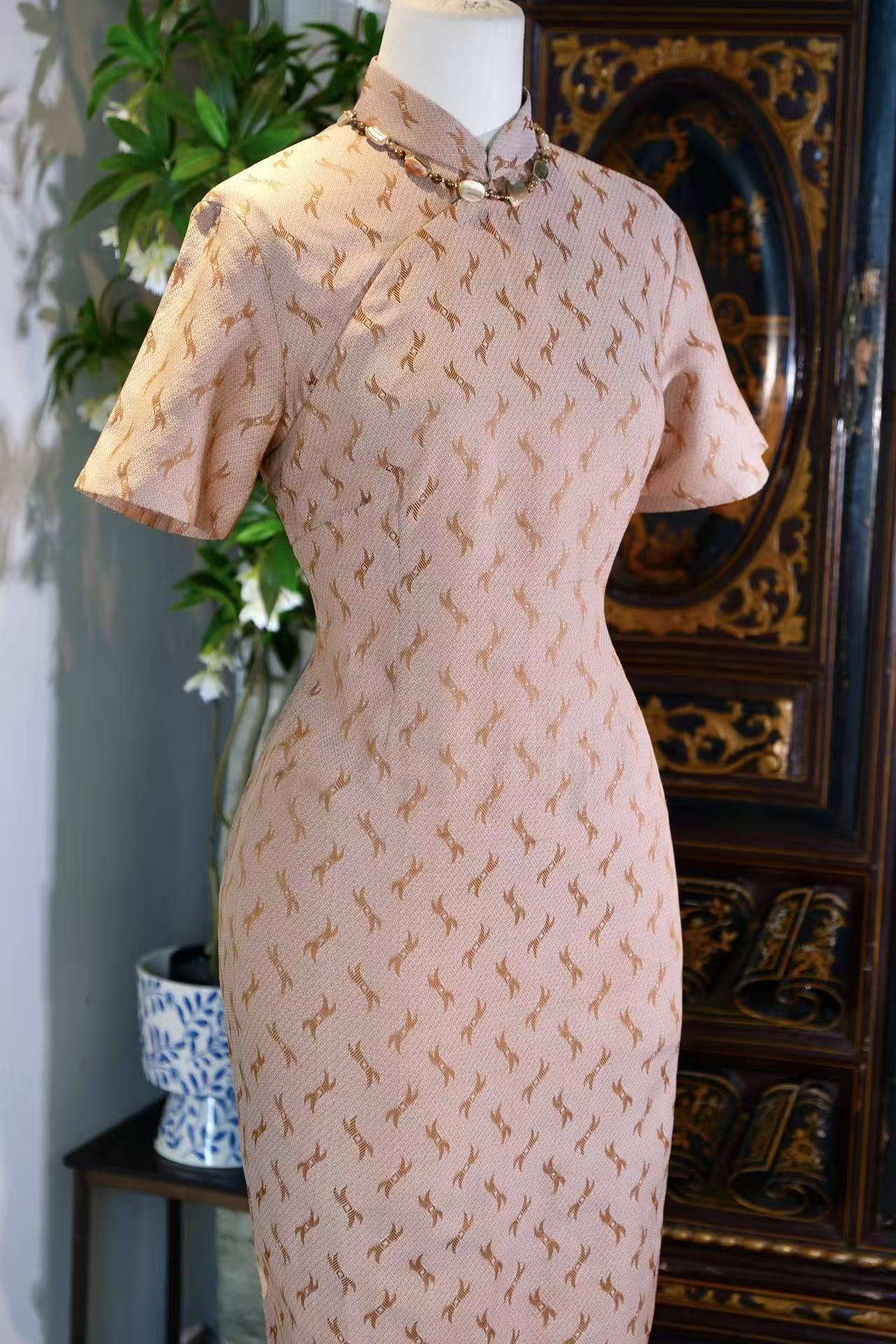
让我们首先将目光聚焦于这件旗袍最引人注目的部分——其面料上的提花图案。这并非寻常的花草鱼虫,而是一种经过高度抽象化与几何化的纹样。
* 纹样本源: 细细审视,这些由金棕色丝线织就的图案,其原型应为“如意云头”或“磬纹”的变体。如意,取“如人所意”之吉祥寓意,是传统器物与纹样中的常客;磬,作为古代礼乐之器,其音清越,象征着喜庆与祥瑞。工匠将这两种传统吉祥符号进行解构,提取其流畅的曲线与转折的棱角,组合成一种充满现代感的、连续不断的几何单元。
* 艺术风格: 这种设计语言,明显受到了装饰艺术(Art Deco)风格的深刻影响。Art Deco在20世纪二三十年代的上海滩风靡一时,它崇尚机械美学,喜爱运用对称、重复的几何图形和放射状线条。这件旗袍的面料,正是这种中西合璧审美潮流下的产物。它将东方的吉祥寓意,用西方现代主义的设计手法重新演绎,形成了一种既古典又摩登的独特韵律。图案以45度角斜向排列,在视觉上产生一种动态的延伸感,使穿着者的身姿更显修长、灵动。
二、 故事溯源:从民国锦缎到香江霓裳
这件旗袍最迷人的故事,在于其“前世今生”的跨越。
* 前世:民国面料的流离与珍藏
面料是民国的。这意味着它诞生于那个新旧交替、思想激荡的黄金年代。彼时,江南的织造局或上海的新式丝织厂,引进了先进的提花织机,生产出这种融合了传统纹样与现代审美的锦缎。它可能曾被一位名门闺秀精心收藏,预备制成一件嫁衣或华服,却因战乱、迁徙等时代洪流而未能如愿。这匹锦缎,如同一位漂泊的游子,带着旧日的荣光与未竟的梦想,辗转南下。
* 今生:六十年代香港的匠心重塑
时间来到上世纪五六十年代的香港。这里汇聚了来自上海、苏州等地的顶尖裁缝,他们将海派旗袍的精髓带到了香江,并发展出更为立体、贴合人体曲线的“港式旗袍”风格。这件旗袍,正是在这样的背景下诞生的。一位技艺高超的香港师傅,得到了这匹珍贵的民国面料。他深知其价值,以极其考究的“归拔”工艺,将平面的布料塑造成完美的立体形态,突出了女性的胸、腰、臀曲线。高耸的立领、恰到好处的短袖、流畅的斜襟与含蓄的开衩,每一处细节都体现了“港工”的严谨与风雅。
这便是一次跨越时空的对话与合作:民国的面料提供了灵魂的底色,而六十年代的香港工艺则赋予了它全新的生命形态。 这不仅是物尽其用的节俭美德,更是一种文化传承的自觉。它见证了历史的断裂与延续,也浓缩了20世纪中国服装史的精华。
三、 稀缺性与艺术价值:不可复制的时代孤品
在今天的时尚语境下,这件旗袍的稀缺性不言而喻。
1. 面料的不可再生: 民国时期的提花织锦缎,其丝线的质感、染色的工艺、以及织机的独特性,都已成绝响。这种带有特定时代审美烙印的面料,存世量极少,堪称“吉光片羽”。
2. 工艺的濒临失传: 纯手工的“港式旗袍”制作,工序繁复,对裁缝的眼力、手感和经验要求极高。在成衣工业化的今天,如此考究的定制工艺已是凤毛麟角。
3. 历史的唯一性: 这件旗袍将两个最具传奇色彩的时尚年代——民国与六十年代香港——完美地融合于一身。它不仅仅是一件衣服,更是一部可穿戴的、关于流亡、记忆与重生的物质文化史。
正如张爱玲在《更衣记》中所写:“我们各人住在各人的衣服里。”这件旗袍里,住着民国女子的未竟之梦,也住着六十年代香港名媛的优雅风姿。它是一件艺术品,一段历史,一个等待被续写的故事。拥有它,便是拥有了一段触手可及的、风华绝代的旧时光。
Measurements / Size Guide:
Bust / Waist / Hips: 100/92/112 cm
Total Length: 100 cm
Detailed Description:
In the dust of time, certain objects act like amber meticulously preserved by the years, freezing the splendor and breath of an era. This 1960s Hong Kong-made jacquard satin antique cheongsam (qipao) is a rare treasure carrying dual layers of historical memory. Its value lies not only in the classic "Hong Kong Tailoring" but in the fabric itself—a magnificent dream from the Republican Era (1912–1949).
Let us first focus on the most striking feature—the jacquard pattern. These are no ordinary floral motifs but highly abstracted and geometric designs.
Origin of the Motif: Upon closer inspection, these patterns woven with golden-brown silk threads appear to be variations of the "Ruyi Cloud Head" or the "Qing (Chime Stone) Pattern." Ruyi symbolizes "as one wishes," a frequent guest in traditional auspicious patterns; the Qing, an ancient ritual musical instrument with a clear tone, symbolizes celebration and luck. The artisan deconstructed these symbols, extracting fluid curves and angular turns to compose a modern, continuous geometric unit.
Artistic Style: This design language was deeply influenced by the Art Deco movement. Flourishing in 1920s and 30s Shanghai, Art Deco championed mechanical aesthetics, symmetrical geometric shapes, and radial lines. This fabric is a product of that East-meets-West aesthetic trend, reinterpreting Eastern auspiciousness through Western Modernist techniques. Arranged at a 45-degree angle, the patterns create a dynamic sense of extension, making the wearer’s silhouette appear even more slender and agile.
The most enchanting story of this cheongsam lies in the leap between its "past and present lives."
Past Life: The Displacement and Preservation of Republican Fabric The fabric belongs to the Republican Era. It was born in that golden age of transition and intellectual ferment, produced perhaps by the Jiangnan Weaving Bureaus or Shanghai’s modern silk mills utilizing advanced jacquard looms. It might have been cherished by a noble young lady for a wedding gown, only to be swept south by the tides of war and migration. Like a wandering traveler, this brocade carried the glory of the past and unfulfilled dreams to Hong Kong.
Present Life: The Ingenious Reshaping in 1960s Hong Kong By the 1950s and 60s, Hong Kong became a sanctuary for master tailors from Shanghai and Suzhou. They brought the essence of the Shanghainese qipao to the colony, developing the more three-dimensional "Hong Kong-Style" that fits the body’s curves perfectly. A skilled Hong Kong master, obtaining this precious Republican fabric, used the sophisticated "Gui Ba" (Iron-shaping) technique to transform flat cloth into a sculptural form, highlighting the chest, waist, and hips. The high standing collar, precise short sleeves, and subtle side slits all reflect the rigor and elegance of "Hong Kong Workmanship."
This is a dialogue across time: the Republican fabric provides the soul’s undertone, while 1960s Hong Kong craftsmanship bestows a new form of life. It is both the virtue of frugality and a conscious act of cultural heritage.
In today's fashion context, the scarcity of this cheongsam is self-evident:
Non-Renewable Fabric: The silk texture, dyeing techniques, and unique looms used for Republican-era jacquard satin have long since vanished. Such fabric, bearing the aesthetic imprint of a specific era, is truly a "rare fragment of a mythical beast."
Vanishing Craftsmanship: Hand-made "Hong Kong-Style" tailoring is complex and requires immense experience. In an age of industrial mass production, such bespoke artistry is a rarity.
Historical Uniqueness: This garment flawlessly fuses the two most legendary fashion eras—the Republican Period and 1960s Hong Kong. It is a "wearable history" of exile, memory, and rebirth.
As Eileen Chang wrote in A Chronicle of Changing Clothes: "We each live in our own clothes." Within this cheongsam live the unfulfilled dreams of a Republican lady and the elegant poise of a 1960s Hong Kong socialite. To own it is to hold a segment of peerless time within your hands.