深圳溯源
60年代 - 靛蓝经纬里的香江旧梦 | 1960s - The Fragrant Harbor Dream in Indigo Warp and Weft
60年代 - 靛蓝经纬里的香江旧梦 | 1960s - The Fragrant Harbor Dream in Indigo Warp and Weft
无法加载取货服务可用情况
靛蓝经纬里的香江旧梦
衣服尺寸:
胸围/腰围/臀围:106/98/108 厘米
衣长:113 厘米
细节描述:
衣上无纹,却自有乾坤
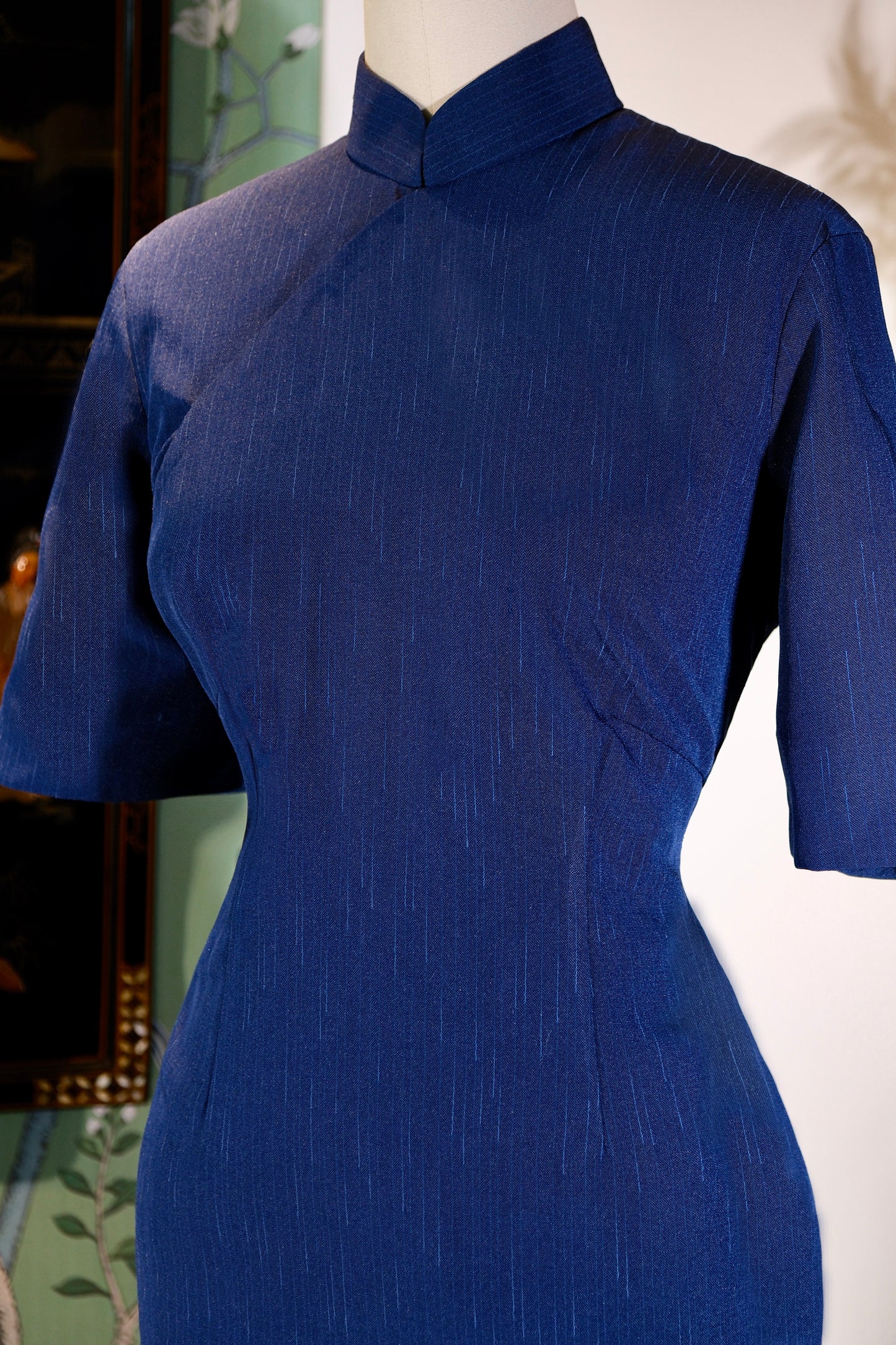
这袭旗袍的妙处,恰在“无图案”处见真章。其面料为上世纪六十年代香港流行的西装料,靛蓝底色中隐现细密竖条纹,似雨丝斜织,又如墨痕轻染。这种“以素为纹”的设计,暗合中国美学“大音希声,大象无形”的哲思——面料本身便是图案:西装料的挺括肌理,让旗袍在行走间自带筋骨,既非江南丝绸的柔媚,亦非北地棉麻的朴拙,而是香江特有的“中西合璧”气质:东方剪裁的婉约,裹着西方面料的利落,恰如张爱玲笔下“穿着西装的东方女子”,在摩登与古典间寻得平衡。
一袭旗袍,半部香江裁缝史
六十年代的香港,是东西方文化碰撞的熔炉。彼时,上海裁缝南迁香江,将海派旗袍的精致工艺与西方西装的立体剪裁相融,催生出独特的“港式旗袍”风格。这袭旗袍便是见证:斜襟仍保留传统形制,却以西装料的硬朗线条重塑轮廓,收腰处的省道设计,暗藏西式剪裁的巧思;靛蓝色泽沉静如墨,既呼应传统士人的“青衿”意象,又因西装料的现代感,成为当时职业女性的“战袍”——她们穿着它出入写字楼、茶餐厅,在殖民地的晨光里,走出属于东方女性的自信步调。
稀缺性:时光淬炼的孤品美学
如今,这般保存完好的六十年代香港产西装料旗袍已属凤毛麟角。彼时,西装料旗袍多为中产阶层定制,面料需从欧洲进口,工艺需名师亲手缝制,一件成衣往往耗时月余。而岁月流转,当年的“日常装”已成“古董衣”,其稀缺性不仅在于年代,更在于它承载的文化记忆:它是香江黄金时代的缩影,是东西方服饰文明对话的实物注脚,更是“衣以载道”的东方美学在二十世纪的独特表达。
正如《考工记》所言:“天有时,地有气,材有美,工有巧,合此四者,然后可以为良。”这袭靛蓝旗袍,便是天时(六十年代香江)、地气(中西文化交汇)、材美(西装料的挺括)、工巧(海派与港式剪裁融合)的结晶。它静默地立在那里,便是一首关于时光、文化与女性力量的无声史诗。
The Fragrant Harbor Dream in Indigo Warp and Weft
Measurements / Size Guide:
Bust / Waist / Hips: 106/98/108 cm
Total Length: 113 cm
Detailed Description:
Patterns in the Patternless: A Universe Within the Fabric
The brilliance of this qipao lies precisely in its "patternless" nature. The fabric is a suit-grade wool-blend popular in 1960s Hong Kong; within the deep indigo base, fine vertical pinstripes subtly emerge like slanted rain or light ink strokes. This design of "plainness as pattern" aligns with the Chinese aesthetic philosophy that "the loudest sound is silent; the greatest form is shapeless." The fabric itself becomes the motif: the crisp texture of the suit material gives the qipao an inherent structure and "backbone." It possesses neither the soft charm of Jiangnan silk nor the rustic simplicity of northern cotton and linen. Instead, it embodies Hong Kong’s unique "East-meets-West" temperament—the grace of Oriental tailoring wrapped in the sharpness of Western fabric. It is exactly like the "Oriental woman in a Western suit" described by Eileen Chang, finding balance between the modern and the classical.
One Qipao, Half a History of Hong Kong Tailoring
Hong Kong in the 1960s was a melting pot of Eastern and Western cultures. At that time, Shanghai tailors migrated south to Hong Kong, fusing the exquisite craftsmanship of the Haipai (Shanghai-style) qipao with the three-dimensional draping of Western suits, giving birth to the unique "Hong Kong-style qipao." This garment is a living witness: while the diagonal lapel retains traditional forms, the silhouette is reshaped by the crisp lines of suit material. The darting at the waist hides the ingenuity of Western tailoring. The quiet, ink-like indigo hue echoes the traditional "blue scholar’s robe" (Qingjin) imagery, yet due to the modernity of the suit fabric, it became the "battle armor" for professional women of the era—they wore it into office buildings and tea restaurants, walking with the confident stride of Oriental women in the morning light of the colony.
Scarcity: The Unique Aesthetic Tempered by Time
Today, such well-preserved 1960s Hong Kong-made suit-fabric qipaos have become "phoenix feathers and unicorn horns" (extremely rare). At the time, these garments were mostly bespoke pieces for the middle class; the fabrics were often imported from Europe, and the craftsmanship required the personal touch of a master tailor, with a single garment often taking over a month to complete. As time flowed, the "everyday wear" of yesteryear became the "antique clothing" of today. Its scarcity lies not only in its age but in the cultural memory it carries: it is a microcosm of Hong Kong’s Golden Age, a physical footnote to the dialogue between Eastern and Western sartorial civilizations, and a unique 20th-century expression of the Oriental aesthetic that "garments carry the Way."
As Kao Gong Ji states: "Heaven has its seasons, Earth its vitality, materials their beauty, and craftsmen their skill; when these four combine, a masterpiece is born." This indigo qipao is the crystallization of the era (1960s Hong Kong), the environment (the convergence of East and West), the material (the crispness of suit wool), and the skill (the fusion of Shanghai and Hong Kong tailoring). Standing there silently, it is a wordless epic of time, culture, and female power.
分享