深圳溯源
无法加载取货服务可用情况
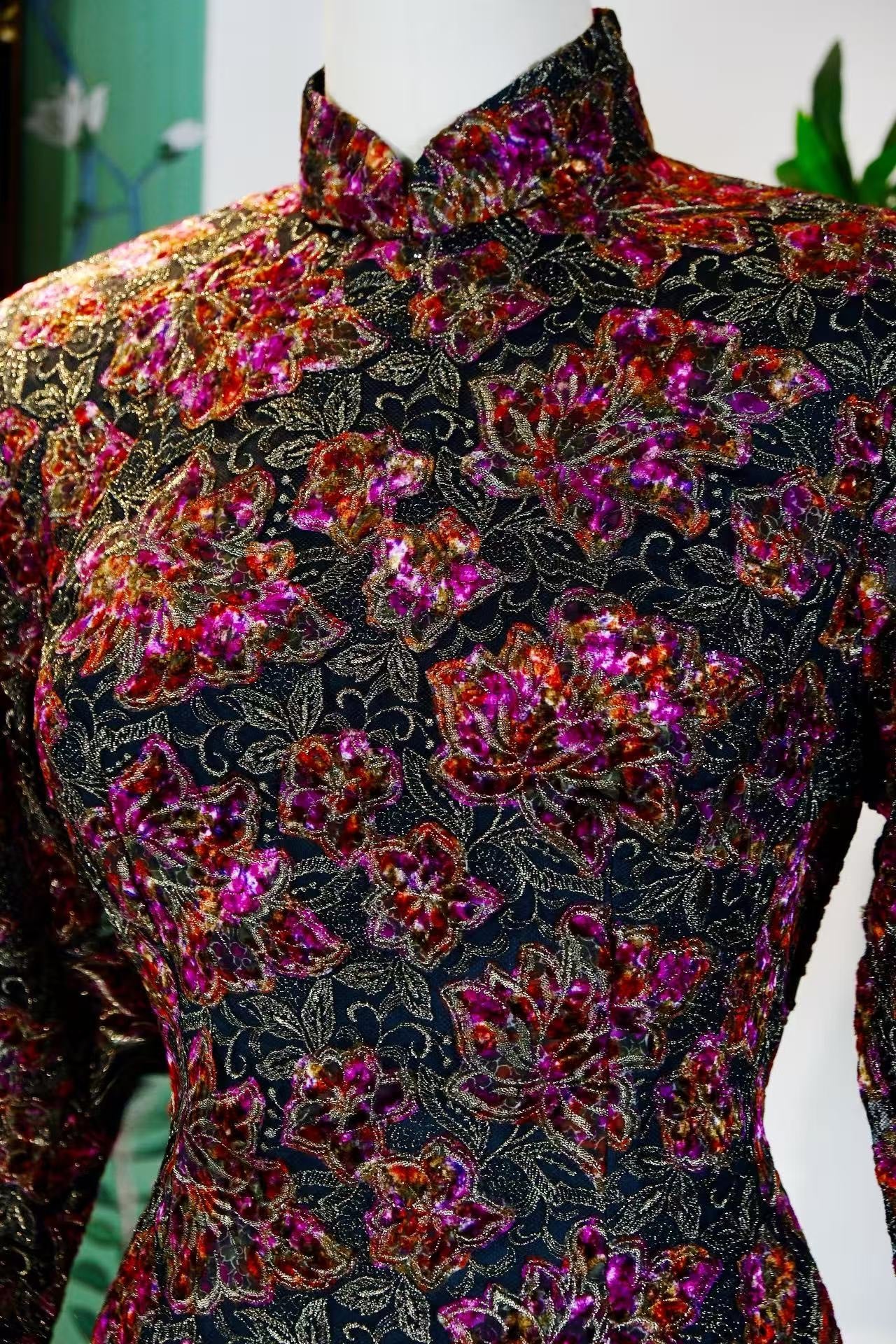
分享一件史诗级的上世纪六十年代香港织金蕾丝烧花丝绒手绘古董旗
这件六十年代香港产古董旗袍的面料,以“植入金属织金蕾丝”
旗袍通体满布花卉,主花形似牡丹与莲花的融合变体,
六十年代的香港,作为东西方文化交汇的“前哨”,
织金蕾丝需用手工织机耗时数月完成,
张爱玲在《更衣记》中写道:“旗袍的裁制,
The fabric of this 1960s Hong Kong vintage cheongsam is based on "implanted metallic gold brocade lace" (植入金属织金蕾丝). Gold threads and lace yarns are interwoven to form the skeletal structure of openwork flowers. Layered upon the lace petals is the "devoré velvet" (烧花丝绒) technique—chemical etching or heat pressing creates a relief-like, three-dimensional floral shape on the velvet surface, where the pile exhibits a subtle, blended gradation in light and shadow. The uppermost layer of hand-painted blending (手绘晕染) bestows the pattern with its soul: the artist uses the velvet as a canvas, applying vegetable dyes layer by layer, allowing the petal edges to transition naturally. This creates a motif, similar to the meticulous flowers of the Mustard Seed Garden Manual of Painting, that possesses both the resilience of the fabric and the charm of painting.
The cheongsam is completely covered with floral motifs. The main flower resembles a hybrid of peony and lotus, with layered petals similar to the honeysuckle motif on Tang Dynasty gilded silver ewers. The stamens are coiled with gold brocade threads in a radial pattern, subtly aligning with the dynamic image of "water caltrops scattered, flowing left and right" from the Classic of Poetry: Zhou Nan. The branches and leaves are rendered in the realistic style of Lingnan flora, with the veins outlined in gold thread and the edges hand-painted to blend from withered yellow to new green. This is a concrete representation of the "Ten Methods for Growing Flowers" from the Fan Sheng Zhi Shu. The overall composition follows the traditional "all-over opulent pattern" (满地娇), but the three-dimensionality of the devoré velvet breaks the rigidity of flat ornamentation. Like Su Shi's critique of Wang Wei's painting, "There is poetry in the painting, and painting in the poetry," a three-dimensional natural garden is constructed upon the cloth.
Hong Kong in the 1960s, as a "cultural outpost" at the intersection of East and West, saw the final innovation in cheongsam craftsmanship. This innovation of "Western technique applied to Eastern use" allowed the cheongsam to retain the solemnity of "conforming to the rules and taking imagery as a guide" from the Classic of Rites: Deep Robe while possessing the assertiveness of modern art.
The gold brocade lace required a manual loom and took several months to complete. The temperature control for the devoré velvet needed to be within a $\pm 2^\circ\text{C}$ tolerance, and the hand-painted blending demanded the painter's precise grasp of dye permeability. The completion rate for a finished product incorporating all three superimposed crafts was less than 10%. Furthermore, as the Hong Kong garment industry shifted toward mechanized production in the 1960s, the number of such fully handmade cheongsams that survive is extremely small. Its value lies not only in the preciousness of the fabric but also in its status as a "living fossil" of the transition from traditional craft to modern design, a perfect interpretation of "skillful work makes for beautiful objects" from The Exploitation of the Works of Nature.
Eileen Chang wrote in Rondeau of Clothes: "The tailoring of the cheongsam gradually became not just the physical adornment of the figure, but a vessel for the soul." This cheongsam uses gold brocade lace as its skeleton, devoré velvet as its flesh, and hand-painted blending as its soul, fusing the female body with natural flora. Every blended transition in its pattern subtly aligns with the spatial aesthetic of "three distances" (三远) from Guo Xi’s Lofty Message of Forests and Streams in the Song Dynasty, constructing an Oriental scene of "accessible, viewable, and habitable" within the small frame of the fabric. Viewing it today, it is not only a fashion witness to 1960s Hong Kong but also an aesthetic echo of traditional craftsmanship in the contemporary era.