深圳溯源
无法加载取货服务可用情况
衣服尺寸:
胸围/腰围/臀围:98/84/102 厘米
衣长:107 厘米
细节描述:
这不仅仅是一件衣裳,它是凝固的时光,是上世纪六十年代东方巴黎——香港,那段流金岁月的绝美注脚。作为服装史的研究者,当我们凝视这件精仿羊毛印花旗袍时,看到的不仅是剪裁的巧思,更是那个东西方文化剧烈碰撞、交融的特殊时代的缩影。
图案解析:抽象表现主义的东方演绎
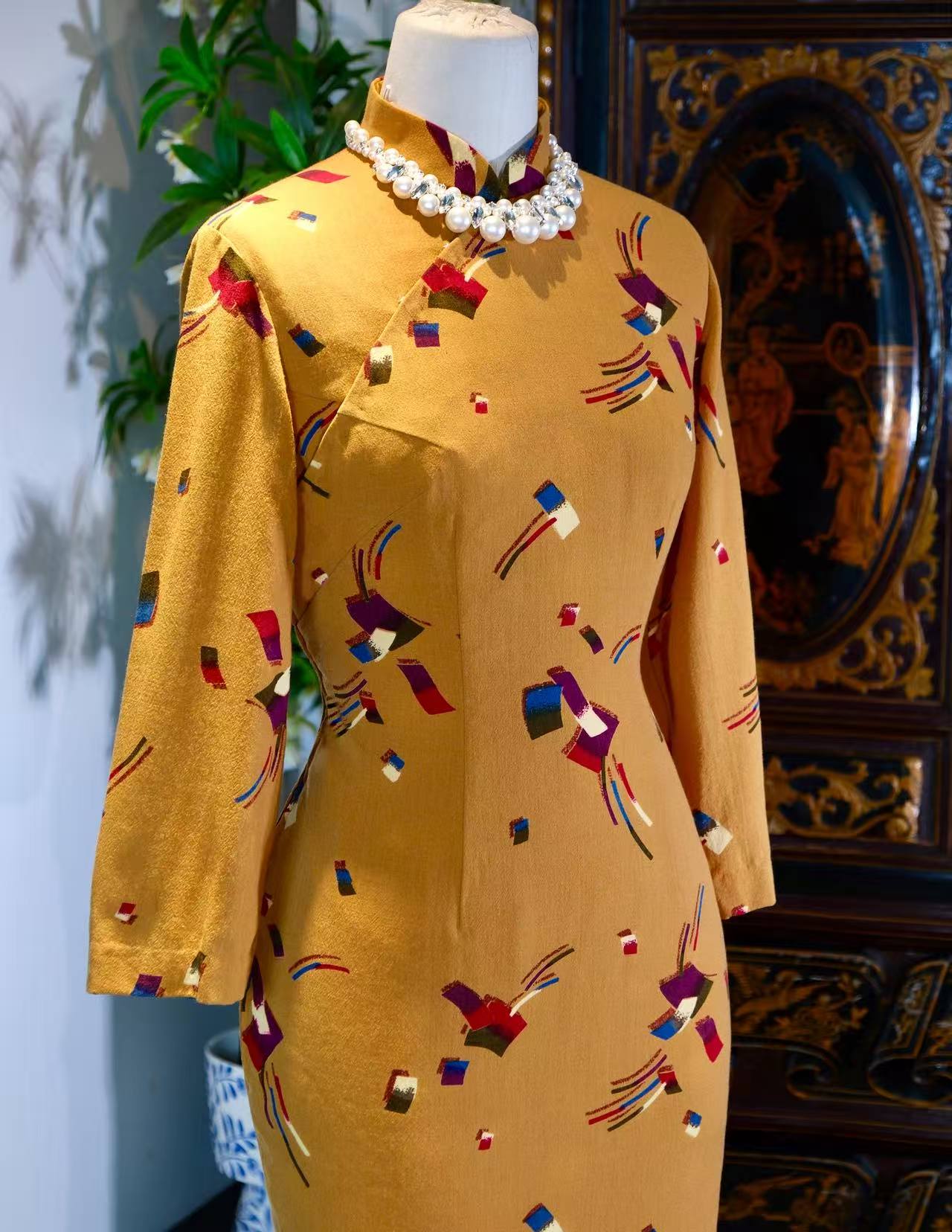
不同于传统旗袍中常见的龙凤、牡丹或山水写意,这件旗袍的图案极具现代主义色彩,是典型的六十年代“摩登”审美体现。
- 几何解构与色彩构成:面料上的印花呈现出一种类似“风筝”或“彩带”的抽象几何形态。设计师运用了康定斯基式的点线面构成法,将红、紫、蓝、白等色块以不规则的矩形和流线型线条进行解构重组。这种设计打破了传统纹样的对称与规整,赋予了面料一种动态的视觉跳跃感,仿佛无数个彩色的梦想在芥末黄的底色上飞舞。
- 芥末黄的底色隐喻:这种色调在六十年代极为流行,它既不同于正黄的皇家威仪,也不同于土黄的质朴,而是一种带有灰度、极具知性与都市感的色彩。它象征着当时香港女性在传统与现代之间寻找到的那种微妙的平衡——既温润内敛,又独立鲜明。
古董衣的故事:香江旧梦与名媛风华
若要追溯这件旗袍的“前世”,我们不妨将其置于那个“东方之珠”熠熠生辉的年代。
六十年代的香港,是张爱玲笔下的倾城之恋,也是王家卫电影里的花样年华。彼时,上海的老裁缝南下香江,将海派旗袍的精髓带到了维多利亚港,并与西方的立体剪裁技术相结合。这件旗袍,极有可能出自当年中环或尖沙咀某家隐秘的高级定制工坊。
想象一下,半个世纪前,一位受过良好教育、精通中英文的世家名媛,或许是在出席一场慈善晚宴,亦或是去半岛酒店喝下午茶时,身着此衣。她佩戴着那串温润的珍珠项链(如图中搭配),举手投足间,羊毛面料随着身形流动,那些抽象的色块仿佛是她内心深处对自由与艺术的向往。这件衣服,见证了香江的繁华初现,也承载了一位女性最曼妙时光里的自信与优雅。
艺术风格与稀缺性:引经据典
从学术角度来看,这件旗袍的艺术价值在于其“中西合璧”的极致表达。
- 面料的稀缺性:六十年代,羊毛混纺或精仿羊毛面料在旗袍制作中并不如丝绸常见。这种面料的选择,体现了当时受西方影响的高级成衣趋势——追求挺括、保暖且易于打理的质感。历经半个世纪,羊毛面料能保存得如此完好,色泽依旧鲜亮,实属凤毛麟角。
- 剪裁的考究:其剪裁遵循了六十年代旗袍的经典廓形——立领微高,衬托颈部线条;腰身极度收敛,强调女性的S型曲线,但又不过分紧绷,保留了东方的含蓄。正如《长物志》所言:“随方制象,各有所宜。”这件旗袍在结构上完美契合了人体工程学,是传统平面剪裁向现代立体剪裁过渡的教科书式范例。
- 不可复制的时代印记:这种带有强烈六十年代波普艺术(Pop Art)风格的印花,在古董旗袍存世量中占比极低。它代表了那个时代特有的乐观主义精神和对未来的憧憬。它不是一件简单的复古服饰,而是一件穿在身上的波普艺术品。
结语
这件六十年代香港产精仿羊毛印花旗袍,是一件可以传世的孤品。它以一种静默而高贵的姿态,诉说着那个黄金年代的时尚密码。对于收藏家而言,拥有的不仅是一件衣服,更是一段无法复刻的历史,一种跨越时空的审美共鸣。
Measurements / Size Guide:
Bust / Waist / Hips: 98/84/102 cm
Total Length: 107 cm
Detailed Description:
This is more than a garment; it is a moment frozen in time—a sublime footnote to the "Gilded Years" of Hong Kong, the "Paris of the East" in the 1960s. As researchers of costume history, when we gaze upon this fine-worsted wool printed cheongsam (qipao), we see not only the ingenuity of the cut but a microcosm of a unique era where Eastern and Western cultures collided and coalesced with fierce intensity.
Departing from the traditional dragons, phoenixes, peonies, or landscape imagery, the patterns on this qipao possess a high modernist flair, serving as a quintessential embodiment of 1960s "mod" aesthetics.
Geometric Deconstruction and Color Composition: The print presents abstract geometric forms reminiscent of "kites" or "ribbons." The designer utilizes a Kandinsky-style approach to points, lines, and planes—deconstructing and reorganizing blocks of red, purple, blue, and white into irregular rectangles and streamlined silhouettes. This design breaks the symmetry and regularity of traditional motifs, granting the fabric a dynamic visual rhythm, as if countless colorful dreams are dancing across the mustard-yellow base.
The Metaphor of Mustard Yellow: This hue was exceptionally popular in the 1960s. It differs from the imperial majesty of true yellow and the rusticity of ochre; instead, it is a grey-toned, highly intellectual, and urban color. It symbolizes the delicate balance found by Hong Kong women of that era between tradition and modernity—gentle and restrained, yet independent and distinct.
To trace the "previous life" of this qipao, we must place it within the era when the "Pearl of the Orient" began to shimmer.
The Hong Kong of the 1960s was the setting for Eileen Chang’s Love in a Fallen City and the inspiration for the In the Mood for Love aesthetic. During this period, master tailors from Shanghai migrated south, bringing the essence of Haipai (Shanghai-style) craftsmanship to Victoria Harbour and merging it with Western three-dimensional tailoring techniques. This piece likely originated from a discreet haute couture workshop in Central or Tsim Sha Tsui.
Imagine, half a century ago, an educated, bilingual socialite wearing this to a charity gala or an afternoon tea at The Peninsula. Paired with a strand of warm pearls (as seen in the styling), the wool fabric moves with her body, and the abstract color blocks reflect her inner longing for freedom and art. This garment witnessed the nascent prosperity of Hong Kong and carried the confidence and grace of a woman in her most beautiful years.
From an academic viewpoint, the artistic value of this qipao lies in its ultimate expression of "Sino-Western fusion."
Material Scarcity: In the 1960s, wool blends or fine-worsted wool were far less common in qipao making than silk. The choice of this fabric reflects the Western-influenced trend of high-end ready-to-wear—pursuing a texture that was crisp, warm, and easy to maintain. It is rare for a wool garment to remain so perfectly preserved with such vibrant colors after half a century.
Exquisite Tailoring: The cut follows the classic 1960s silhouette—a slightly high standing collar to elongate the neck, and an extremely tapered waist to emphasize the S-curve. Yet, it avoids excessive tightness, retaining Eastern modesty. As noted in the Treatise on Superfluous Things: "Form is crafted according to the occasion, each finding its proper place." This qipao is a textbook example of the transition from traditional flat cutting to modern three-dimensional tailoring.
Irreplaceable Mark of an Era: Prints with such strong Pop Art influences are extremely rare among extant antique qipaos. It represents the specific optimism and yearning for the future characteristic of that time. It is not a simple vintage piece; it is a wearable work of Pop Art.
This 1960s Hong Kong-made fine-worsted wool printed cheongsam is a unique treasure worthy of being passed down through generations. With a silent and noble posture, it decodes the fashion secrets of a Golden Age. For a collector, to own this is to possess more than a garment; it is to own a segment of unrepeatable history and a transcendental resonance of aesthetic beauty.