深圳溯源
无法加载取货服务可用情况
五彩织金·香江夜语——五十年代末香港古董旗袍
这件产自上世纪五十年代末香港的织金亮片旗袍,是华服史中“
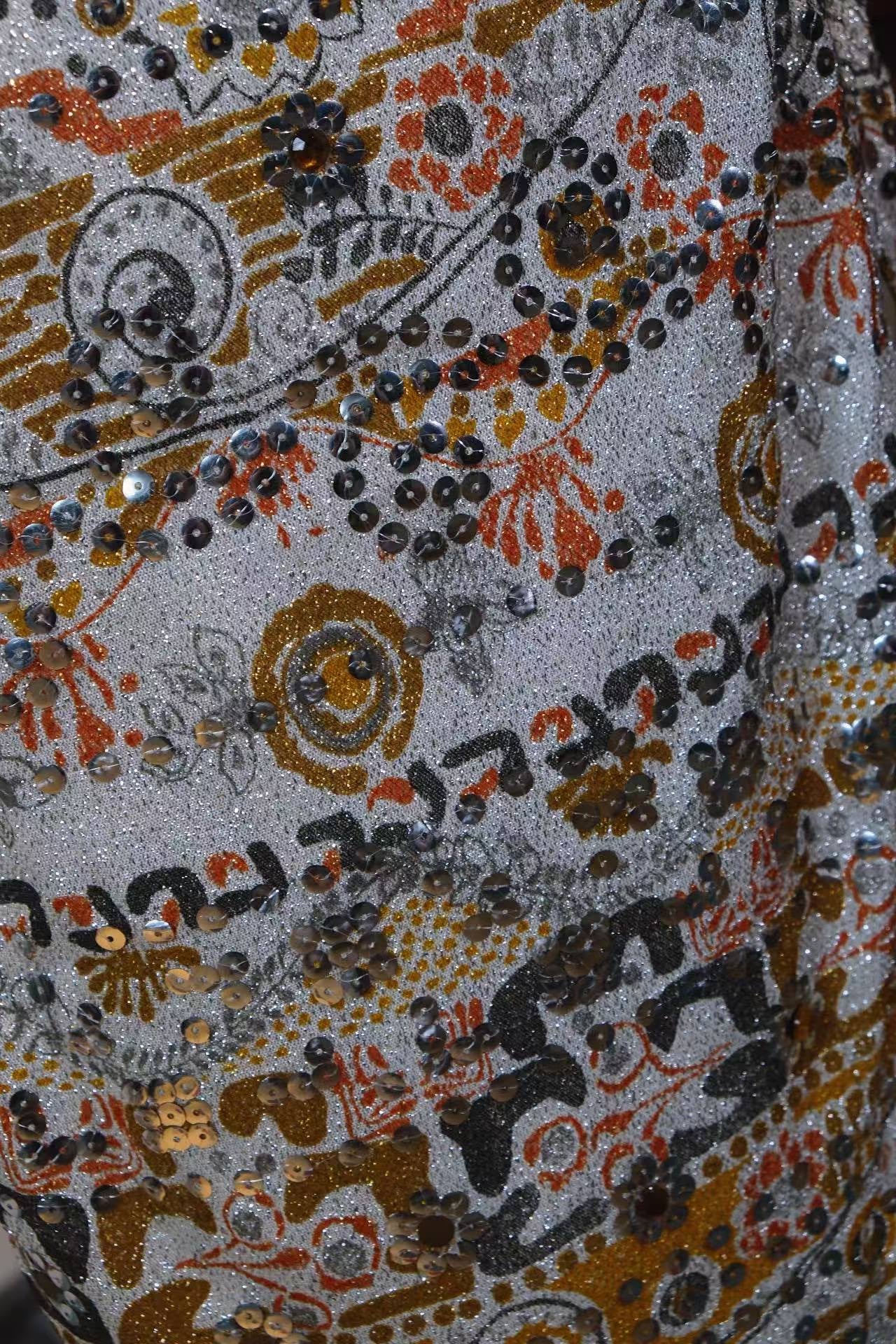
旗袍下摆与袖口的织金纹样,以渐变排列组合成抽象的“鸟兽纹”:
衣身上散落的亮片并非随意铺陈,而是以“星罗棋布”
每一片亮片皆以手工缝制,针脚细密如“秋毫之末”。
五十年代末的香港,正处于从转口贸易港向工业城市转型的关键期:
历经六十余载岁月,能完整保留至今者,更是凤毛麟角:
当指尖抚过这件旗袍,你会感受到:立领处的细腻滚边,是匠人对“
这般珍罕的织金亮片古董旗袍,世间仅此一件。它等待的,
Five-Color Gold Weaving · Night Whispers of the Fragrant River: A Late 1950s Hong Kong Antique Cheongsam
A Transitional Masterpiece of Sartorial History Produced in Hong Kong during the late 1950s, this gold-woven sequined cheongsam is a rare specimen that bridges two eras. While its silhouette maintains the classic "Shanghai Style" (Haipai)—characterized by a flat, narrow frame, high collar, and low hem—its decorative language carves a new path for "Oriental Deco." The high collar sits snugly against the neck, and the waistline hides a master tailor’s ingenuity, yet the side slits are lavishly covered in gold weaving and sequins. This fusion of traditional modesty and the burgeoning modernity of colonial Hong Kong embodies Eileen Chang’s famous adage: "Clothes are a pocket drama that one carries around." This cheongsam is a visual soliloquy set against the Hong Kong night.
Mythical Motifs and Abstract Totems The gold-woven patterns at the hem and cuffs form an abstract "Bird and Beast" composition. The fluid curves of scrolling grass patterns create a rhythmic background, through which geometric bird motifs emerge. These designs evoke the "Black Bird" (Xuanniao) totems found on Shang and Zhou dynasty bronzes or the abstract "Vermilion Bird" (Zhuque) depicted on Han dynasty stone reliefs.
The Narrative of Light: Sequins as Stars The sequins scattered across the garment are not placed at random; they are arranged in a "star-studded" formation that mimics a night sky. This interplay of light and shadow captures the poetic essence of the Song Dynasty poet Wu Wenying: "Clouds have shadows while the moon is bashful"—the silent sequins speak of an "eternal movement within stillness," a core principle of Oriental aesthetics.
The "Stacked-Layer" Technique: A Vanished Craft Every single sequin is hand-sewn with stitches as fine as "the tip of an autumn hair." Most breathtaking is the "Stacked Compression Technique" (Dieya): a motif is first embroidered in gold thread to create a three-dimensional outline, then covered with sequins. This ensures the pattern possesses both the structural depth of gold thread and the shifting radiance of sequins. In today’s era of mass-produced machine embroidery, this dual-layered manual craft has become an extinct art.
Historical Context: The Rise of the "Pearl of the Orient" Late 1950s Hong Kong was at a pivotal turning point, transforming from an entrepôt into an industrial city. Tailors from Shanghai and Guangzhou moved south, bringing exquisite skills, while Western modern design concepts flooded in. This "East meets West" environment birthed the gold-woven sequin cheongsam. Due to the high cost and complexity, such pieces were only available in limited quantities at high-end bespoke boutiques in Central, Hong Kong, often as one-of-a-kind private commissions.
A Rare Survivor of Time To find a piece preserved for over sixty years in such pristine condition—without missing sequins, oxidized gold thread, or fabric decay—is a true "survivor’s bias." It is more than a garment; it is a cultural specimen of Hong Kong’s early rise, a silent chronicle of the city’s heritage.
To touch this cheongsam is to feel the artisan’s obsession with the "beauty of proportions" in the delicate piping of the high collar; to see a tribute to nature in the ancient bird motifs; and to witness the symbiosis of tradition and modernity in the shimmering gold weaving. It is a "poem of time" worn on the body—a poem that contains the neon lights of 1950s Hong Kong and the warmth of a human hand.