深圳溯源
无法加载取货服务可用情况
衣服尺寸:
胸围/腰围/臀围:88/74/96 厘米
衣长:123 厘米
细节描述:
时光的褶皱里,总藏着几件让人屏息的衣裳。这件上世纪七十年代香港制造的提花旗袍,便是其中一件。它并非一件冰冷的古董,而是一段凝固的、流动的、带着体温的东方美学史诗。
它的美,首先在于那份“低调的奢华”。通体采用一种沉稳的墨绿或苔绿色为底,其上遍布着细密而雅致的提花图案。这些图案并非浓墨重彩的牡丹或龙凤,而是以一种更为内敛、更具文人气息的方式呈现——它们是散落的、仿佛随风飘零的小花与枝叶。这些花朵形态简约,线条流畅,如同宋人小品画中的折枝花卉,疏密有致,于不经意间流露出一种“清水出芙蓉,天然去雕饰”的意境。这种图案在七十年代的香港旗袍中颇为经典,它摒弃了繁复的装饰,追求一种“少即是多”的现代感,却又根植于传统的审美土壤,是东西方文化在那个特殊年代碰撞出的优雅火花。
这件旗袍的故事,要从它的诞生地——七十年代的香港说起。彼时的香港,是东西方文化交融的熔炉,也是华人世界时尚的中心。旗袍,作为东方女性的国服,在这里经历了从传统到现代的华丽转身。它不再仅仅是旧时代的遗存,而是被赋予了新的生命。这件旗袍的剪裁,便体现了这种时代精神:它保留了传统旗袍的立领、斜襟、盘扣等核心元素,但在版型上更趋修身,线条流畅,完美地勾勒出女性的曲线美。这种“新式旗袍”是那个时代香港女性独立、自信、优雅的缩影。
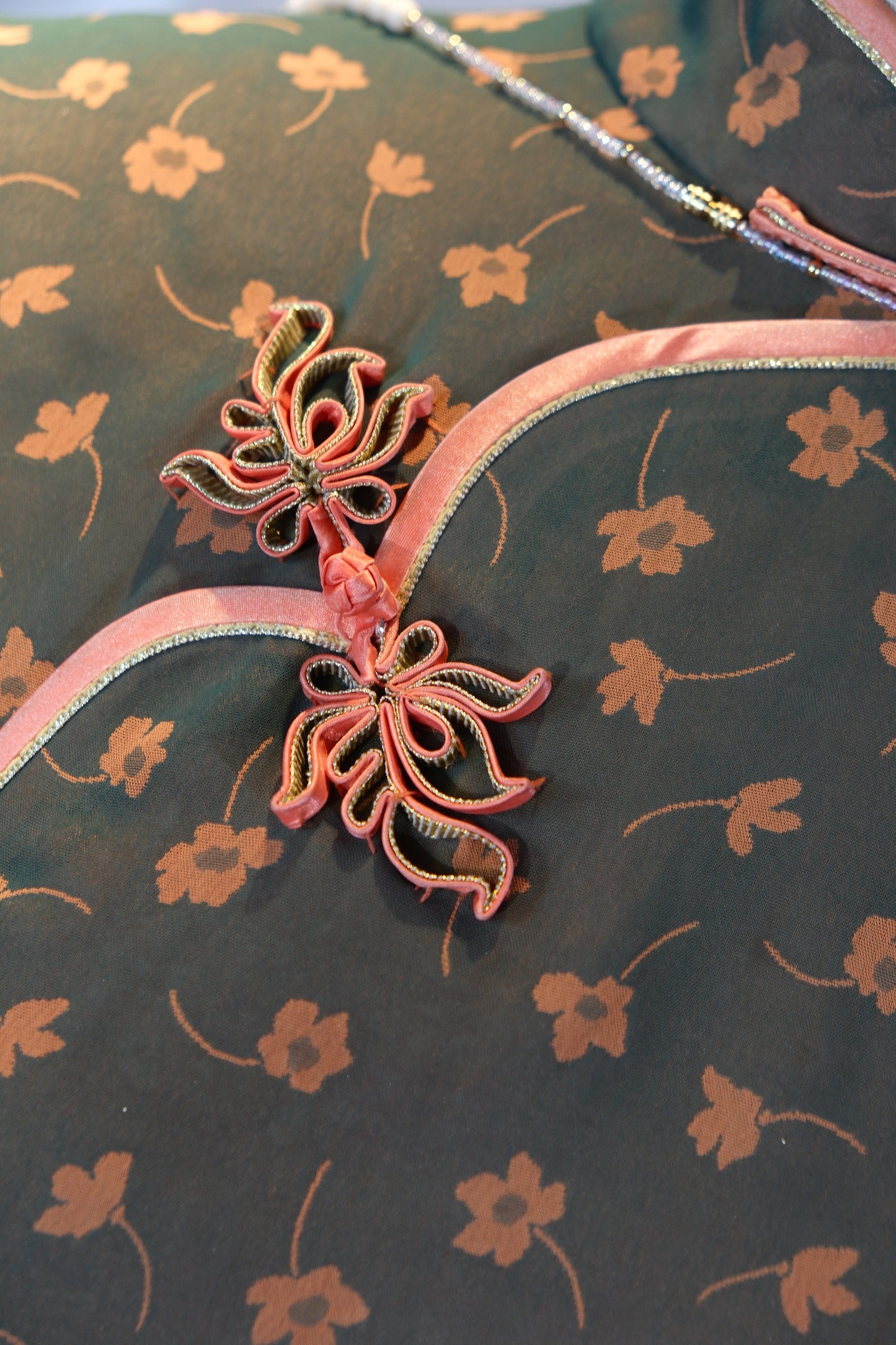
它的稀缺性,不仅在于其年代,更在于其工艺。提花工艺本身便是一种高难度的织造技术,需要在织机上预先设计好图案,通过经纬线的交织变化,使图案“浮”于面料之上,形成凹凸有致的立体感。这种工艺耗时耗力,成本高昂,非寻常面料可比。而图中这件旗袍的提花,更是做到了“花中有花,叶中有韵”,在光线下,那些小花仿佛有了生命,随着穿着者的移动而微微摇曳,光影流转间,尽显华贵。此外,其领口、襟边、袖口处的粉色滚边,与主体的墨绿形成柔和的撞色,既打破了沉闷,又增添了一抹娇俏与温柔。而那枚精雕细琢的盘扣,更是点睛之笔,其造型繁复,工艺精湛,如同一件微缩的雕塑,是整件旗袍的灵魂所在。
引经据典,这件旗袍的美学,恰如《诗经》中所言:“有美一人,婉如清扬。”它不张扬,却自有风骨;不浓烈,却余韵悠长。它承载着一个时代的记忆,也诉说着一种永恒的东方韵味。在今天这个快时尚的时代,这样一件凝聚了匠人之心、时代之魂的古董旗袍,其价值早已超越了衣物本身,它是一件值得被珍藏、被传颂的艺术品。
Measurements / Size Guide:
Bust / Waist / Hips: 88/74/96 cm
Total Length: 123 cm
Detailed Description:
Within the folds of time, there are always a few garments that take one's breath away. This jacquard Qipao, made in Hong Kong during the 1970s, is one of them. It is not a cold antique, but a frozen, flowing epic of Oriental aesthetics carrying the warmth of the human body.
Its beauty lies, first and foremost, in its "understated luxury." The entire garment features a steady dark green or moss green base, covered with dense and elegant jacquard patterns. These motifs are not the heavily colored peonies or dragons and phoenixes, but are presented in a more restrained, scholarly manner—scattered small flowers and leaves that seem to drift with the wind. The flower forms are minimalist with smooth lines, resembling the broken-branch floral paintings of the Song Dynasty. Their sparse yet orderly arrangement inadvertently reveals an artistic mood of "a lotus rising from clear water, naturally elegant without adornment." This pattern was quite classic for Hong Kong Qipaos in the 1970s; it discarded complex decorations in pursuit of a "less is more" modern feel, yet remained rooted in traditional aesthetic soil. It is an elegant spark ignited by the collision of Eastern and Western cultures during that unique era.
The story of this Qipao begins with its birthplace—Hong Kong in the 1970s. At that time, Hong Kong was a melting pot of Eastern and Western cultures and the fashion center of the Chinese world. The Qipao, as the national dress for Oriental women, underwent a magnificent transformation from tradition to modernity here. It was no longer merely a relic of the old era but was endowed with new life. The tailoring of this Qipao embodies this spirit of the times: it retains core traditional elements such as the mandarin collar, diagonal closure, and frog buttons, but the silhouette is more form-fitting with fluid lines, perfectly tracing the curved beauty of the female form. This "New Style Qipao" is a microcosm of the independence, confidence, and elegance of Hong Kong women of that era.
Its rarity lies not only in its age but also in its craftsmanship. The jacquard process itself is a high-difficulty weaving technique that requires designing the patterns on the loom in advance. Through the interlacing variations of warp and weft threads, the patterns "float" upon the fabric, creating a textured, three-dimensional effect. This process is time-consuming and labor-intensive with high costs, incomparable to ordinary fabrics. The jacquard on this specific Qipao achieves a level of "flowers within flowers, rhythm within leaves." Under the light, those small blossoms seem to gain life, swaying slightly with the wearer's movements, displaying nobility amidst the shifting light and shadow. Furthermore, the soft pink piping at the collar, lapel, and cuffs forms a gentle contrast with the primary dark green, breaking the somberness while adding a touch of charm and tenderness. That exquisitely crafted frog button is the finishing touch; its complex shape and refined craftsmanship make it like a miniature sculpture—the very soul of the entire Qipao.
Citing the classics, the aesthetics of this Qipao are just as described in the Book of Songs: "There is a beautiful lady, graceful and clear-eyed." It is not flamboyant, yet it possesses its own character; it is not intense, yet its charm lingers long. It carries the memory of an era and speaks of an eternal Oriental rhythm. In today's era of fast fashion, such a vintage Qipao—condensing the heart of the craftsman and the soul of an era—has a value that far transcends the garment itself. It is a work of art worthy of being cherished and passed down.