深圳溯源
无法加载取货服务可用情况
衣服尺寸:
胸围/腰围/臀围:94/76/94 厘米
衣长:107 厘米
细节描述:
这真是一件令人屏息的“织物诗篇”。作为一位研究服装史的学者,
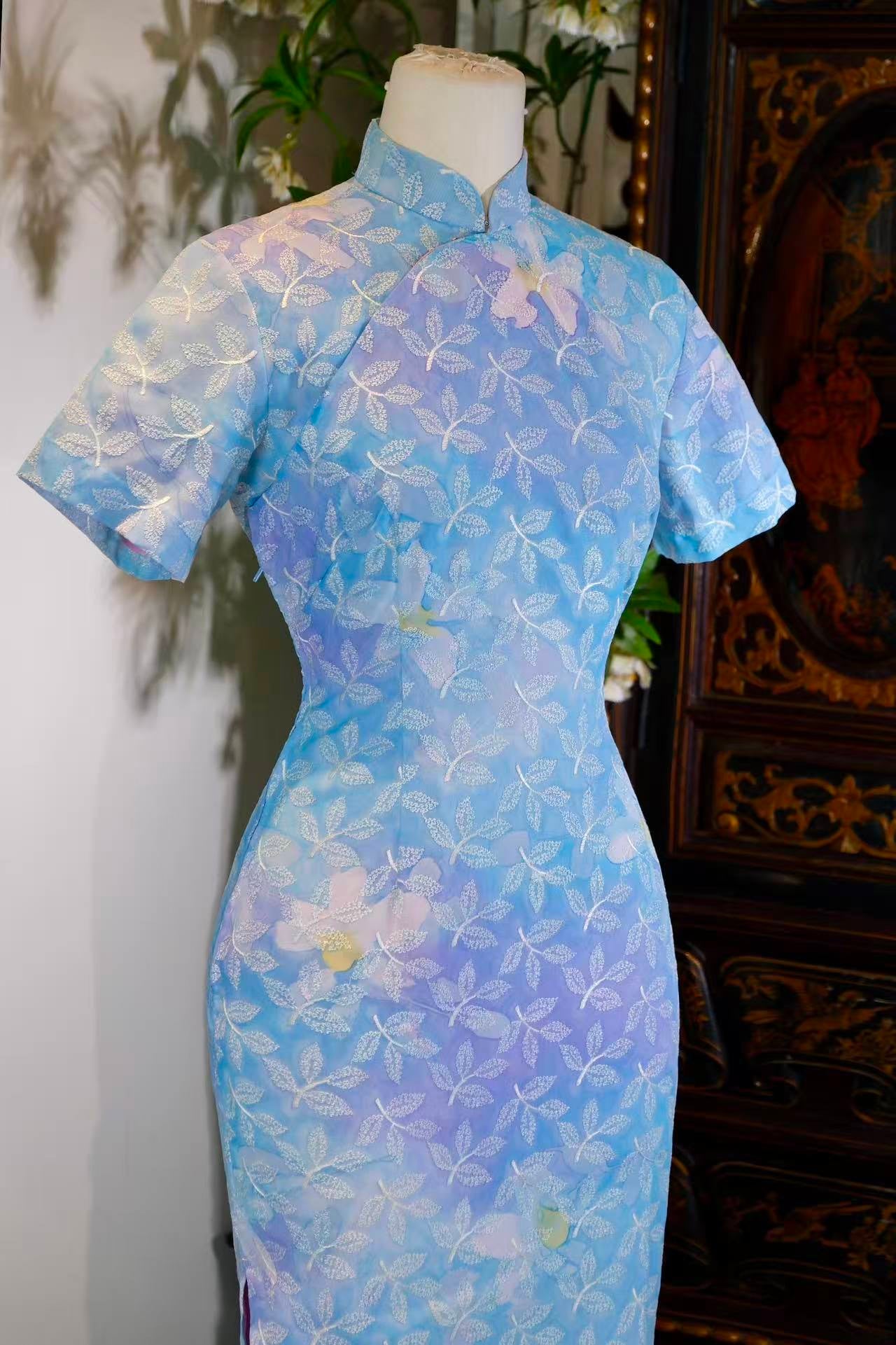
这件旗袍,它不属于喧嚣的尘世,它属于梦境。 色彩与纹样的艺术解析:一场“色晕”与“光影”的芭蕾
这件旗袍最令人着迷之处,在于它运用了极其高超的手绘晕染(
- 色彩的流动:从领口倾泻而下的天青色,
- 刺绣的幻影:在这一片氤氲的底色之上, 古董衣的故事:乱世中的“温柔乡”
这件旗袍诞生于上世纪五十年代的台湾。
“所谓伊人,在水一方。”
这件旗袍的设计,仿佛是对《诗经》中这句诗的完美注解。
它是一件“贴身的屏风”,为穿着它的女子隔绝了外界的纷扰, 引经据典:如烟、如雾、如电
这件旗袍所散发的浪漫气息,正如唐代诗人李商隐在《锦瑟》
“沧海月明珠有泪,蓝田日暖玉生烟。”
- 珠有泪:旗袍上那细腻的晕染,宛如月光下沧海中的珍珠,
- 玉生烟:整件衣服呈现出的质感, 稀缺性与艺术价值
在那个年代,“手绘晕染”与“精细蕾丝刺绣”
如今,这样保存完好、色彩依然鲜活动人、
它等待的,是那个能读懂它眼中诗情画意的灵魂。
Measurements / Size Guide:
Bust / Waist / Hips: 94/76/94 cm
Total Length: 107 cm
Detailed Description:
This is truly a breathtaking "fabric poem." As a scholar of costume history, when I gaze upon this 1950s antique qipao from Taiwan, I see far more than mere fabric and thread; I see a "mirage" frozen within the warp and weft.
This qipao does not belong to the clamor of the mortal world; it belongs to the realm of dreams.
The most captivating aspect of this qipao lies in its masterful use of hand-painted ombre (Color Blending) techniques. Its base color is not a monotonous blue, but a chromatic variation akin to "sky-blue after the rain."
The Fluidity of Color: The sky-blue pouring down from the collar resembles the sea shrouded in mist at dawn. As it flows toward the hem, it transitions gracefully into a deep violet. This gradient is not mechanical; it diffuses naturally like ink on Xuan paper, filled with the "vivid rhythmic vitality" (Qi Yun Sheng Dong) of Oriental aesthetics.
The Phantom of Embroidery: Atop this hazy base lies a layer of dreamlike embroidery. These are not ordinary blossoms, but clusters of slender vines and leaf veins. White silk threads outline the skeletal textures of the leaves, as if moonlight were piercing through a forest, casting shadows onto fine gauze. This contrast between "transparency" and "opacity," between "void" and "solid," creates an ethereal, misty sensation.
This qipao was born in 1950s Taiwan—an era where upheaval and rebirth coexisted, and people sought a sense of belonging amidst the torrents of history.
"The beauty I seek is there, on the other side of the water."
The design of this qipao serves as a perfect annotation to this line from the Book of Songs. The Taiwanese artisans of that era poured their nostalgia for their homeland and their yearning for the future into every stitch. Eschewing heavy, sprawling floral patterns, they chose these delicate, rhythmic vine motifs to symbolize the poetic resilience of life growing within the cracks of time. It acts as a "wearable screen," insulating the wearer from external distractions and constructing a cool, serene, and private sanctuary.
The romantic aura exuded by this qipao mirrors the imagery in Li Shangyin’s Tang Dynasty masterpiece, The Ornamented Zither:
"In the vast sea, under a bright moon, pearls have tears; on the warm sun of Indigo Field, jade engenders mist."
Pearls have tears: The exquisite ombre effects are like pearls in the moonlit sea, shimmering with a restrained, moist luster—carrying a hint of faint sorrow and nobility.
Jade engenders mist: The texture of the entire garment is like fine jade from Indigo Field emanating a hazy vapor under the warm sun. This "misty beauty" is the ultimate manifestation of classical Oriental aesthetics.
In that era, the combination of "hand-painted ombre" and "fine lace embroidery" was an extremely expensive and time-consuming process. It required painters and embroiderers to possess immense artistic cultivation, understanding not only the nuances of color but the tension of silk threads.
Today, a 1950s Taiwanese antique qipao that remains so perfectly preserved, with colors so vivid and craftsmanship so complex, is a rarity of rarities. It is more than a garment; it is a flowing sculpture, an Impressionist oil painting worn on the body. It waits for a soul capable of deciphering the poetic sentiment held within its eyes.