Brocade Qipao with Double Bodice: An Epic of Oriental Weaving in Resplendent Silk
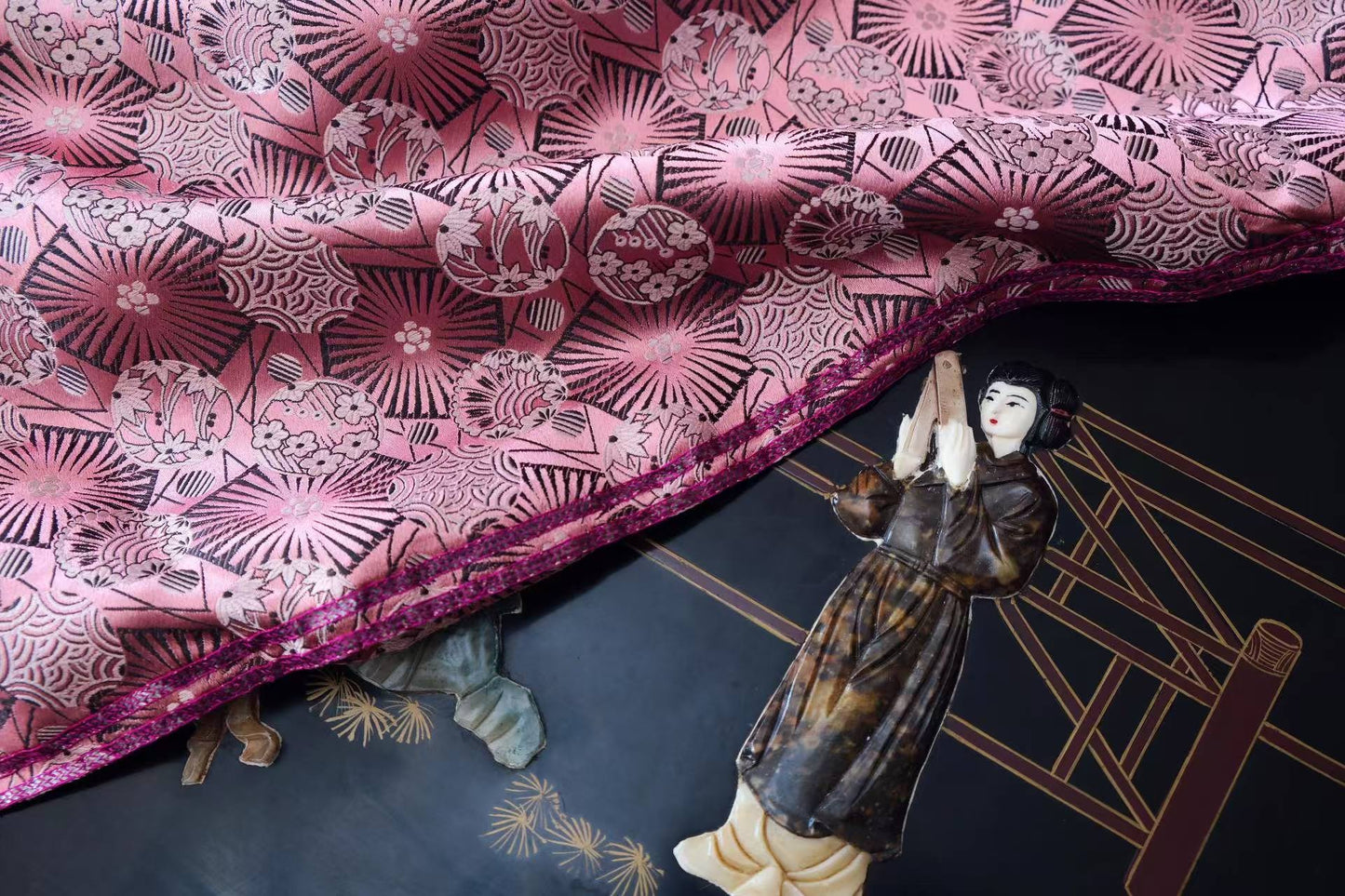
The Geometric Cipher: Fans and Cobwebs Within the magnificent genealogy of Republic-era qipaos, the mid-1940s brocade pieces serve as "movable annals of silk." This double-bodice long gown, with its mauve base and brocade soul, resembles a scroll from Tiangong Kaiwu (The Exploitation of the Works of Nature), condensing the pinnacle of traditional weaving into every square inch.
The Fan Motif: Drawing from the Kao Gong Ji, the fan skeleton symbolizes "measured opening and closing." It echoes the phoenix's wings and the ancient homophone for "goodness" (Shan), conveying humanistic expectations of perfection.
The Cobweb Motif: Tracing back to Warring States "cloud-net" silks, the spider web represents the cosmic order of latitude and longitude. Together, they create a visual rhythm of "order amidst complexity," as described in Huainanzi.
The Alchemy of Brocade: "Soft Gold" The fabric inherits the "cut-weave" mastery of Song Brocade, reaching new heights of opulence:
Technique: Using mulberry silk as the warp and multi-colored velvet as the weft, the pattern is formed through a "three-piece twill" structure to create a relief-like texture. Every edge and node requires manual "gold-couching," resulting in a luster as gentle as Song ceramics.
Historical Rarity: Once an imperial tribute, brocade was produced by only a few weaving bureaus in Shanghai and Suzhou during the Republic era. The "Fan-Web" pattern is an isolated case—unseen in extant samples—suggesting a bespoke commission for a prominent family, likely drafted by a master from the Jiangnan Weaving Bureau.
Conclusion: A Half-Scroll of Wind and Clouds In the mid-1940s, amidst national turbulence, this qipao froze an era's elegance in brocade. It once belonged to a lady swaying under the lights of a concession-era ballroom; it was later folded away in camphor chests alongside national memories during wartime. As the scholar Shen Congwen noted: "The beauty of silk is the beauty of time, of craftsmanship, and of the human heart." Every thread is a footnote to history; every line a cultural code.