深圳溯源
无法加载取货服务可用情况
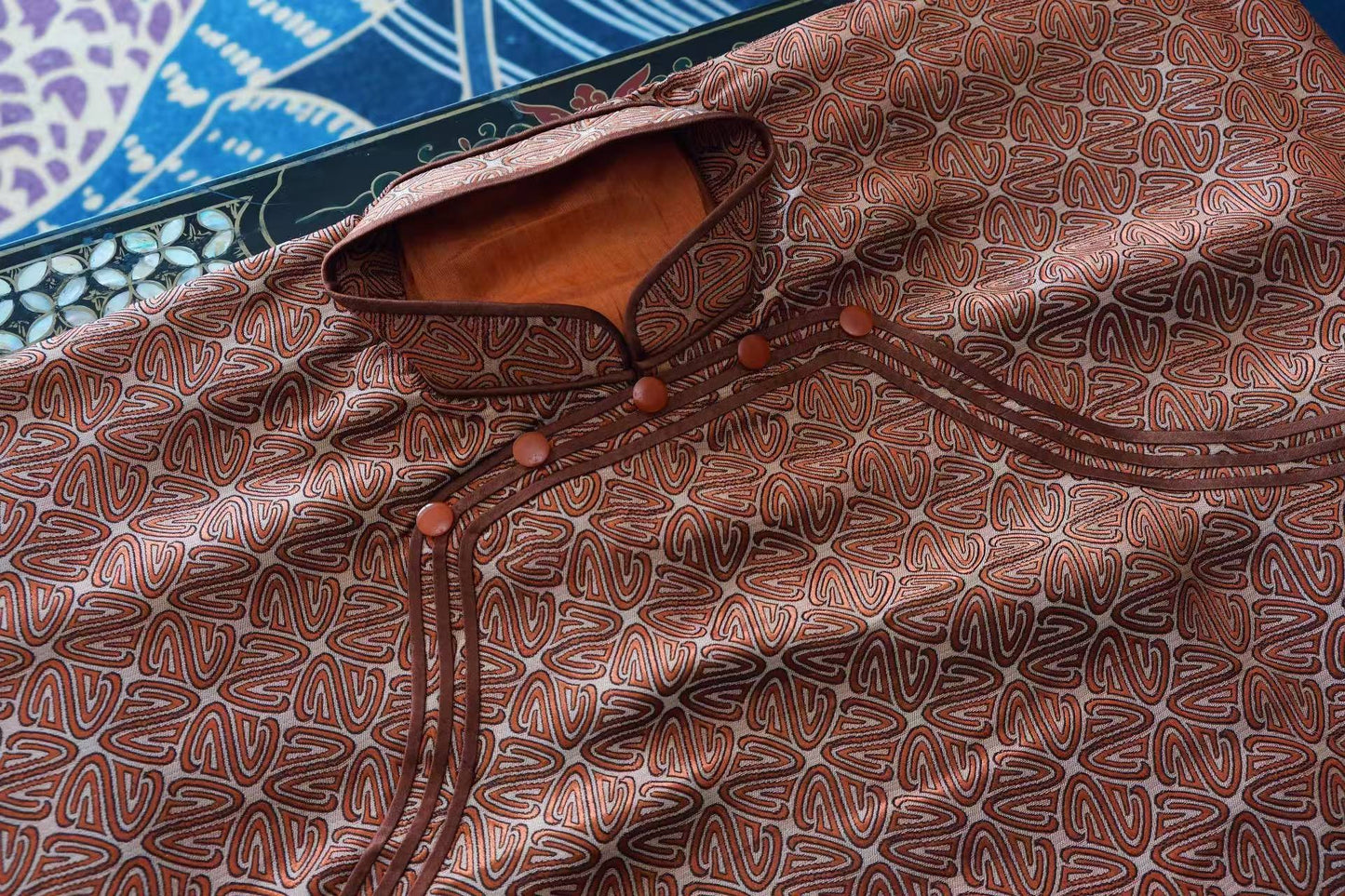
四十年代双襟旗袍:绞花纹纬,镶绲宕条里的民国余韵
旗袍上的图案并非具象的花鸟山水,
若要为这绞花纹寻一处古典注脚,不妨引《三才图会》中对“回纹”
这种绞花纹的编织工艺,更暗藏“挑花”技法的影子。《天工开物》
这件旗袍的稀缺性,更在于其形制与细节的“三重罕见”:
双襟设计:民国旗袍的“末代风雅”
双襟(即旗袍前片有两条平行的襟边)
一绲两宕条:手工绲边的“毫米艺术”
“一绲两宕条”是旗袍工艺的精髓:绲边是用布条包裹旗袍的边缘,
玉石包扣:材质与工艺的“双重奢侈”
旗袍的扣子为玉石包扣,呈暖棕色,与面料颜色相呼应。
从艺术风格来看,这件旗袍完美诠释了民国旗袍“中西合璧”
更难得的是,这件旗袍历经八十年,
这件旗袍上的绞花纹,如同一段被编织的历史:线条的交织,
正如沈从文在《中国古代服饰研究》中所言:“服饰之美,
The patterns on this qipao are not figurative depictions of flowers, birds, or landscapes; instead, they consist of dense, brownish-red lines interwoven into an all-over "Twisted Flower Pattern" (also known as a "Geometric Fill Pattern"). While not directly derived from nature, this motif aligns with the ancient Chinese textile tradition that "every pattern must hold meaning." The prototype of this twisted pattern can be traced back to the Cloud and Thunder patterns found on Shang and Zhou dynasty bronzes. By deconstructing continuous swirling lines into abstract geometric shapes, it preserves the auspicious symbolism of "endless continuity" while embracing the modernist aesthetic explorations of the Republican era (1912–1949).
If one were to seek a classical commentary for this pattern, one might look to the Sancai Tuhui, which records of the "Hui" (meander) pattern: "Hui means to return; it is continuous and reciprocal, symbolizing the idea of endless life." Although the twisted flower pattern differs slightly from the typical meander, its entanglement and interlacing essentially carry the philosophical core of traditional Chinese motifs: using the repetition and variation of geometric forms to represent the laws of the universe. As stated in The Literary Mind and the Carving of Dragons: "When the mind is born, speech is established; when speech is established, civilization appears—this is the Way of Nature." The arrangement of these patterns functions like the strokes of written characters, constructing a silent "civilization" on fabric—a visual poem where lines are the language and repetition is the rhythm.
The weaving technique of this twisted pattern carries traces of the "Tiao Hua" (brocade picking) method. Tiangong Kaiwu (The Exploitation of the Works of Nature) records: "For a floral loom... a flower-pulling boy sits atop the tower, while the weaver below raises the heddles." This process requires manually lifting warp threads to form complex patterns, making it incredibly labor-intensive. Although mechanical looms were prevalent by the 1940s, the delicacy of this pattern suggests it may have been woven on a manual Jacquard loom. Such a hybrid of manual and mechanical craft was exceptionally rare in wartime Shanghai. Amidst resource shortages and factory closures, a qipao that retains such exquisite patterning is a craft masterpiece snatched from the cracks of history.
| Feature | Significance | Cultural Context |
| Double-Front (Shuangjin) | The "Last Elegance" of the era. | While daily wear favored the simple single-front, the double-front was reserved for formal, sophisticated occasions in 1940s Shanghai. |
| One Binding, Two Strips | The "Millimeter Art" of the edge. | The 3mm brownish-red strips required the precision of "Hongbang" tailors, blending Qing court techniques with Western sartorial accuracy. |
| Jade-Encasement Buttons | Luxury in material and restraint. | Unlike the common glass or plastic buttons of the 40s, these jade-encased buttons signaled elite status and the "modest beauty" of a refined lady. |
From an artistic standpoint, this garment perfectly interprets the "East meets West" aesthetic of the Republican era. The abstract, geometric feel of the twisted pattern echoes Western Modernism, while the double-front, standing collar, and Pankou (frog fasteners) are quintessentially Chinese. This was not a simple patchwork but a manifestation of Shanghai’s cultural confidence as the "Paris of the East"—balancing Oriental subtlety with Western boldness.
To find a qipao that has survived eighty years with its form intact and its patterns unfaded is akin to "protecting an ancient painting through a fire." It reflects a woman’s persistent pursuit of beauty and "decency" (Tímian) amidst the chaos of war.
As Shen Congwen wrote in Researches on Ancient Chinese Costumes: "The beauty of clothing does not stop at its form, but lies in the cultural memory it carries." This double-front twisted pattern qipao is a vessel of memory—a rare "living specimen" that marks the pivotal moment when Chinese dress transitioned from tradition to modernity.