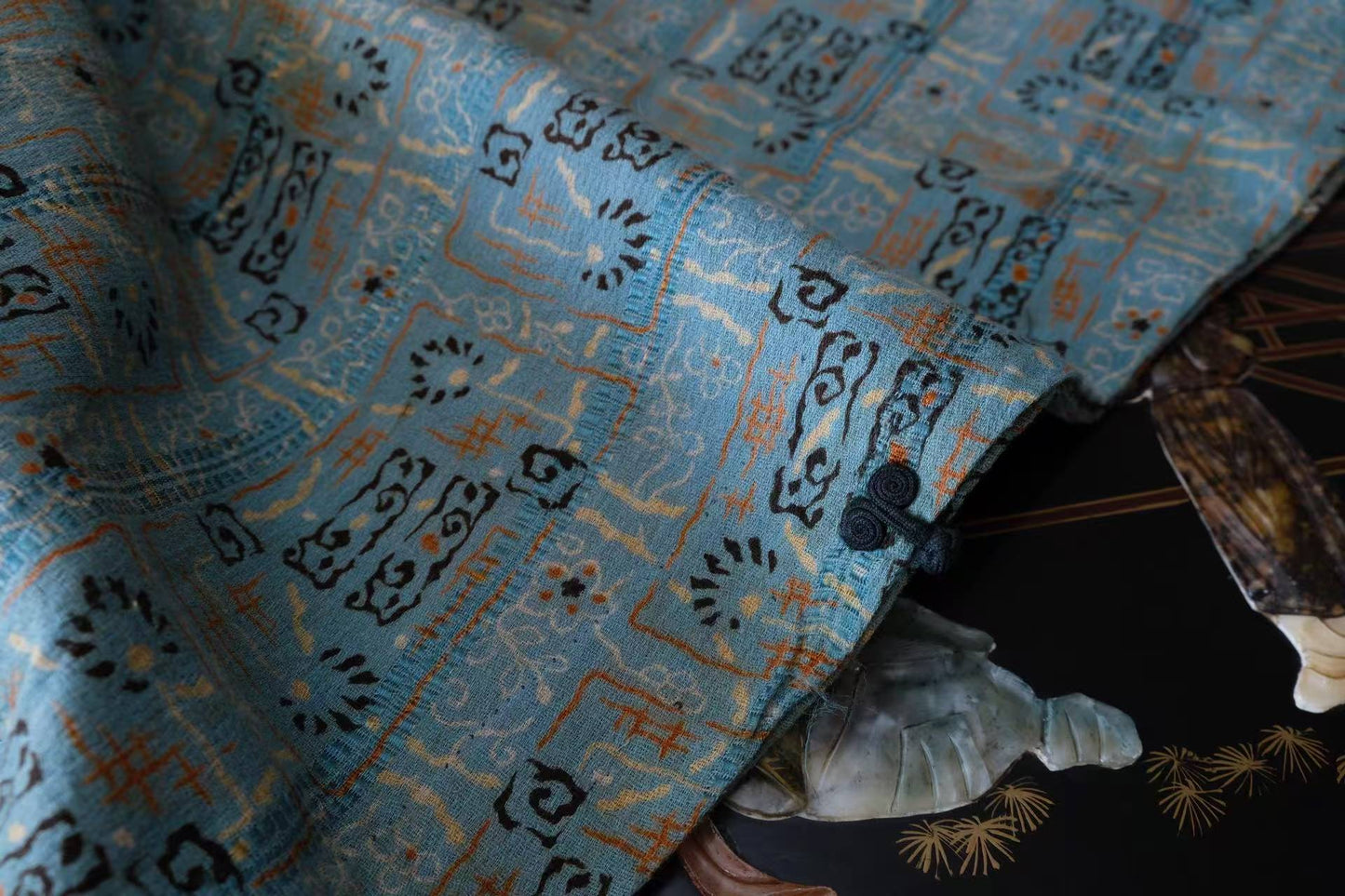
上世纪二十年代喷绘印花提花倒大袖古董旗袍
此件存世珍品,为上世纪二十年代初期典型倒大袖旗袍,乃近代女性服饰转型之实物见证。浅湖蓝地似一泓秋水,其上以喷绘印花工艺布满回纹与花卉纹样,辅以提花工艺显暗纹,尽显工艺之精妙。
旗袍主体纹样以回纹为骨,间以团花点缀,辅以几何纹为填充。
- 回纹:取《诗经·周颂·清庙》“於皇之轩,朱芾斯皇”中“轩”之回旋意象,寓“富贵不断头”之吉祥寓意,乃商周青铜器纹样在织物上的延续。
- 团花:近于“宝相花”形制,取《洛阳伽蓝记》“宝相庄严”之禅意,糅合了唐代团窠纹的饱满与宋代文人画的疏朗,或暗合当时“新生活运动”对传统美学的重构。
喷绘印花工艺(Spray Printing)于二十世纪初传入中国,其特点是色点朦胧如泼墨,较之传统木版印刷更具层次感。此袍以喷绘技法施于提花织物之上,湖蓝底色中隐现橙褐斑点,似青花瓷釉中流淌的“铁锈斑”,与《陶说》中“釉色青翠,斑点如铁”之记载遥相呼应。提花部分则以平纹组织显几何暗纹,与喷绘的写意形成“刚柔并济”之视觉张力,此工艺组合在现存民国旗袍中极为罕见。
倒大袖(又称“喇叭袖”)为1920年代旗袍标志性元素,正如《清稗类钞》所载“袖口宽逾二尺,转折如弓”,恰与当时上海《妇女杂志》倡导的“舒展自如,合于卫生”之新女性审美相契合。
这件旗袍正如巫鸿所言“衣物是身体的历史”,其上每一道纹路皆是近代中国社会变革的缩影:喷绘工艺见证着东西方技术交融,倒大袖折射着女性解放思潮,而斑驳的色点更似岁月刻下的年轮。其艺术价值不仅在于“美”,更在于“真”——以织物为载体,铭刻着一个时代的呼吸与脉搏。
1920s Antique Qipao with Spray-Print, Jacquard, and Bell Sleeves
A Witness to Sartorial Transformation This surviving treasure is a quintessential example of the "Inverted Bell Sleeve" (Dao Daxiu) qipao from the early 1920s—a physical witness to the transformation of modern Chinese feminine attire. The pale lake-blue base resembles autumnal waters, adorned with intricate fretwork and floral motifs created through spray-printing, while jacquard weaving adds a layer of subtle hidden patterns, manifesting the zenith of early 20th-century textile craftsmanship.
The Symbolic Lexicon of Motifs The pattern system utilizes the fret motif (Huiwen) as its skeleton, interspersed with floral medallions (Tuanhua) and geometric fillers.
-
Fret Motif: Inheriting the "endless prosperity" symbolism from Shang and Zhou dynasty bronzes, it evokes the rhythmic continuity found in the Classic of Poetry.
-
Floral Medallions: Resembling the "Precious Appearance Flower" (Baoxianghua), these combine the fullness of Tang dynasty circular motifs with the airy elegance of Song literati painting, reflecting a reconstruction of traditional aesthetics during the early Republic.
The Rarity of "Spray-Printing" on Jacquard The spray-printing technique, introduced to China in the early 20th century, creates a misty, ink-wash effect that offers more depth than traditional woodblock printing. On this garment, the technique is applied over a jacquard fabric; orange-brown speckles emerge from the lake-blue base like the "rust spots" found in antique blue-and-white porcelain glazes—a visual resonance with descriptions in the Records of Ceramics. The contrast between the rigid geometric jacquard and the ethereal spray-print creates a "harmony of strength and softness" that is exceedingly rare in extant Republic-era qipaos.
The Bell Sleeve: A Silhouette of Liberation The "Inverted Bell Sleeve"—a hallmark of 1920s fashion—is described in historical records as "curving like a bow." This silhouette aligned with the "healthy and free" aesthetic promoted by the Women's Journal in Shanghai at the time, signaling the dawn of feminine liberation.
Conclusion: The History of the Body As art historian Wu Hung noted, "Clothing is the history of the body." Every line on this qipao is a microcosm of social change: the spray-print marks the fusion of East-West technology, the bell sleeves reflect the tide of women’s emancipation, and the mottled colors act as the growth rings of time itself.