三十年代真丝素绉葫芦扣背带旗袍:织造时光的古董美学
在民国旗袍的谱系中,素绉缎旗袍向来是“素工见真章”的典范,而此件上世纪三十年代中期的真丝素绉葫芦扣背带款旗袍,更以材质的珍罕、形制的古意与工艺的精微,成为凝固于丝线间的时光标本。其通体采用真丝素绉缎织就,暗纹隐现如流云舒卷,《释名·释采帛》载:“素,朴素也,织丝有文以为饰”,素绉缎的暗纹肌理恰似中国书画中的“飞白”,以无纹胜有纹,尽显“大巧若拙”的东方哲思。衣身无繁绣重彩,唯以真丝的天然光泽与垂坠感勾勒身形,恰如李渔《闲情偶寄》所言“素雅之色,最宜妇人”,在克制中暗藏风华。
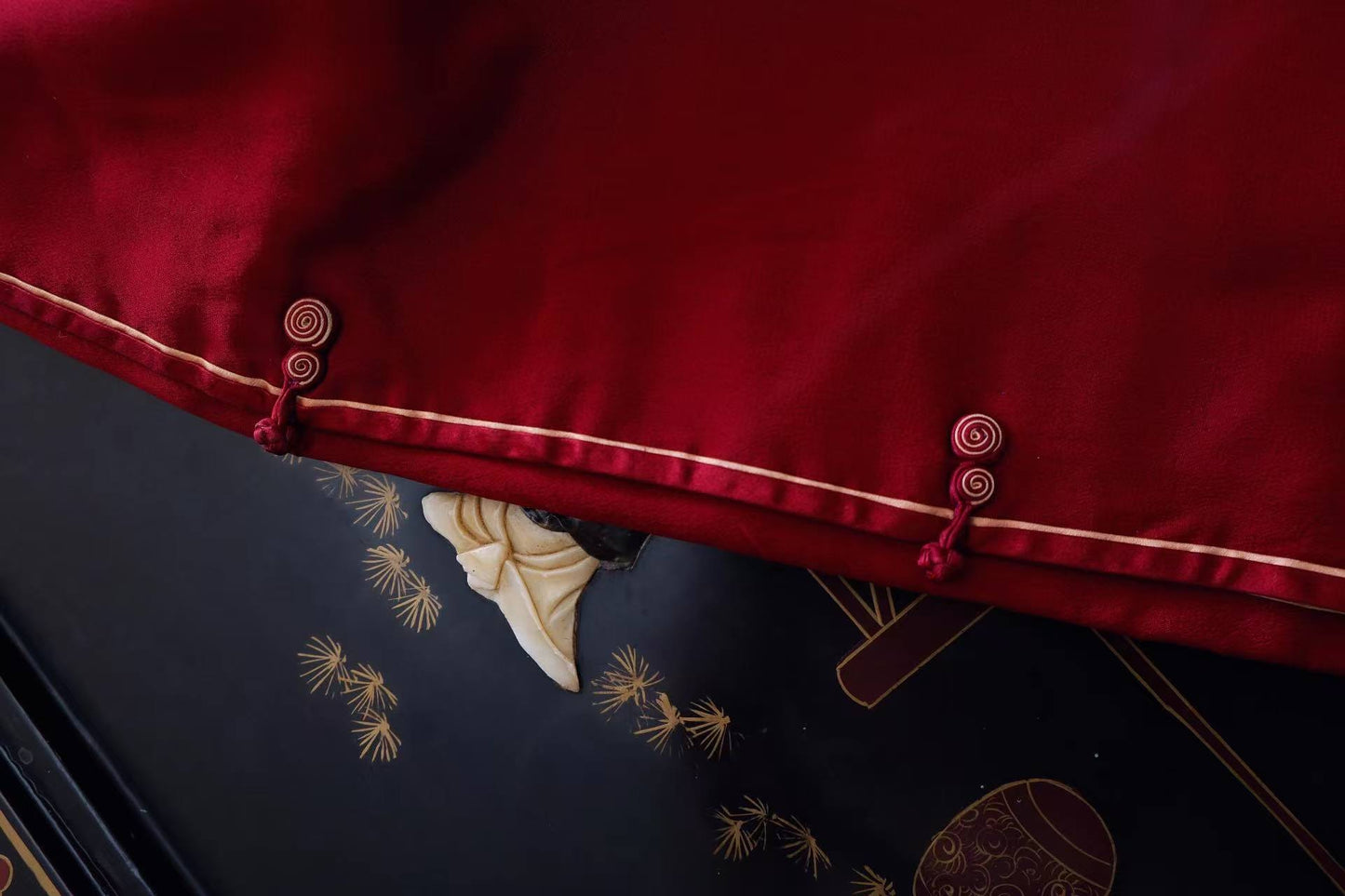
此袍形制尤显稀缺性:背带设计承袭清代服装“两片式”遗韵,又融汇西式内衣的支撑结构,是民初“改良旗袍”过渡期的珍贵实证。立领高崇三寸,符合《北平谱》所记“领必崇,以束其颈”的传统规制,而领缘、袖口及开衩处的米色嵌条,纤细如发,恰似宋代“勒帛”的纤丽遗风。最具古意者,当属葫芦形盘扣——《诗经·七月》有“七月食瓜,八月断壶”之句,葫芦(壶)向来象征“福禄绵长”,民国婚俗更以葫芦扣寓“子孙蕃息”。此袍十一对葫芦扣皆以真丝捻线手工盘织,扣头细密如螺,扣襻婉转成涡,仿若商周青铜器上的涡纹缩影,将古老的吉祥符号织入日常衣装。
细观衣襟,对称排列的葫芦扣如“却月”悬于赤霄,衣摆处暗纹流转,恍若《捣练子》词中“斜月无声照杵衣”的意境。其红如朱砂,非艳俗之赤,而是《周礼·考工记》所载“三入为朱”的正色,昔为婚嫁“婚袍”的专属色调,今观之犹觉喜气盈盈。背带连接处的暗线细密如“蟹脚”,针脚匀净若“蝇头小楷”,足见当年苏绣工匠的“闺阁针神”之技。
此袍之珍,更在于其承载的服饰史密码:素绉缎的暗纹肌理承袭宋代“素罗”之雅,葫芦扣的吉祥符号溯源《诗经》之礼,背带形制衔接清汉女装之变,滚边工艺暗合明清“镶绲”之粹。它不仅是民初上海“摩登”与“传统”博弈的物证,更是“衣以载道”的具象表达——正如沈从文在《中国古代服饰研究》中所言:“服装之美,不在锦绣,而在形制与材质的相得益彰。”此件旗袍以素工胜,以古韵胜,以稀缺的三十年代原品状态胜,诚为民国服饰史的“活化石”,今得以完好存世,实为研究与收藏之幸事。
1930s Plain Silk Crepe-de-Chine Qipao with Gourd Closures and Back-Strap: An Antique Aesthetic Woven in Time
The Philosophy of Plainness: Silk Crepe-de-Chine Within the genealogy of Republic-era qipaos, plain silk crepe-de-chine (Su Zhou Duan) is the ultimate testament to the principle that "true mastery lies in simplicity." This mid-1930s piece, with its rare back-strap design and gourd-shaped closures, stands as a temporal specimen frozen in silk. The fabric features subtle hidden patterns reminiscent of drifting clouds; as the ancient lexicon Shi Ming records: "Plainness is simplicity; weaving silk with hidden patterns serves as its own ornament." This texture echoes the "flying white" (Feibai) stroke in Chinese calligraphy—where the absence of overt patterns triumphs over the ornate, embodying the Oriental philosophy of "great ingenuity appearing as clumsiness."
Iconography of the Gourd: Auspicious Symbols of Antiquity The most archaic element is the system of Gourd-shaped Frog Buttons (Hulu Kou). Tracing back to the Classic of Poetry, the gourd (Hu) has long symbolized "eternal prosperity and longevity" (Fu-Lu), while Republic-era wedding customs used it to invoke blessings of abundant progeny. These eleven pairs of buttons are handcrafted from twisted silk threads, with heads as dense as conch shells and loops as graceful as the vortex motifs found on Shang and Zhou dynasty bronzes—weaving ancient auspicious symbols into the fabric of daily life.
Sartorial Archeology: The "Suspender" and the "Six-Layer Weft" The silhouette is exceptionally rare: the back-strap design inherits the "two-piece" legacy of Qing Dynasty attire while integrating the structural support of Western undergarments—a precious material evidence of the transitional "Improved Qipao" era. The three-inch standing collar adheres to the traditional regulation of "binding the neck with height." The crimson hue is not a gaudy red, but the "Standard Cinnabar" (Zhu) described in the Rites of Zhou, originally reserved for bridal gowns (Hun Pao).
Conclusion: A Living Fossil of Dress History This qipao is more than a masterpiece of "plain craftsmanship" (Sugong); it is a carrier of historical codes. Its hidden patterns inherit the elegance of Song Dynasty "Plain Silk" (Su Luo), its gourd closures trace back to the rituals of the Classic of Poetry, and its binding techniques echo the essence of Ming and Qing craftsmanship. As the scholar Shen Congwen noted: "The beauty of clothing lies not in embroidery, but in the harmony of form and material." To have this 1930s original survive in such pristine condition is a rare fortune for both research and collection.